Erber Ramona, Rübner Matthias, Davenport Simon, Hauke Sven, Beckmann Matthias W, Hartmann Arndt, Häberle Lothar, Gass Paul, Press Michael F, Fasching Peter A
Institute of Pathology, Comprehensive Cancer Center EMN, Erlangen University Hospital, Friedrich Alexander University of Erlangen-Nuremberg (FAU), Krankenhausstrasse 8-10, 91054, Erlangen, Germany.
Department of Obstetrics and Gynecology, Comprehensive Cancer Center EMN, Erlangen University Hospital, Friedrich Alexander University of Erlangen-Nuremberg (FAU), Erlangen, Germany.
Breast Cancer Res Treat. 2020 Nov;184(2):311-324. doi: 10.1007/s10549-020-05865-2. Epub 2020 Aug 27.
Various aberrations in the fibroblast growth factor receptor genes FGFR1, FGFR2, and FGFR3 are found in different cancers, including breast cancer (BC). This study analyzed the impact of FGFR amplification on the BC prognosis.
The study included 894 BC patients. The amplification rates of FGFR1, FGFR2, and FGFR3 were evaluated on tissue microarrays using fluorescence in situ hybridization (FISH). Associations between these parameters and prognosis were analyzed using multivariate Cox regression analyses.
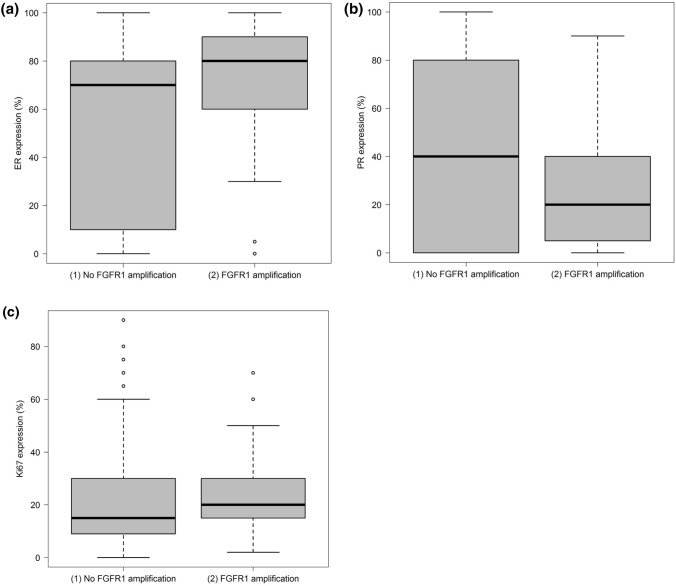
FGFR1 FISH was assessable in 503 samples, FGFR2 FISH in 447, and FGFR3 FISH in 562. The FGFR1 amplification rate was 6.6% (n = 33). Increased FGFR2 copy numbers were seen in 0.9% (n = 4); only one patient had FGFR3 amplification (0.2%). Most patients with FGFR1 amplification had luminal B-like tumors (69.7%, n = 23); only 32.6% (n = 153) of patients without FGFR1 amplification had luminal B-like BC. Other patient and tumor characteristics appeared similar between these two groups. Observed outcome differences between BC patients with and without FGFR1 amplification did not achieve statistical significance; however, there was a trend toward poorer distant metastasis-free survival in BC patients with FGFR1 amplification (HR = 2.08; 95% CI 0.98 to 4.39, P = 0.05).
FGFR1 amplification occurs most frequently in patients with luminal B-like BC. The study showed a nonsignificant correlation with the prognosis, probably due to the small sample size. Further research is therefore needed to address the role of FGFR1 amplifications in early BC patients. FGFR2 and FGFR3 amplifications are rare in patients with primary BC.
在包括乳腺癌(BC)在内的不同癌症中发现了成纤维细胞生长因子受体基因FGFR1、FGFR2和FGFR3的各种畸变。本研究分析了FGFR扩增对BC预后的影响。
该研究纳入了894例BC患者。使用荧光原位杂交(FISH)在组织微阵列上评估FGFR1、FGFR2和FGFR3的扩增率。使用多变量Cox回归分析这些参数与预后之间的关联。
503个样本可进行FGFR1 FISH检测,447个可进行FGFR2 FISH检测,562个可进行FGFR3 FISH检测。FGFR1扩增率为6.6%(n = 33)。FGFR2拷贝数增加见于0.9%(n = 4);仅有1例患者FGFR3扩增(0.2%)。大多数FGFR1扩增患者患有腔面B样肿瘤(69.7%,n = 23);无FGFR1扩增的患者中仅有32.6%(n = 153)患有腔面B样BC。这两组患者的其他患者和肿瘤特征相似。FGFR1扩增的BC患者与未扩增患者之间观察到的结局差异未达到统计学意义;然而,FGFR1扩增的BC患者远处无转移生存期有较差的趋势(HR = 2.08;95% CI 0.98至4.39,P = 0.05)。
FGFR1扩增最常见于腔面B样BC患者。该研究显示与预后的相关性不显著,可能是由于样本量小。因此,需要进一步研究以阐明FGFR1扩增在早期BC患者中的作用。FGFR2和FGFR3扩增在原发性BC患者中罕见。