Departamento de Saúde Comunitária. Rua Professor Costa Mendes 1608 - Bloco Didático 5° andar - Rodolfo Teófilo, Universidade Federal do Ceará, Faculdade de Medicina, Fortaleza, Ceará, CEP: 60430-140, Brazil.
Secretaria da Saúde do Estado do Ceará, Fortaleza, CE, Brazil.
BMC Genet. 2020 Aug 27;21(1):92. doi: 10.1186/s12863-020-00903-w.
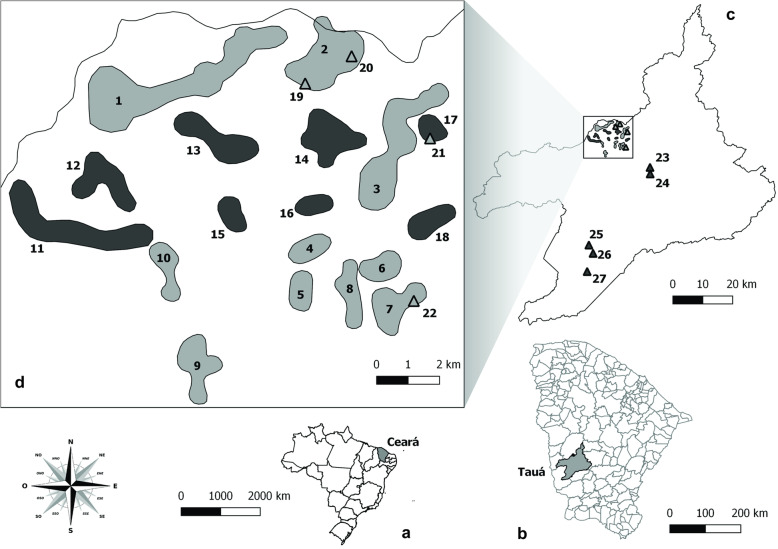
Triatoma brasiliensis Neiva, 1911 is the main vector of Trypanosoma cruzi in the caatinga of Northeastern Brazil. Despite of its epidemiological relevance, there are few studies on its genetic variability. Using microsatellite markers, we characterized the variability and dynamics of infestation and reinfestation of T. brasiliensis after residual insecticide spraying in five surveys conducted in a well-defined rural area located in the municipality of Tauá, Ceará, between 2009 and 2015. We evaluated: (1) general variability among local of captures; (2) variability along the time analysis (2009, 2010 and 2015); (3) and reinfestation process.
On the analysis (1) global and pairwise F values suggested absence of clusters among the area. AMOVA indicated that total variation is mainly represented by individual differences. Absence of clustering indicates a panmitic unit, with free gene flow. For (2), Pairwise F indicated alterations in the genetic profile of the triatomines along the time. (3) Analysis of the reinfestation process showed that the domiciliary units investigated had different sources of infestation despite of its proximity.
Observed homogeneity can be explained by the great dispersal capacity of T. brasiliensis, overlapping the different environments. Persistent house infestation in Tauá may be attributed to the occurrence of postspraying residual foci and the invasion of triatomines from their natural habitats.
巴西三锥虫(Triatoma brasiliensis Neiva, 1911)是巴西东北部卡廷加地区克氏锥虫(Trypanosoma cruzi)的主要传播媒介。尽管它具有流行病学意义,但关于其遗传变异性的研究很少。本研究使用微卫星标记,对 2009 年至 2015 年期间在塞阿拉州陶亚市一个明确界定的农村地区进行的五次调查中,残留杀虫剂喷洒后巴西三锥虫的侵染和再侵染的变异性和动态进行了描述。我们评估了:(1)局部捕获的总体变异性;(2)随时间的变异性分析(2009 年、2010 年和 2015 年);(3)和再侵染过程。
在分析(1)时,全局和成对 F 值表明该地区没有聚类。AMOVA 表明,总变异主要由个体差异代表。无聚类表明是一个泛米特单元,具有自由基因流。对于(2),成对 F 值表明随着时间的推移,三锥虫的遗传特征发生了变化。(3)再侵染过程的分析表明,尽管相邻,但调查的家庭单位有不同的侵染来源。
观察到的同质性可以用巴西三锥虫的强大扩散能力来解释,这种扩散能力覆盖了不同的环境。陶亚持续的家庭侵染可能归因于喷洒后残留焦点的出现以及来自其自然栖息地的三锥虫的入侵。