Chemistry-School of Natural and Environmental Sciences, Newcastle University, Newcastle-upon-Tyne NE1 7RU, UK.
Newcastle University Centre for Cancer, Newcastle University, Newcastle NE1 7RU, UK.
Int J Mol Sci. 2020 Aug 26;21(17):6166. doi: 10.3390/ijms21176166.
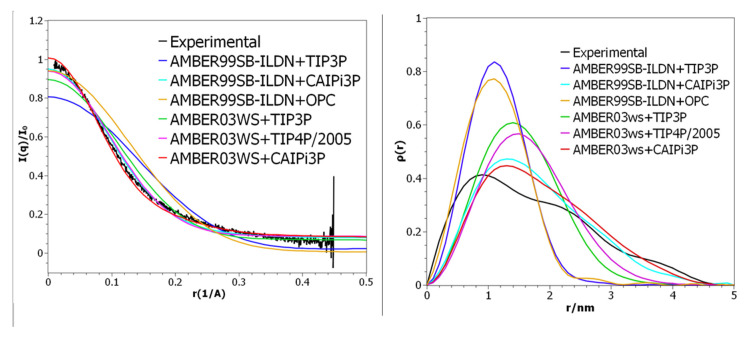
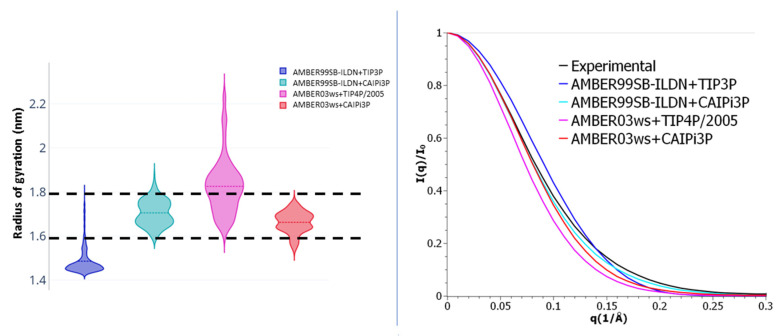
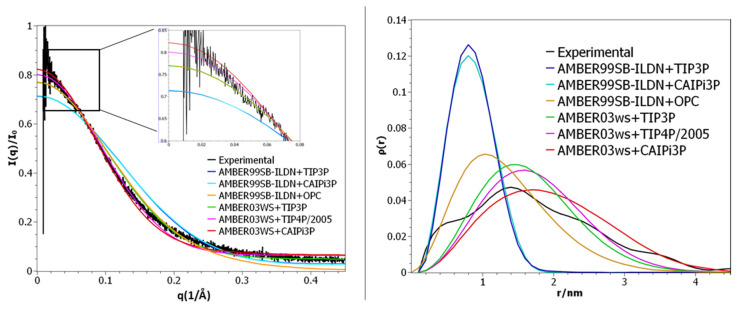
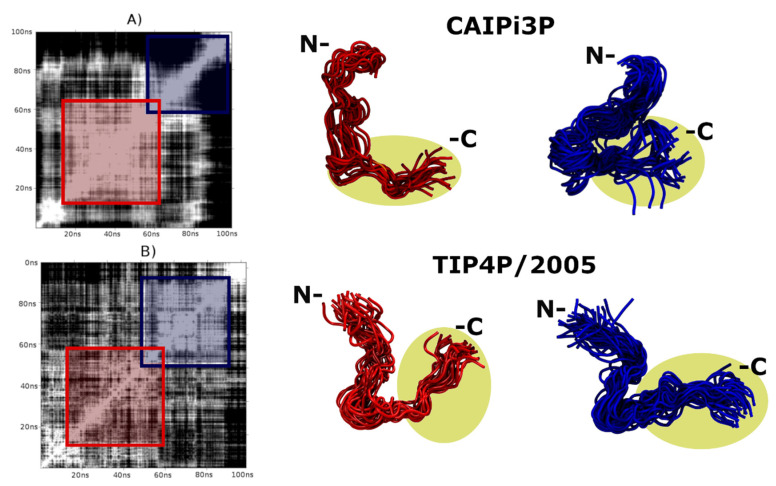
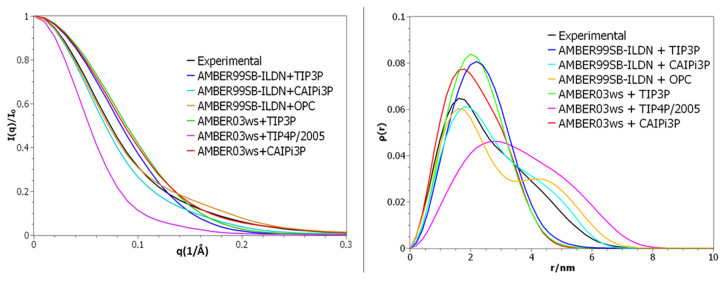
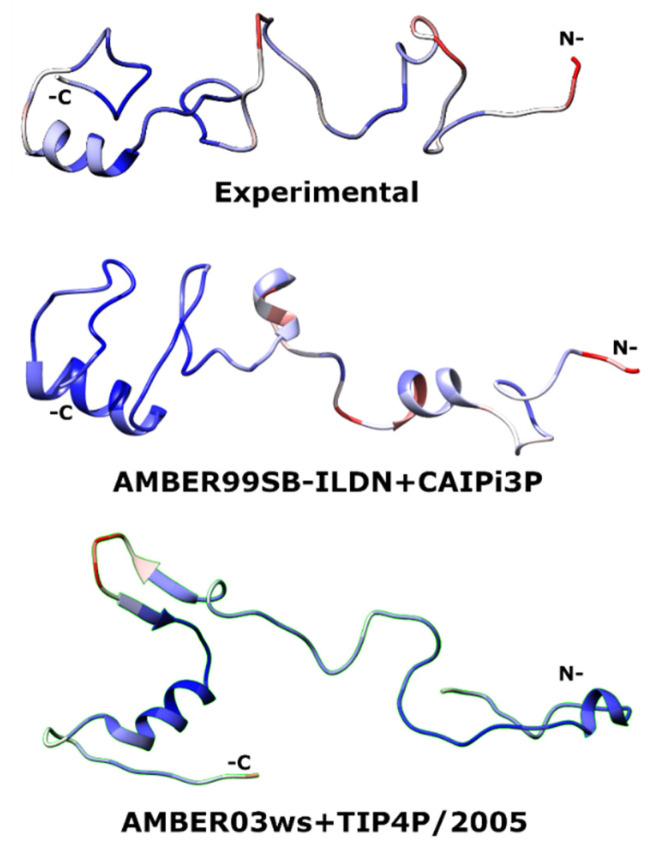
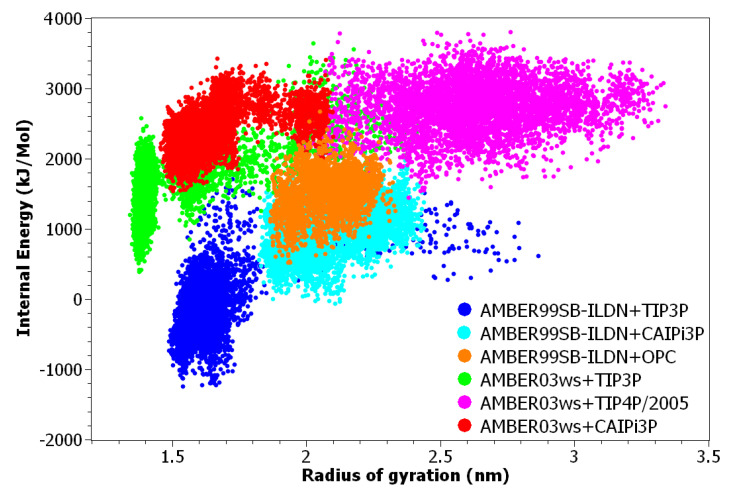
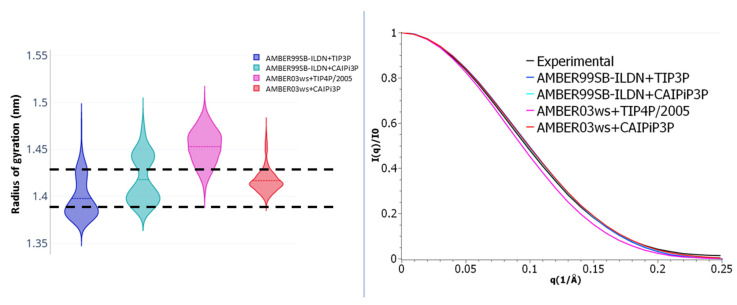
Intrinsically disordered proteins (IDPs) are molecules without a fixed tertiary structure, exerting crucial roles in cellular signalling, growth and molecular recognition events. Due to their high plasticity, IDPs are very challenging in experimental and computational structural studies. To provide detailed atomic insight in IDPs' dynamics governing their functional mechanisms, all-atom molecular dynamics (MD) simulations are widely employed. However, the current generalist force fields and solvent models are unable to generate satisfactory ensembles for IDPs when compared to existing experimental data. In this work, we present a new solvation model, denoted as the Charge-Augmented Three-Point Water Model for Intrinsically Disordered Proteins (CAIPi3P). CAIPi3P has been generated by performing a systematic scan of atomic partial charges assigned to the widely popular molecular scaffold of the three-point TIP3P water model. We found that explicit solvent MD simulations employing CAIPi3P solvation considerably improved the small-angle X-ray scattering (SAXS) scattering profiles for three different IDPs. Not surprisingly, this improvement was further enhanced by using CAIPi3P water in combination with the protein force field parametrized for IDPs. We also demonstrated the applicability of CAIPi3P to molecular systems containing structured as well as intrinsically disordered regions/domains. Our results highlight the crucial importance of solvent effects for generating molecular ensembles of IDPs which reproduce the experimental data available. Hence, we conclude that our newly developed CAIPi3P solvation model is a valuable tool for molecular simulations of intrinsically disordered proteins and assessing their molecular dynamics.
无规卷曲蛋白质(IDPs)是没有固定三级结构的分子,在细胞信号转导、生长和分子识别事件中发挥着关键作用。由于其高可塑性,IDPs 在实验和计算结构研究中极具挑战性。为了提供对 IDPs 动力学的详细原子洞察力,从而控制其功能机制,广泛采用全原子分子动力学(MD)模拟。然而,与现有实验数据相比,当前的通用力场和溶剂模型无法为 IDPs 生成令人满意的集合。在这项工作中,我们提出了一种新的溶剂模型,称为用于无规卷曲蛋白质的电荷增强三点点水模型(CAIPi3P)。CAIPi3P 是通过对广泛流行的三点 TIP3P 水模型的分子支架进行原子部分电荷的系统扫描生成的。我们发现,使用 CAIPi3P 溶剂的显式溶剂 MD 模拟大大改善了三种不同 IDPs 的小角 X 射线散射(SAXS)散射曲线。毫不奇怪,这种改进通过在 CAIPi3P 水与针对 IDPs 参数化的蛋白质力场结合使用时得到进一步增强。我们还证明了 CAIPi3P 在含有结构域和无规卷曲区域/域的分子系统中的适用性。我们的结果强调了溶剂效应对生成与现有实验数据相匹配的 IDPs 分子集合的重要性。因此,我们得出结论,我们新开发的 CAIPi3P 溶剂模型是模拟无规卷曲蛋白质和评估其分子动力学的有价值的工具。