Massachusetts General Hospital, Harvard Medical School, Boston, MA.
Emory University Hospital Midtown, Emory University, Atlanta, GA.
Chest. 2020 Dec;158(6):2590-2601. doi: 10.1016/j.chest.2020.08.2064. Epub 2020 Aug 27.
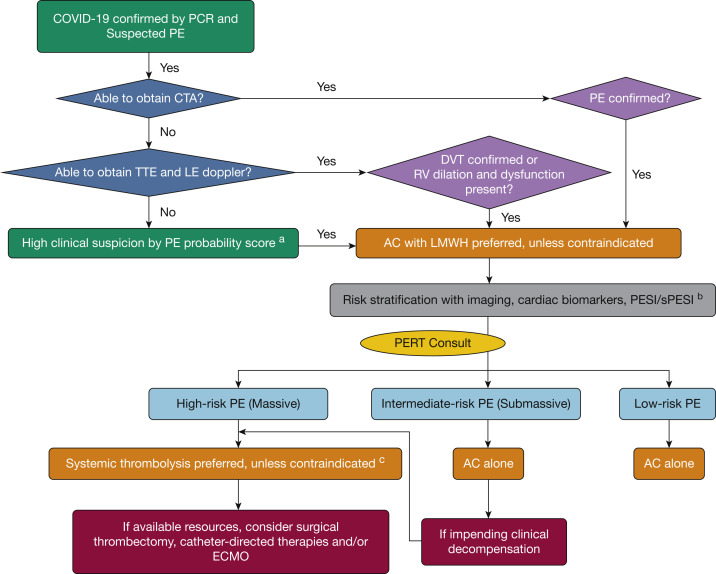
The coexistence of coronavirus disease 2019 (COVID-19) and pulmonary embolism (PE), two life-threatening illnesses, in the same patient presents a unique challenge. Guidelines have delineated how best to diagnose and manage patients with PE. However, the unique aspects of COVID-19 confound both the diagnosis and treatment of PE, and therefore require modification of established algorithms. Important considerations include adjustment of diagnostic modalities, incorporation of the prothrombotic contribution of COVID-19, management of two critical cardiorespiratory illnesses in the same patient, and protecting patients and health-care workers while providing optimal care. The benefits of a team-based approach for decision-making and coordination of care, such as that offered by pulmonary embolism response teams (PERTs), have become more evident in this crisis. The importance of careful follow-up care also is underscored for patients with these two diseases with long-term effects. This position paper from the PERT Consortium specifically addresses issues related to the diagnosis and management of PE in patients with COVID-19.
新型冠状病毒病 2019(COVID-19)和肺栓塞(PE)这两种危及生命的疾病同时出现在同一患者身上,这是一个独特的挑战。指南已经阐明了如何最好地诊断和管理 PE 患者。然而,COVID-19 的独特方面使 PE 的诊断和治疗变得复杂,因此需要修改既定的算法。重要的考虑因素包括诊断方式的调整、COVID-19 的促血栓形成贡献的纳入、同一患者中两种严重心肺疾病的管理,以及在提供最佳护理的同时保护患者和医护人员。团队合作决策和护理协调的方法(如肺栓塞反应小组(PERT)提供的方法)在这场危机中变得更加明显。对于 COVID-19 患者,仔细的随访护理对于这两种具有长期影响的疾病的患者也非常重要。该 PERT 联合会的立场文件专门针对 COVID-19 患者中 PE 的诊断和管理相关问题。