Nag Arpita, Bornheimer Rebecca, Oster Gerry
Shire, a member of the Takeda group of companies, 55 Hayden Avenue, Lexington, MA 02421, USA.
Policy Analysis Inc., 4 Davis Court, Brookline, MA 02455, USA.
Drugs Context. 2020 Aug 12;9. doi: 10.7573/dic.2020-5-10. eCollection 2020.
Chronic idiopathic constipation (CIC) is a common gastrointestinal disorder in community settings. Limited information exists on its treatment with the prosecretory agents linaclotide and lubiprostone. This retrospective cohort study investigated real-world pharmacotherapy patterns of linaclotide and lubiprostone.
Patients (≥18 years) with CIC who received linaclotide or lubiprostone between January 2013 and December 2015 were identified in a United States health insurance claims database. Follow-up was from the date of the earliest claim for either drug to the end of continuous enrolment or switch to the alternative agent. Patterns of pharmacotherapy, evidence of irritable bowel syndrome (IBS), and concomitant use of selective serotonin reuptake inhibitors were examined using the International Classification of Diseases, Ninth or Tenth Revision, Clinical Modification codes and National Drug Codes.
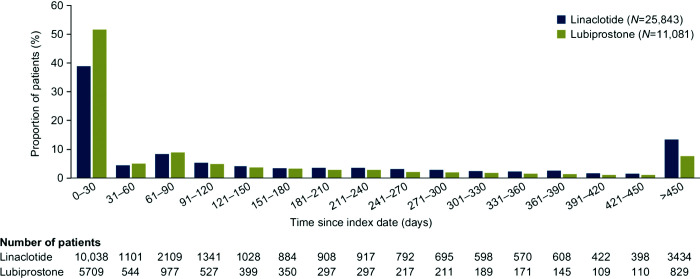
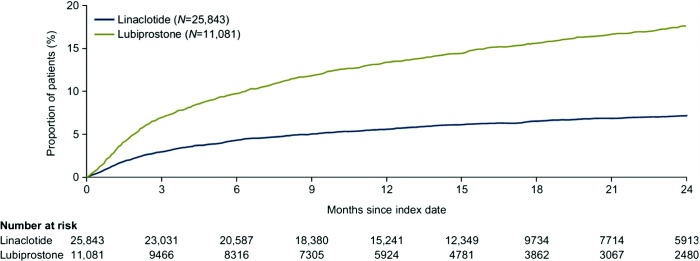
In total, 43,164 and 17,743 patients with CIC received linaclotide and lubiprostone, respectively (80% women, mean age ~47 years). Approximately 40% of subjects (linaclotide: 40.1%; lubiprostone: 37.6%) had evidence of IBS. Over a mean follow-up of 17 months, mean (standard deviation) treatment duration in patients without IBS was 6.6 (7.9) months for linaclotide and 4.5 (6.5) months for lubiprostone. Treatment episodes >180 days were more common with linaclotide (36.1%) than with lubiprostone (23.2%). At 12 months, Kaplan-Meier estimates of switching from lubiprostone to linaclotide and from linaclotide to lubiprostone were 13.4 and 5.6%, respectively. The number of patients receiving serotonin reuptake inhibitors was unchanged with treatment (22%).
Most patients with CIC receive linaclotide or lubiprostone for <6 months; few remain on therapy for >1 year. Additional research is warranted to understand the potential reason(s) for early discontinuation.
慢性特发性便秘(CIC)是社区环境中常见的胃肠道疾病。关于促分泌剂利那洛肽和鲁比前列酮治疗该病的信息有限。这项回顾性队列研究调查了利那洛肽和鲁比前列酮的实际药物治疗模式。
在美国医疗保险理赔数据库中识别出2013年1月至2015年12月期间接受利那洛肽或鲁比前列酮治疗的CIC患者(≥18岁)。随访从首次使用任一药物的日期开始,直至连续参保结束或改用替代药物。使用国际疾病分类第九版或第十版临床修订本编码和国家药品编码检查药物治疗模式、肠易激综合征(IBS)证据以及选择性5-羟色胺再摄取抑制剂的联合使用情况。
共有43164例和17743例CIC患者分别接受了利那洛肽和鲁比前列酮治疗(约80%为女性,平均年龄约47岁)。约40%的受试者(利那洛肽:40.1%;鲁比前列酮:37.6%)有IBS证据。在平均17个月的随访中,无IBS患者的利那洛肽平均(标准差)治疗时长为6.6(7.9)个月,鲁比前列酮为4.5(6.5)个月。治疗疗程>180天的情况在利那洛肽组(36.1%)比鲁比前列酮组(23.2%)更常见。在12个月时,从鲁比前列酮改用利那洛肽以及从利那洛肽改用鲁比前列酮的Kaplan-Meier估计值分别为13.4%和5.6%。接受5-羟色胺再摄取抑制剂治疗的患者数量在治疗期间无变化(约22%)。
大多数CIC患者接受利那洛肽或鲁比前列酮治疗的时间<6个月;很少有患者持续治疗>1年。有必要进行更多研究以了解早期停药的潜在原因。