Liu Shu, Ye Fan, Li Dongqi, He Chuanchun, He Hao, Zhang Jing
Department of Orthopaedics, Bone and Soft Tissue Tumors Research Center of Yunnan Province, The Third Affiliated Hospital of Kunming Medical University, Tumor Hospital of Yunnan Province, Kunming, Yunnan 650118, P.R. China.
Oncol Lett. 2020 Oct;20(4):86. doi: 10.3892/ol.2020.11947. Epub 2020 Aug 5.
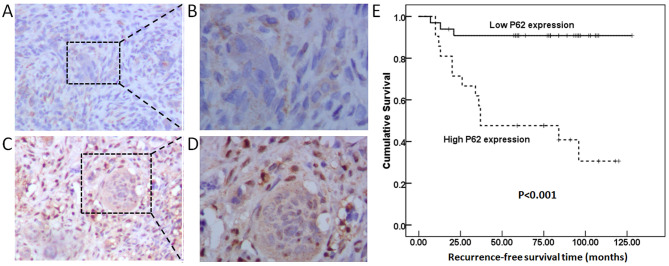
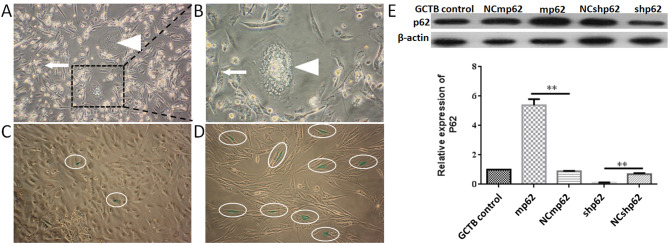
Giant cell tumor of bone (GCTB) is an intermediate (locally aggressive) bone tumor with a recurrence rate of >30% following surgery. GCTB recurrence is ultimately due to the proliferation of neoplastic stromal (NS) cells. However, the precise mechanism underlying the regulation of NS cell proliferation remains unknown. p62 protein is a multifunctional adaptor protein that exerts a positive role in bone tumors and metabolic bone diseases. In the present study, the mRNA and protein expression levels of p62 were detected by reverse transcription-quantitative PCR and western blotting, respectively, in 8 paired fresh GCTB tumor tissues and adjacent normal cancellous bone tissues. The association between p62 expression level and patient prognosis was subsequently analyzed in 54 paraffin-embedded tumor specimens by immunohistochemistry assay. NS cells were isolated from GCTB primary cell culture, and the role of p62 was evaluated using cell proliferation, migration and invasion assays. The results revealed that p62 mRNA and protein were overexpressed in tumor tissues. High p62 expression levels were significantly associated with the recurrence of GCTB (P=0.001). The patients in the high p62 expression group had shorter 5-year recurrence-free survival rates compared with the patients in the low p62 expression group (P<0.001). Cox regression analysis identified p62 expression as an independent prognostic indicator of the recurrence-free survival of patients with GCTB (P<0.001). The experiments revealed that p62 downregulation inhibited NS cell proliferation, invasion and migration, and promoted apoptosis. In conclusion, it was found that p62 overexpression is associated with the recurrence of GCTB via the promotion of NS cell proliferation. Therefore, p62 could be a novel prognostic indicator, and a potential therapeutic target for GCTB.
骨巨细胞瘤(GCTB)是一种中间型(局部侵袭性)骨肿瘤,术后复发率>30%。GCTB复发最终归因于肿瘤性基质(NS)细胞的增殖。然而,NS细胞增殖调控的精确机制仍不清楚。p62蛋白是一种多功能衔接蛋白,在骨肿瘤和代谢性骨病中发挥积极作用。在本研究中,分别通过逆转录定量PCR和蛋白质印迹法检测了8对新鲜GCTB肿瘤组织和相邻正常松质骨组织中p62的mRNA和蛋白表达水平。随后,通过免疫组织化学分析在54个石蜡包埋的肿瘤标本中分析了p62表达水平与患者预后之间的关联。从GCTB原代细胞培养物中分离出NS细胞,并使用细胞增殖、迁移和侵袭试验评估p62的作用。结果显示,p62 mRNA和蛋白在肿瘤组织中过表达。高p62表达水平与GCTB复发显著相关(P=0.001)。与低p62表达组患者相比,高p62表达组患者的5年无复发生存率较短(P<0.001)。Cox回归分析确定p62表达是GCTB患者无复发生存的独立预后指标(P<0.001)。实验表明,p62下调抑制NS细胞增殖、侵袭和迁移,并促进细胞凋亡。总之,发现p62过表达通过促进NS细胞增殖与GCTB复发相关。因此,p62可能是一种新的预后指标,也是GCTB潜在的治疗靶点。