Wang Michael, Recht Michael, Iyer Neeraj N, Cooper David L, Soucie J Michael
Hemophilia and Thrombosis Center University of Colorado School of Medicine Aurora Colorado USA.
The Hemophilia Center at Oregon Health & Science University Portland Oregon USA.
Res Pract Thromb Haemost. 2020 Jul 6;4(6):1035-1045. doi: 10.1002/rth2.12347. eCollection 2020 Aug.
Recurrent joint bleeding in hemophilia results in arthropathy and functional impairment. The relationship of arthropathy development and factor activity (FA) has not been reported in patients with FA levels <15%-20%.
During the Centers for Disease Control and Prevention Universal Data Collection, joint range-of-motion (ROM) measurements were taken at each comprehensive visit. Data were extracted from male patients with hemophilia (PWH) age ≥2 years with baseline factor activity levels ≤40%, excluding those prescribed prophylaxis, and used to calculate a proportion of normal ROM (PN-ROM) measure. Data were analyzed using regression models.
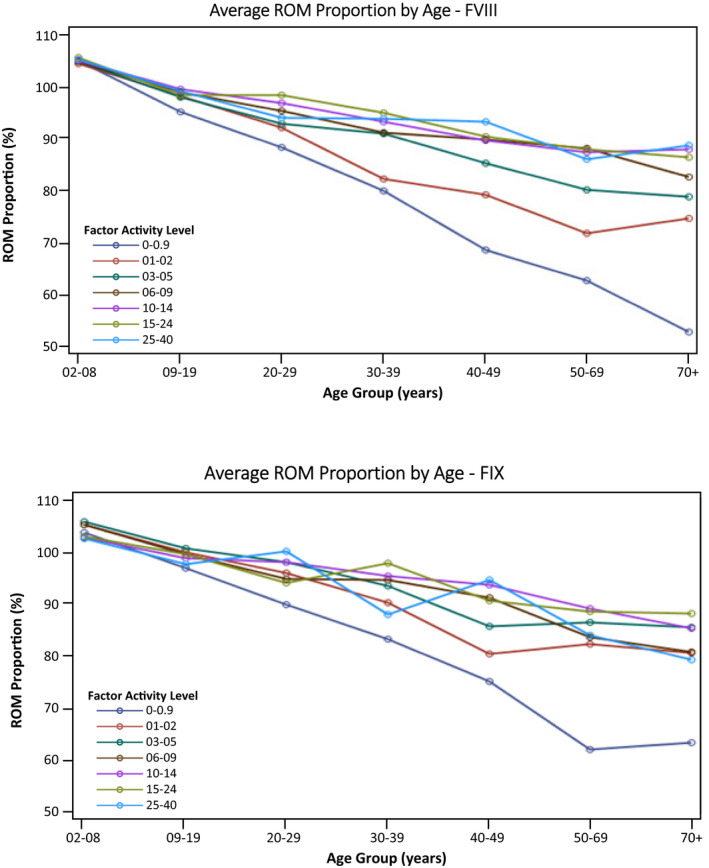
There were 6703 eligible PWH with 30 102 visits. PN-ROM declined with increasing age, and was associated with hemophilia severity, race/ethnicity, obesity, and viral illnesses. PWH ≥30 years old with fFA ≤2% and those ≥50 years old with FA ≤5% had mean PN-ROM values >10% less than controls; those ≥40 years old with FA <1% had values >20% less than controls. In the multivariable analysis, subjects with <1% FA had a 0.43% greater decrease (-0.49 to -0.37, 95% confidence interval) in PN-ROM each year relative to those with 16%-40% factor activity. A less pronounced effect was seen with 1%-5% or 6%-9% FA.
The effect of FA on ROM loss is far greater than that of any of the other characteristics, especially with FA <10%. This emphasizes the need to maintain a high index of suspicion for arthropathy in individuals with moderate and low-mild hemophilia.
血友病患者反复关节出血会导致关节病和功能障碍。因子活性(FA)水平<15%-20%的患者中,关节病发展与因子活性的关系尚未见报道。
在疾病控制和预防中心通用数据收集期间,每次综合就诊时均进行关节活动范围(ROM)测量。数据来自年龄≥2岁、基线因子活性水平≤40%的男性血友病患者(PWH),不包括接受预防治疗的患者,并用于计算正常ROM比例(PN-ROM)测量值。使用回归模型分析数据。
共有6703例符合条件的PWH,进行了30102次就诊。PN-ROM随年龄增长而下降,并与血友病严重程度、种族/族裔、肥胖和病毒感染相关。fFA≤2%的30岁及以上PWH和FA≤5%的50岁及以上PWH的平均PN-ROM值比对照组低>10%;FA<1%的40岁及以上患者的PN-ROM值比对照组低>20%。在多变量分析中,与因子活性为16%-40%的受试者相比,FA<1%的受试者每年PN-ROM下降幅度大0.43%(-0.49至-0.37,95%置信区间)。FA为1%-5%或6%-9%时,效果不那么明显。
FA对ROM丧失的影响远大于任何其他特征所造成的影响,尤其是FA<10%时。这强调了对中度和轻度血友病患者的关节病需保持高度怀疑指数。