Boston University School of Public Health, Boston, Massachusetts.
Brown University School of Public Health, Providence, Rhode Island.
Health Serv Res. 2020 Oct;55 Suppl 2(Suppl 2):873-882. doi: 10.1111/1475-6773.13555. Epub 2020 Sep 3.
To describe social needs among low-income adults and estimate the relationship between level of unmet social needs and key indicators of health care access and quality.
National survey data from 12 states from the 2017 Behavioral Risk Factor Surveillance System, which added a "Social Determinants of Health" Module in 2017.
We examined differences in eight measures of health care access and quality (eg, check-up in last 12 months, inability to see doctor due to cost, receipt of eye examination for diabetics) for low-income adults with 0, 1, 2-3, and 4+ unmet social needs based on 7 social needs measures. We used adjusted logistic regression models to estimate the association between level of unmet need and each outcome.
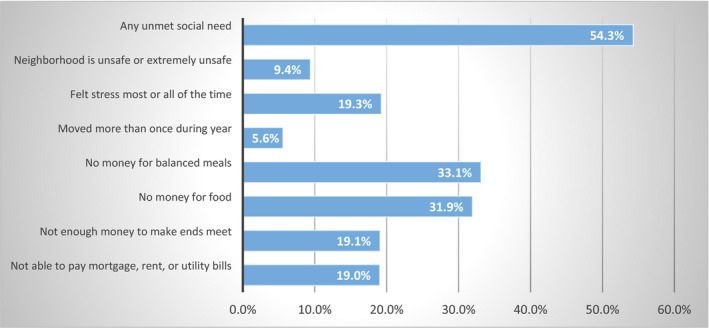
Most common unmet social needs included not having enough money for balanced meals (33 percent) or food (32 percent). After adjusting for observable characteristics, higher levels of unmet social need were associated with poorer access and quality. Compared to those with no reported unmet needs, having 4+ unmet needs was significantly associated with reduced probability of having a yearly check-up (65 percent vs 78 percent, adjusted difference = -7.1 percentage points (PP)), receiving a flu vaccine (33 percent vs 42 percent, adjusted difference = -5.4 PP), having a personal doctor (74 percent vs 80 percent, adjusted difference = -3.1 PP), and having a foot (63 percent vs 80 percent, adjusted difference = -12.8 PP) or eye examination (61 percent vs 73 percent, adjusted difference = -12.6 PP) for diabetic patients, and increased probability of being unable to see a doctor due to cost (44 percent vs 9 percent, adjusted difference = 27.9 PP) and having diabetes affect the eyes (22 percent vs 19 percent, adjusted difference = 8.0 PP) at α = 0.05.
Higher levels of unmet social needs were associated with poorer access to and quality of care among low-income adults. Addressing social needs both inside and outside of health care settings may help mitigate these negative effects. Additional research on if and how to effectively do so is critical.
描述低收入成年人的社会需求,并评估未满足的社会需求水平与医疗保健获取和质量的关键指标之间的关系。
2017 年来自 12 个州的国家调查数据,该数据在 2017 年增加了“健康决定因素的社会决定因素”模块。
我们根据 7 项社会需求衡量标准,检查了 0、1、2-3 和 4+ 项未满足的社会需求的低收入成年人在八项医疗保健获取和质量衡量标准(例如,过去 12 个月的体检、因费用而无法看医生、接受糖尿病患者的眼部检查)方面的差异。我们使用调整后的逻辑回归模型来估计未满足需求水平与每个结果之间的关联。
最常见的未满足的社会需求包括没有足够的钱购买均衡饮食(33%)或食物(32%)。在调整了可观察特征后,较高水平的未满足社会需求与较差的获取和质量相关。与未报告未满足需求的人相比,有 4+ 项未满足需求的人接受年度体检的可能性显著降低(65%对 78%,调整差异=-7.1%(PP)),接种流感疫苗的可能性降低(33%对 42%,调整差异=-5.4 PP),有私人医生的可能性降低(74%对 80%,调整差异=-3.1 PP),足部(63%对 80%,调整差异=-12.8 PP)或眼部检查(61%对 73%,调整差异=-12.6 PP)的糖尿病患者,以及因费用而无法看医生的可能性增加(44%对 9%,调整差异=27.9 PP)和糖尿病影响眼睛(22%对 19%,调整差异=8.0 PP)的可能性更高,在α=0.05 时。
较高水平的未满足社会需求与低收入成年人获得医疗保健的机会较差和医疗质量较差有关。在医疗保健内外解决社会需求可能有助于减轻这些负面影响。关于是否以及如何有效地做到这一点的进一步研究至关重要。