Department of Orthopedic Surgery, Hanyang University Guri Hospital, Guri, South Korea.
College of Medicine, Hanyang University, Seoul, South Korea.
PLoS One. 2020 Sep 3;15(9):e0238208. doi: 10.1371/journal.pone.0238208. eCollection 2020.
Peripheral nerve injury (PNI) often leads to significant functional loss in patients and poses a challenge to physicians since treatment options for improving functional outcomes are limited. Recent studies suggest that erythropoietin and glucocoticoids have beneficial effects as mediators of neuro-regenerative processes. We hypothesized that combination treatment with erythropoietin and glucocoticoids would have a synergistic effect on functional outcome after PNI.
Sciatic nerve crush injury was simulated in ten-week-old male C57BL/6 mice. The mice were divided into four groups according to the type of drugs administered (control, erythropoietin, dexamethasone, and erythropoietin with dexamethasone). Motor functional recovery was monitored by walking track analysis at serial time points up to 28 days after injury. Morphological analysis of the nerve was performed by immunofluorescent staining for neurofilament (NF) heavy chain and myelin protein zero (P0) in cross-sectional and whole-mount nerve preparations. Additionally, morphological analysis of the muscle was performed by Hematoxylin and eosin staining.
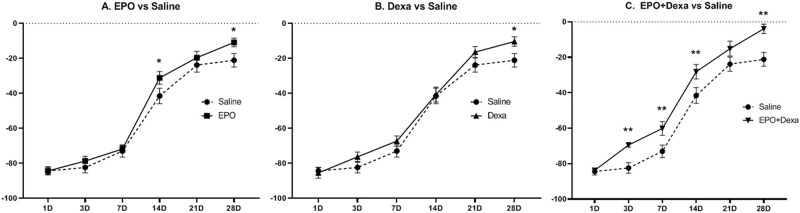
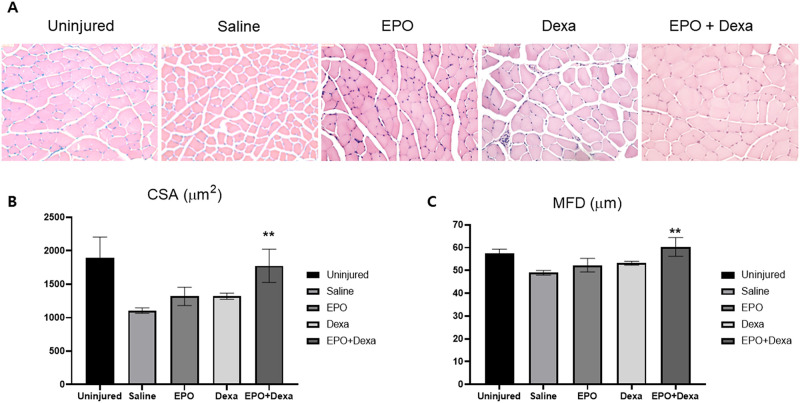
Combination treatment with erythropoietin and dexamethasone significantly improved the sciatic functional index at 3, 7, 14, and 28 days after injury. Fluorescence microscopy of cross sectional nerve revealed that the combination treatment increased the ratio of P0/NF-expressing axons. Furthermore, confocal microscopy of the whole-mount nerve revealed that the combination treatment increased the fluorescence intensity of P0 expression. The cross-sectional area and minimum Feret's diameter of the muscle fibers were significantly larger in the mice which received combination treatment than those in the controls.
Our results demonstrated that combination treatment with erythropoietin and dexamethasone accelerates functional recovery and reduces neurogenic muscle atrophy caused by PNI in mice, which may be attributed to the preservation of myelin and Schwann cell re-myelination. These findings may provide practical therapeutic options for patients with acute PNI.
周围神经损伤(PNI)常导致患者出现显著的功能丧失,且由于改善功能预后的治疗选择有限,这对医生来说是一个挑战。最近的研究表明,促红细胞生成素和糖皮质激素作为神经再生过程的介质具有有益的作用。我们假设促红细胞生成素和糖皮质激素联合治疗对 PNI 后的功能结果有协同作用。
在 10 周龄雄性 C57BL/6 小鼠中模拟坐骨神经挤压伤。根据给予的药物类型(对照、促红细胞生成素、地塞米松和促红细胞生成素与地塞米松)将小鼠分为四组。在损伤后至 28 天的多个时间点通过行走轨迹分析监测运动功能恢复。通过对横切和全神经制备物中的神经丝(NF)重链和髓鞘蛋白零(P0)进行免疫荧光染色进行神经形态学分析。此外,通过苏木精和伊红染色对肌肉进行形态学分析。
促红细胞生成素和地塞米松联合治疗在损伤后 3、7、14 和 28 天明显改善坐骨功能指数。横切神经的荧光显微镜显示,联合治疗增加了 P0/NF 表达轴的比例。此外,全神经共聚焦显微镜显示,联合治疗增加了 P0 表达的荧光强度。接受联合治疗的小鼠的肌肉纤维横截面积和最小 Feret 直径明显大于对照组。
我们的结果表明,促红细胞生成素和地塞米松联合治疗可加速功能恢复并减少 PNI 引起的神经源性肌肉萎缩,这可能归因于髓鞘的保存和施万细胞的再髓鞘化。这些发现可能为急性 PNI 患者提供实用的治疗选择。