Bergen Addiction Research group, Department of Addiction Medicine, Haukeland University Hospital, Østre Murallmenningen 7, N-5012, Bergen, Norway.
Department of Global Public Health and Primary Care, University of Bergen, Bergen, Norway.
Subst Abuse Treat Prev Policy. 2020 Sep 3;15(1):68. doi: 10.1186/s13011-020-00309-y.
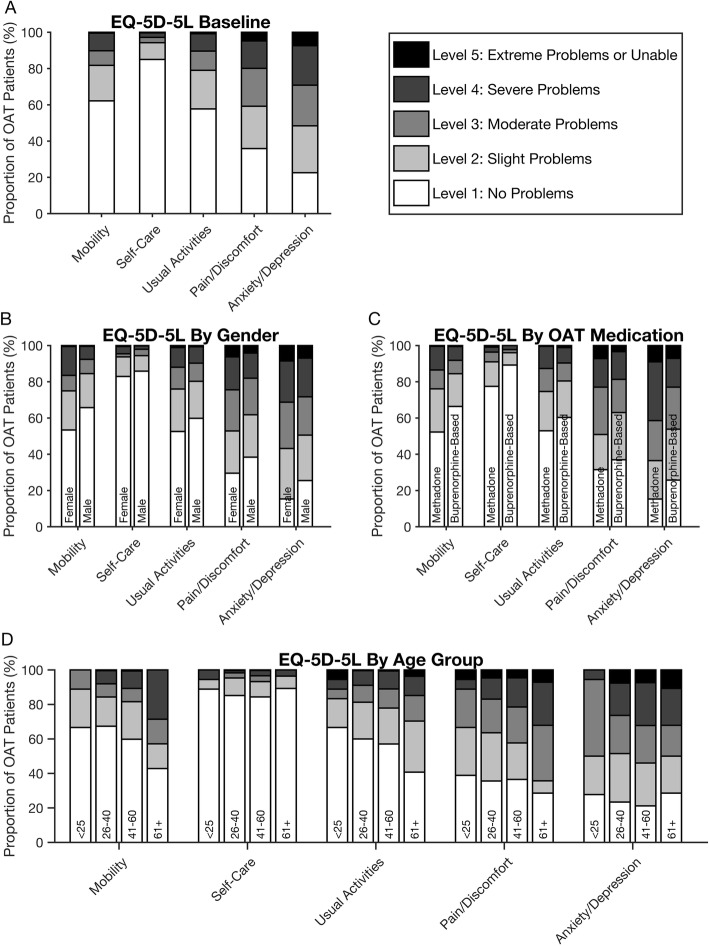
Opioid dependence carries the highest disease burden of all illicit drugs. Opioid agonist therapy (OAT) is an evidence-based medical intervention that reduces morbidity and mortality. There is limited knowledge on the health-related quality of life (HRQoL) of long-term patients in OAT. This study measures HRQoL and self-perceived health of long-term patients on OAT, compares the scores to a Norwegian reference population, and assesses changes in these scores at 1-year follow up.
We conducted a nested prospective cohort study among nine OAT outpatient clinics in Norway. 609 OAT patients were included, 245 (40%) followed-up one year later. Data on patient characteristics, HRQoL, and self-perceived health was collected. HRQoL was assessed with the EQ-5D-5L, which measures five dimensions (mobility, self-care, usual activities, pain/discomfort and anxiety/depression) on a five-point Likert scale (from "no problems" to "extreme problems"). An UK value set was applied to calculate index values (from 0 to 1) for the EQ-5D-5L and compare them to a Norwegian reference population. Self-perceived health was measured with EQ-VAS (from 0 to 100).
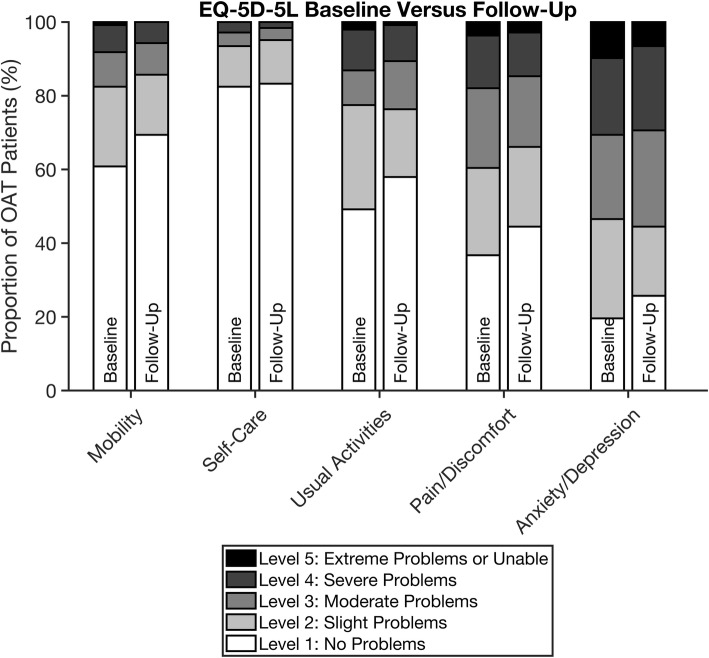
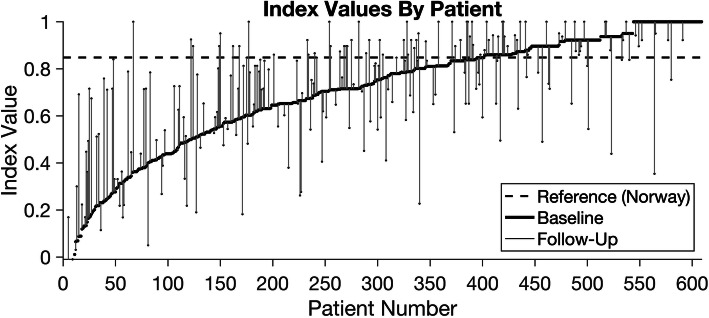
Mean (standard deviation (SD)) EQ-5D-5L index value at baseline was 0.699 (0.250) and EQ-VAS 57 (22) compared to 0.848 (0.200) and 80(19) for the Norwegian reference population. There were large variations in EQ-5D-5L index values, where 43% had > 0.8 and 5% had < 0.2 at baseline. The lowest EQ-5D-5L index values were observed for female patients, age groups older than 40 years and for methadone users. At follow-up, improvements in HRQoL were observed across almost all dimensions and found significant for mobility and pain/discomfort. Mean (SD) overall index value and EQ-VAS at follow up were 0.729 (0.237) and 59 (22) respectively.
The average HRQoL and self-perceived health of OAT patients is significantly lower than that of the general population, and lower than what has been found among other severe somatic and psychiatric conditions. Around 34% had very good HRQoL, higher than average Norwegian values, and around 5% had extremely poor HRQoL.
阿片类药物依赖是所有非法药物中疾病负担最高的。阿片类药物激动剂治疗(OAT)是一种基于证据的医学干预措施,可降低发病率和死亡率。关于长期接受 OAT 治疗的患者的健康相关生活质量(HRQoL)知之甚少。本研究测量了长期接受 OAT 治疗的患者的 HRQoL 和自我感知健康,并将这些评分与挪威参考人群进行比较,并评估了 1 年随访时这些评分的变化。
我们在挪威的九个 OAT 门诊进行了嵌套前瞻性队列研究。共纳入 609 名 OAT 患者,其中 245 名(40%)在一年后进行了随访。收集了患者特征、HRQoL 和自我感知健康的数据。HRQoL 使用 EQ-5D-5L 进行评估,该量表在五个维度(移动性、自我护理、日常活动、疼痛/不适和焦虑/抑郁)上采用五点 Likert 量表(从“无问题”到“极度问题”)。应用英国价值量表计算 EQ-5D-5L 的指数值(0 至 1),并与挪威参考人群进行比较。自我感知健康采用 EQ-VAS(0 至 100)进行测量。
基线时平均(标准差(SD))EQ-5D-5L 指数值为 0.699(0.250),EQ-VAS 为 57(22),而挪威参考人群的指数值分别为 0.848(0.200)和 80(19)。EQ-5D-5L 指数值存在较大差异,其中 43%的患者基线值大于 0.8,5%的患者基线值小于 0.2。女性患者、年龄大于 40 岁和使用美沙酮的患者的 EQ-5D-5L 指数值最低。在随访时,几乎所有维度的 HRQoL 都有所改善,移动性和疼痛/不适方面的改善具有统计学意义。随访时平均(SD)整体指数值和 EQ-VAS 分别为 0.729(0.237)和 59(22)。
OAT 患者的平均 HRQoL 和自我感知健康明显低于普通人群,也低于其他严重躯体和精神疾病患者的水平。约 34%的患者 HRQoL 非常好,高于平均挪威值,约 5%的患者 HRQoL 极差。