Yu Yue, Huang Jun, Tang Xuehui, Allison Jerome, Sandlin David, Ding Dalian, Pang Yi, Zhang Chunming, Chen Tianwen, Yin Nathan, Chen Lan, Mustain William, Zhou Wu, Zhu Hong
Departmant of Otolaryngology and Communicative Sciences, University of Mississippi Medical Center, Jackson, MS, USA.
Department of Neurobiology and Anatomical Sciences, University of Mississippi Medical Center, Jackson, MS, USA.
J Otol. 2020 Sep;15(3):77-85. doi: 10.1016/j.joto.2020.01.003. Epub 2020 Jan 22.
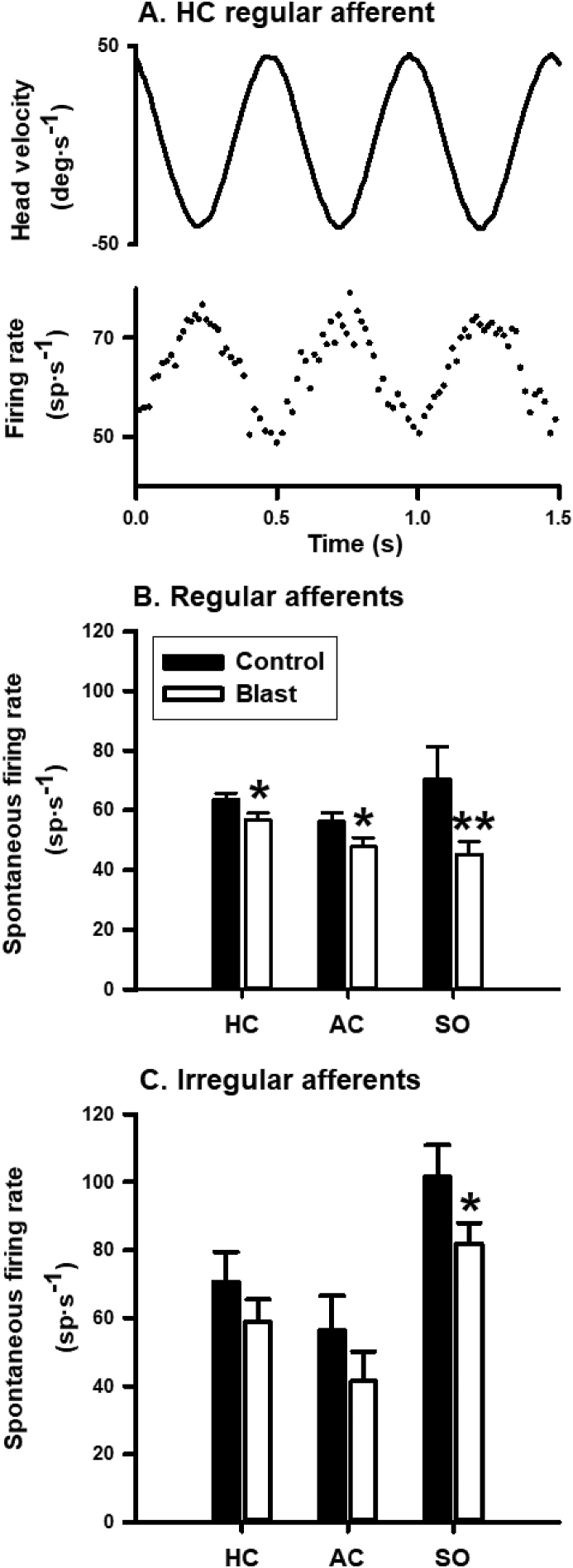
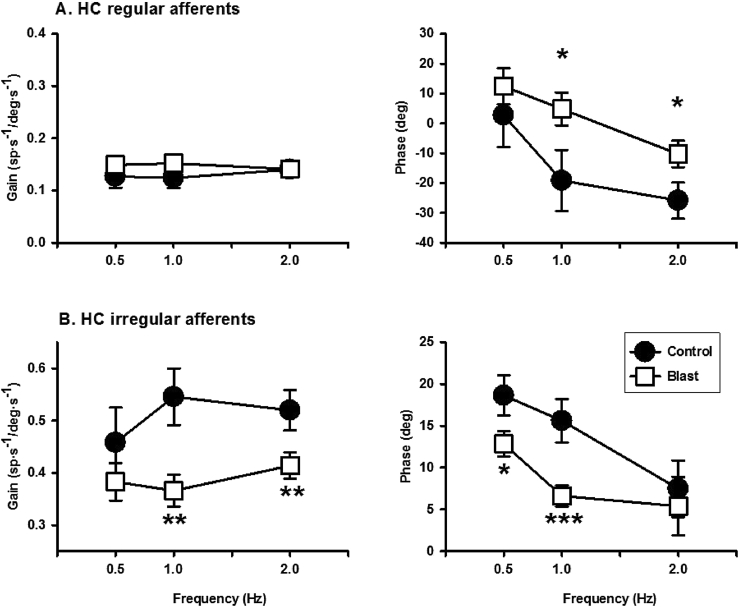
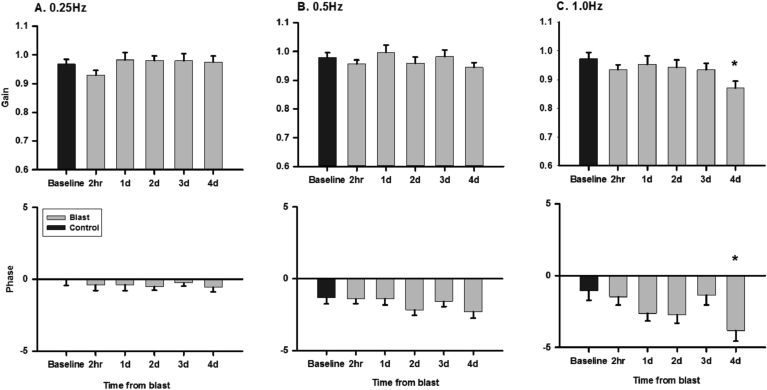
The ears are air-filled structures that are directly impacted during blast exposure. In addition to hearing loss and tinnitus, blast victims often complain of vertigo, dizziness and unsteady posture, suggesting that blast exposure induces damage to the vestibular end organs in the inner ear. However, the underlying mechanisms remain to be elucidated. In this report, single vestibular afferent activity and the vestibulo-ocular reflex (VOR) were investigated before and after exposure to blast shock waves (∼20 PSI) delivered into the left external ear canals of anesthetized rats. Single vestibular afferent activity was recorded from the superior branch of the left vestibular nerves of the blast-treated and control rats one day after blast exposure. Blast exposure reduced the spontaneous discharge rates of the otolith and canal afferents. Blast exposure also reduced the sensitivity of irregular canal afferents to sinusoidal head rotation at 0.5-2Hz. Blast exposure, however, resulted in few changes in the VOR responses to sinusoidal head rotation and translation. To the best of our knowledge, this is the first study that reports blast exposure-induced damage to vestibular afferents in an animal model. These results provide insights that may be helpful in developing biomarkers for early diagnosis of blast-induced vestibular deficits in military and civilian populations.
耳朵是充满空气的结构,在爆炸暴露期间会直接受到影响。除了听力损失和耳鸣外,爆炸受害者还经常抱怨眩晕、头晕和姿势不稳,这表明爆炸暴露会对内耳的前庭终器造成损伤。然而,其潜在机制仍有待阐明。在本报告中,研究了在将爆炸冲击波(约20磅力/平方英寸)传入麻醉大鼠的左外耳道之前和之后的单前庭传入活动和前庭眼反射(VOR)。在爆炸暴露一天后,从爆炸处理组和对照组大鼠的左前庭神经上支记录单前庭传入活动。爆炸暴露降低了耳石和半规管传入神经的自发放电率。爆炸暴露还降低了不规则半规管传入神经对0.5-2Hz正弦头部旋转的敏感性。然而,爆炸暴露对正弦头部旋转和平移的VOR反应几乎没有影响。据我们所知,这是第一项报道在动物模型中爆炸暴露引起前庭传入神经损伤的研究。这些结果提供了一些见解,可能有助于开发生物标志物,用于早期诊断军事和 civilian人群中爆炸引起的前庭缺陷。 (注:原文中“civilian”未翻译完整,可能是笔误,推测应为“平民”)