Department of Endocrinology, Henan Provincial People's Hospital, People's Hospital of Zhengzhou University, Zhengzhou, China.
Department of Finance, Henan Provincial People's Hospital, People's Hospital of Zhengzhou University, Zhengzhou, China.
J Diabetes Investig. 2021 May;12(5):828-836. doi: 10.1111/jdi.13394. Epub 2020 Sep 29.
AIMS/INTRODUCTION: This study aimed to evaluate the association between time in range (TIR) obtained from continuous glucose monitoring and the prevalence and degree of painful diabetic neuropathy.
A total of 364 individuals with diabetic peripheral neuropathy were enrolled in this study. Sensor-based flash glucose monitoring systems were used to monitor the participants' glucose levels, and the glycemic variability metrics were calculated, including the TIR, glucose coefficient of variation, standard deviation and the mean amplitude of glycemic excursions. The participants were asked to record any form of pain during the 2 weeks of monitoring, and score the pain every day on a numerical rating scale. Based on the numerical rating scale, the patients were divided into the pain-free group, mild pain group and moderate/severe pain group.
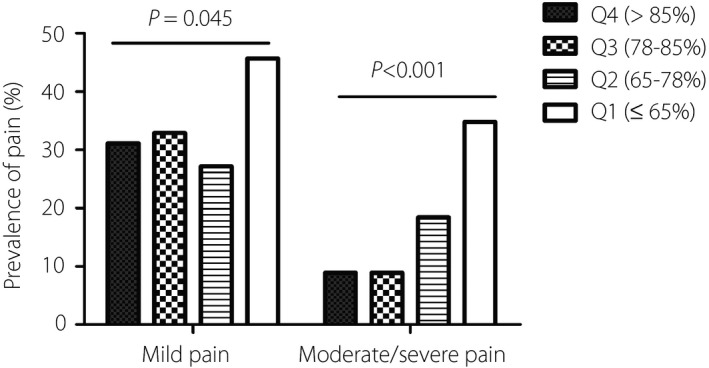
Overall, 51.92% (189/364) of the participants were diagnosed with painful diabetic neuropathy. Compared with the pain-free group, the level of TIR decreased significantly in the mild pain and moderate/severe pain groups (P < 0.05). The prevalence of mild pain and moderate/severe pain decreased with increasing TIR quartiles (all P < 0.05). Multiple linear regression analysis showed that TIR was significantly negatively correlated with the numerical rating scale score after adjustment for glycated hemoglobin, glycemic variability indicators and other risk factors (P < 0.05). Logistic regression analysis showed that a decreasing level of TIR was significantly associated with an increasing risk of any pain and moderate/severe pain (P < 0.05).
TIR is correlated with painful diabetic neuropathy and is underscored as a valuable clinical evaluation measure.
目的/引言:本研究旨在评估连续血糖监测获得的时间在目标范围内(TIR)与疼痛性糖尿病周围神经病变的患病率和严重程度之间的关系。
本研究共纳入 364 名患有糖尿病周围神经病变的患者。使用基于传感器的闪光血糖监测系统监测参与者的血糖水平,并计算血糖变异性指标,包括 TIR、血糖变异系数、标准差和血糖波动幅度的平均值。参与者被要求在监测的 2 周内记录任何形式的疼痛,并在数字评分量表上每天记录疼痛评分。根据数字评分量表,患者被分为无痛组、轻度疼痛组和中度/重度疼痛组。
总体而言,51.92%(189/364)的参与者被诊断为疼痛性糖尿病周围神经病变。与无痛组相比,轻度疼痛组和中度/重度疼痛组的 TIR 水平显著降低(P<0.05)。随着 TIR 四分位值的增加,轻度疼痛和中度/重度疼痛的患病率显著降低(均 P<0.05)。多线性回归分析显示,在调整糖化血红蛋白、血糖变异性指标和其他危险因素后,TIR 与数字评分量表评分显著负相关(P<0.05)。Logistic 回归分析显示,TIR 水平降低与任何疼痛和中度/重度疼痛的风险增加显著相关(P<0.05)。
TIR 与疼痛性糖尿病周围神经病变相关,是一种有价值的临床评估指标。