Department of Medical Oncology, McGill University, Montreal, Canada.
Levine Cancer Institute, Pulmonary and Critical Care, Atrium Health, Charlotte, NC.
Am J Health Syst Pharm. 2020 Sep 4;77(18):1466-1476. doi: 10.1093/ajhp/zxaa197.
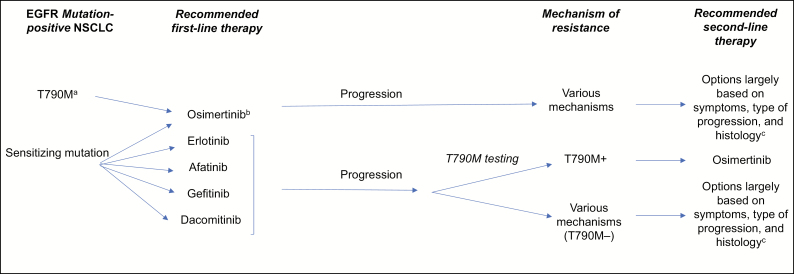
To summarize current understanding of the efficacy, role, and cost-effectiveness of the available epidermal growth factor receptor (EGFR) tyrosine kinase inhibitors (TKIs), and to evaluate sequencing strategies based on the available evidence. Summary. EGFR TKIs are the current standard of care for patients with EGFR mutation-positive non-small cell lung cancer (NSCLC). Five EGFR TKIs are currently approved in the United States for use in a first-line setting; these TKIs differ in mechanism of action, efficacy, safety, and cost. Most patients develop resistance to first-line EGFR TKIs and require subsequent therapy with additional EGFR TKIs, chemotherapy, and/or other targeted agents. A major consideration when selecting EGFR TKIs, both as first-line or subsequent treatment options, is cost-effectiveness. Although clinical trials have shown that the second- and third-generation EGFR TKIs are superior in efficacy to the first-generation agents, pharmacoeconomic studies suggest that the first-generation agents are the most cost-effective, with the second-generation TKI afatinib also considered cost-effective in some studies. Despite its impressive efficacy, osimertinib appears to be less cost-effective due to substantially higher acquisition costs.
Preliminary data suggest that first-line afatinib followed by osimertinib may offer promising survival outcomes and, on the basis of efficacy alone, may represent an optimal sequencing strategy in the majority of patients with EGFR mutation-positive NSCLC, in particular Asian patients and those with Del19-positive tumors. However, considerably more research into outcomes and costs associated with consecutive sequencing of EGFR TKIs is needed before any conclusions can be reached.
总结目前对可用表皮生长因子受体(EGFR)酪氨酸激酶抑制剂(TKI)的疗效、作用和成本效益的认识,并根据现有证据评估测序策略。 总结。 EGFR TKI 是目前 EGFR 突变阳性非小细胞肺癌(NSCLC)患者的标准治疗方法。目前在美国有 5 种 EGFR TKI 被批准用于一线治疗;这些 TKI 在作用机制、疗效、安全性和成本方面存在差异。大多数患者对一线 EGFR TKI 产生耐药性,需要随后使用其他 EGFR TKI、化疗和/或其他靶向药物进行治疗。在选择 EGFR TKI 时,无论是作为一线还是二线治疗选择,成本效益都是一个主要考虑因素。尽管临床试验表明,第二代和第三代 EGFR TKI 在疗效上优于第一代药物,但药物经济学研究表明,第一代药物最具成本效益,第二代 TKI 阿法替尼在某些研究中也被认为具有成本效益。尽管奥希替尼疗效显著,但由于收购成本高,其成本效益似乎较低。
初步数据表明,一线阿法替尼序贯奥希替尼可能提供有希望的生存结果,仅基于疗效,在大多数 EGFR 突变阳性 NSCLC 患者中,特别是亚洲患者和 Del19 阳性肿瘤患者中,可能代表一种最佳的测序策略。然而,在得出任何结论之前,还需要对 EGFR TKI 连续测序相关的结果和成本进行更多研究。