Bottiroli Maurizio, De Caria Daniele, Belli Oriana, Calini Angelo, Andreoni Patrizia, Siragusa Antonio, Moreo Antonella, Ammirati Enrico, Mondino Michele, Fumagalli Roberto
Anesthesia and Critical Care, ASST Grande Ospedale Metropolitano Niguarda, Milan, Italy.
Cardiology, ASST Grande Ospedale Metropolitano Niguarda, Milan, Italy.
ESC Heart Fail. 2020 Dec;7(6):4297-4300. doi: 10.1002/ehf2.12912. Epub 2020 Sep 4.
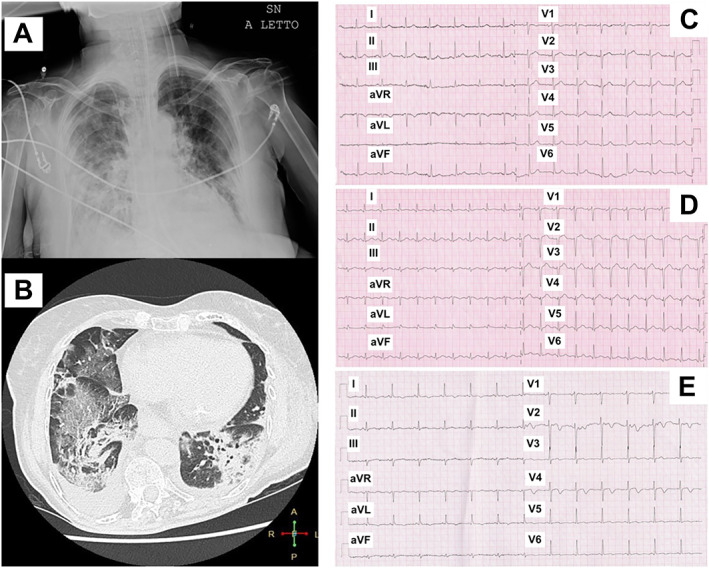
Coronavirus disease 2019 (COVID-19) patients with cardiac injury have an increased risk of mortality. It remains to be determined the mechanism of cardiac injury and the identification of specific conditions that affect the heart during COVID-19. We present the case of a 76-year-old woman with COVID-19 pneumonia that developed a takotsubo syndrome (TTS). Although the patient presented normal left ventricular ejection fraction and normal levels of troponin on admission, after 16 days in intensive care unit due to respiratory distress, she suddenly developed cardiogenic shock. Shock occurred few hours after a spontaneous breathing trial through her tracheostomy. Bed-side echocardiographic revealed apical ballooning promptly supporting the diagnosis of TTS. She was successfully treated with deep sedation and low dosage of epinephrine. The relevance of this case is that TTS can occur in the late phase of COVID-19. Awareness of late TTS and bed-side echocardiographic evaluation can lead to prompt identification and treatment.
2019冠状病毒病(COVID-19)合并心脏损伤的患者死亡风险增加。COVID-19期间心脏损伤的机制以及影响心脏的特定情况的识别仍有待确定。我们报告一例76岁患COVID-19肺炎并发生应激性心肌病(TTS)的女性病例。尽管患者入院时左心室射血分数正常且肌钙蛋白水平正常,但因呼吸窘迫在重症监护病房治疗16天后,突然发生心源性休克。休克发生在通过气管切开进行自主呼吸试验数小时后。床旁超声心动图显示心尖部气球样变,迅速支持了TTS的诊断。她通过深度镇静和低剂量肾上腺素成功治愈。该病例的意义在于TTS可发生在COVID-19后期。认识到晚期TTS并进行床旁超声心动图评估可实现及时识别和治疗。