Division of Plastic and Craniofacial Surgery, Children's Mercy Hospital, 2401 Gillham Road, Kansas City, MO, 64108, USA.
University of Missouri-Kansas City School of Medicine, 2411 Holmes Street, Kansas City, MO, 64108, USA.
Pediatr Rheumatol Online J. 2020 Sep 4;18(1):68. doi: 10.1186/s12969-020-00453-6.
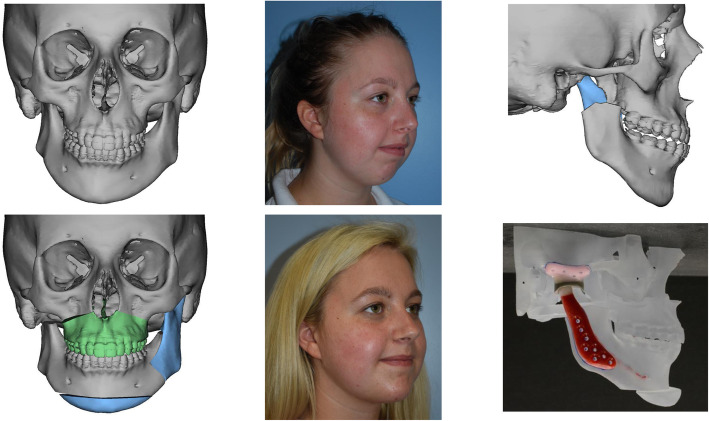
Temporomandibular joint (TMJ) arthritis and involvement is commonly seen in Juvenile Idiopathic Arthritis (JIA). Therapy includes conservative measures, but also includes intraarticular corticosteroid injections (IASI) and systemic immunosuppressive therapy. Despite aggressive medical therapy, some patients develop arthritic changes and frank TMJ ankylosis that can result in persistent pain and limitation in range of motion (ROM). A surgical option is prosthetic TMJ replacement with concurrent correction of dentofacial deformities, which can be performed simultaneously. The objective of this study was to evaluate the outcomes of prosthetic TMJ replacement in a cohort of adolescent females with JIA and severe TMJ involvement.
This is a retrospective case series that took place at one tertiary care center. Patients with a diagnosis of JIA who also underwent alloplastic TMJ replacement were identified through electronic medical record system (EMR) and reviewed. Chart review included analysis of all documents in the EMR, including demographic data, JIA history, surgical complications, ROM of TMJ measured by maximal incisal opening in millimeters (mm) and TMJ pain scores (4-point Likert scale: none, mild, moderate, severe) obtained pre- and postoperatively.
Five female patients, ages 15-17 year when TMJ replacement was performed, had nine total joints replaced with a post-operative follow-up period of 12-30 months. All patients had polyarticular, seronegative JIA and were treated with IASI and multiple immunosuppressive therapies without resolution of TMJ symptoms. One patient had bilateral TMJ ankylosis. Three of the five patients demonstrated significant dentofacial deformities, and all underwent simultaneous or staged orthognathic surgery. All patients had improvement in TMJ pain with most (80%) reporting no pain, and all had similar or improved ROM of their TMJ postoperatively. There was one delayed postoperative infection with Cutibacterium Acnes that presented 15 months after surgery and required removal and reimplantation of prosthesis.
The sequelae of TMJ arthritis and involvement from JIA in the adolescent population can be difficult to treat. Current medical therapy can be successful, however, in select cases that develop chronic changes in the TMJ despite extensive medical therapy, early results show that prosthetic joint replacement maybe a reasonable surgical option. With prosthetic joint replacement pain levels were reduced and range of motion was maintained or improved for all patients.
颞下颌关节(TMJ)关节炎和受累在幼年特发性关节炎(JIA)中很常见。治疗包括保守措施,但也包括关节内皮质类固醇注射(IASI)和全身免疫抑制治疗。尽管采用了积极的药物治疗,但一些患者仍会出现关节炎改变和明显的 TMJ 强直,从而导致持续性疼痛和运动范围(ROM)受限。一种手术选择是假体 TMJ 置换,同时矫正牙颌面畸形,可以同时进行。本研究的目的是评估假体 TMJ 置换在一组患有 JIA 和严重 TMJ 受累的青少年女性中的治疗效果。
这是一项在一家三级保健中心进行的回顾性病例系列研究。通过电子病历系统(EMR)识别并回顾了诊断为 JIA 且接受了全关节置换术的患者。图表审查包括分析 EMR 中的所有文件,包括人口统计学数据、JIA 病史、手术并发症、通过最大切牙开口毫米(mm)测量的 TMJ 运动范围以及术前和术后的 TMJ 疼痛评分(4 分李克特量表:无、轻度、中度、重度)。
5 名 15-17 岁女性患者接受了 9 个 TMJ 关节置换术,术后随访时间为 12-30 个月。所有患者均患有多关节、血清阴性 JIA,并接受了 IASI 和多种免疫抑制治疗,但 TMJ 症状仍未缓解。1 名患者双侧 TMJ 强直。5 名患者中有 3 名存在明显的牙颌面畸形,均同时或分期接受了正颌手术。所有患者的 TMJ 疼痛均有改善,大多数(80%)患者报告无疼痛,所有患者的 TMJ 运动范围在术后均相似或改善。有 1 例术后迟发性感染,由痤疮丙酸杆菌引起,术后 15 个月出现,需要取出并重新植入假体。
青少年人群中 TMJ 关节炎和受累的后遗症可能难以治疗。目前的药物治疗可能有效,但是对于某些尽管接受了广泛的药物治疗仍出现 TMJ 慢性改变的患者,早期结果表明关节置换术可能是一种合理的手术选择。通过关节置换术,所有患者的疼痛程度均降低,运动范围得到维持或改善。