Azienda USL-IRCCS di Reggio Emilia, Reggio Emilia, Italy.
Primary Care Service, Azienda USL-IRCCS di Reggio Emilia, Reggio Emilia, Italy.
Ital J Pediatr. 2020 Sep 4;46(1):123. doi: 10.1186/s13052-020-00886-5.
Anticipatory guidance for parents is commonly used to improve parenting skills. The objective of this pre/post-intervention controlled study was to evaluate the effectiveness of a periodic newsletter with advice on childcare and development in improving parenting self-efficacy.
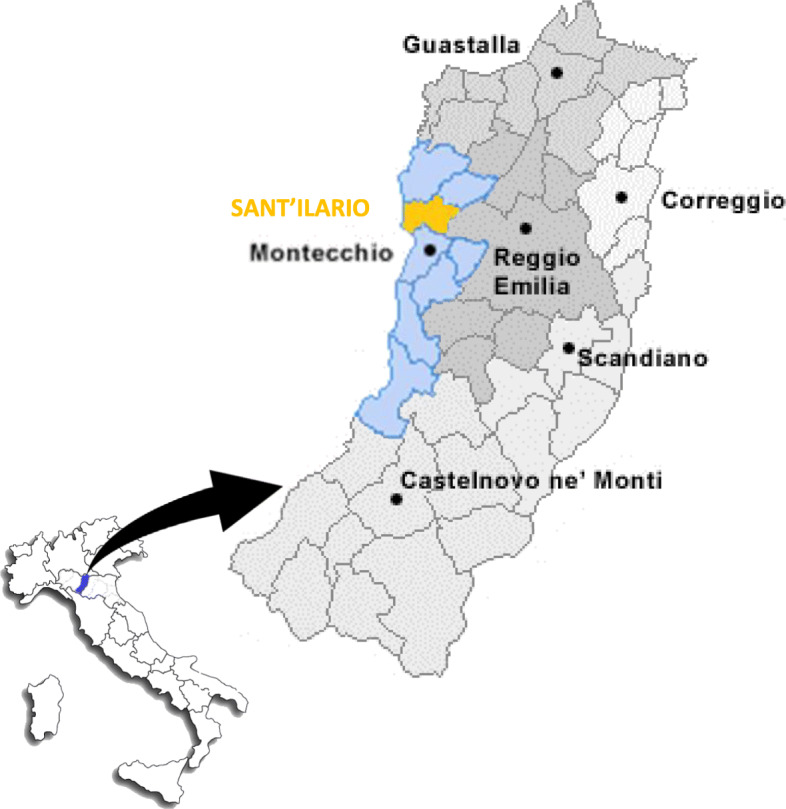
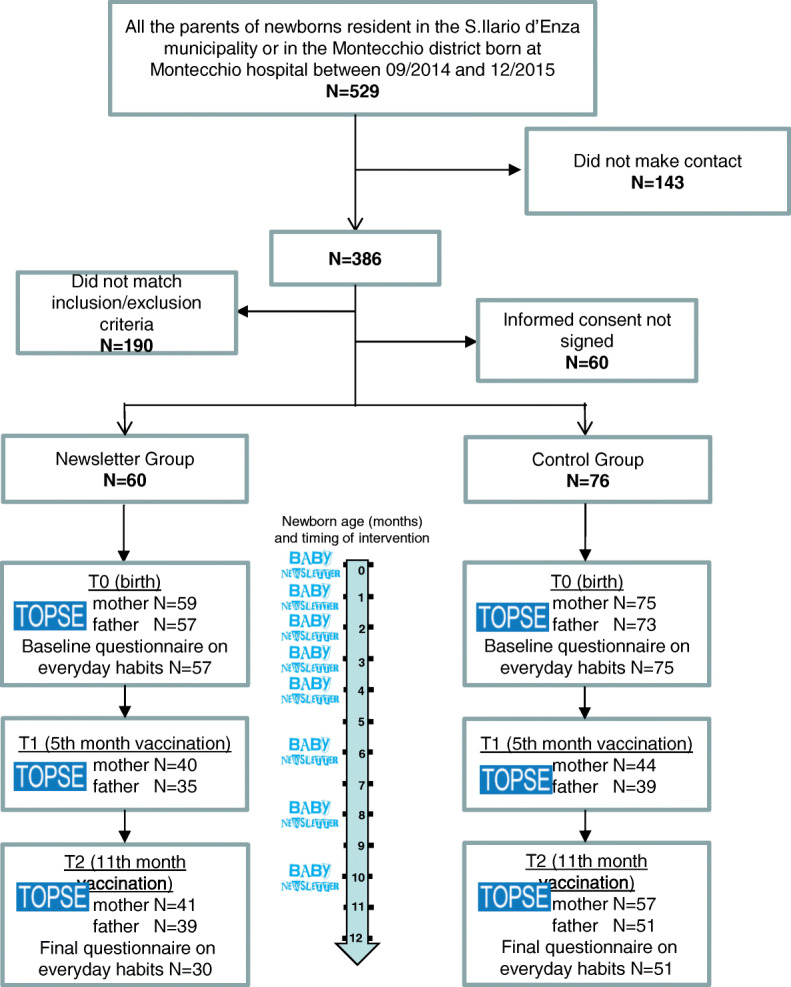
This was a non-randomized pre/post-intervention controlled study. All the parents of children born between September 2014 and December 2015 resident in the S. Ilario d'Enza municipality (Italy) received eight Baby Newsletters. Parents resident in other municipalities of the same Health District were the control. Parents with linguistic barriers or with preterm or hospitalized children were excluded. Improvement in parenting self-efficacy was measured through the TOPSE (Tool to Measure Parenting Self-Efficacy) questionnaire during the first week (t0) after delivery and at 5 (t1) and 12 months (t2) of life at two vaccination appointments. A score ranging from 0 to 60 was computed for each of the eight domains investigated by the TOPSE. Variations of each TOPSE score between delivery and 12 months in the two groups were compared, adjusting for parity, education, age of parents, and child's sex, and stratifying by parity and education.
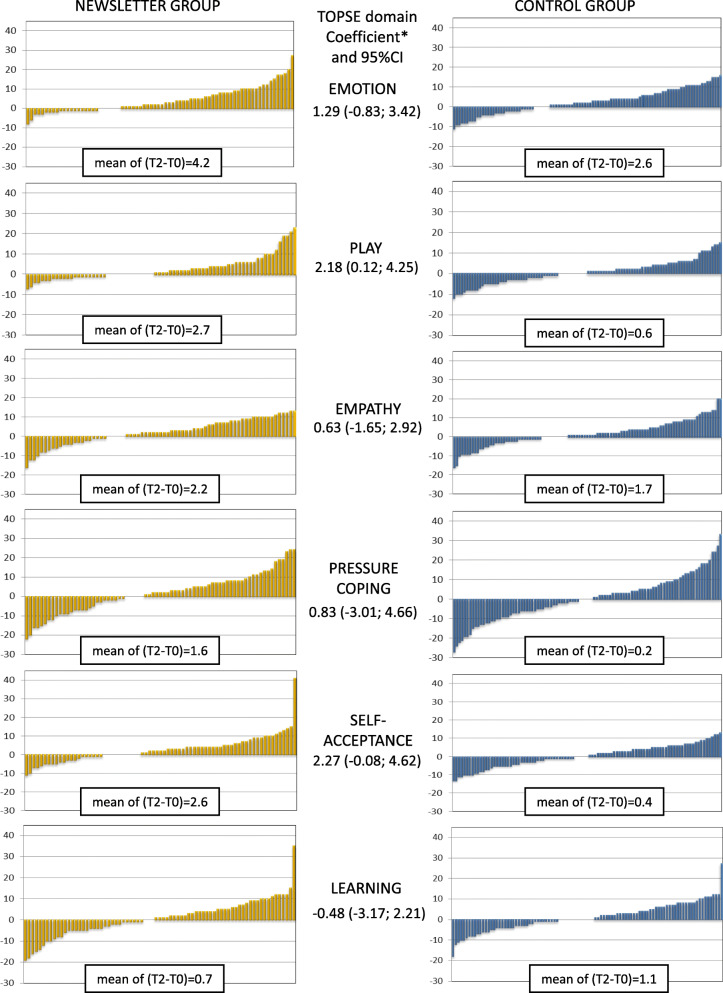
RESULTS /FINDINGS: One hundred thirty-six families accepted to participate in the study. Scores at 12 months were higher than 1 week after delivery in both groups for all TOPSE domains. The improvement was slightly stronger in the Newsletter group for almost all the skills except learning and knowledge [difference in the mean of variation: -0.48 (95% CI: - 3.17; 2.21)]; the difference was significant only for play and enjoyment [2.18 (95% CI: 0.12; 4.25)]. The increase in scores in almost all domains was more pronounced for parents with high education level at first child.
The intervention was effective in improving parents' ability to play. However, it risks worsening existing differences between parents with high and with low education levels.
Clinical trial registration: NCT03268408 .
父母的预期指导常用于提高育儿技能。本前瞻性干预对照研究的目的是评估定期育儿通讯对育儿自我效能的影响,该通讯提供育儿和儿童发展建议。
这是一项非随机的前瞻性干预对照研究。所有 2014 年 9 月至 2015 年 12 月期间在意大利 S. Ilario d'Enza 市出生的儿童的父母均收到了 8 期育儿通讯。同一卫生区其他城市的父母为对照组。语言障碍或有早产或住院儿童的父母被排除在外。在两次疫苗接种预约时,通过育儿自我效能工具(TOPSE)问卷在分娩后第一周(t0)和 5 个月(t1)和 12 个月(t2)测量育儿自我效能的改善情况。每个 TOPSE 调查的八个领域都计算了 0 到 60 的得分。在两组中,比较分娩和 12 个月时每个 TOPSE 评分的变化,调整了胎次、教育程度、父母年龄和孩子性别,并按胎次和教育程度分层。
结果/发现:136 个家庭接受了研究。在两组中,12 个月时的评分均高于分娩后第一周的评分,TOPSE 的所有领域都是如此。在除学习和知识外的几乎所有技能方面,通讯组的改善幅度都略大[差异的平均变化:-0.48(95%CI:-3.17;2.21)];差异仅在游戏和娱乐方面显著[2.18(95%CI:0.12;4.25)]。在大多数领域,对于第一个孩子受过高等教育的父母,分数的增加更为明显。
干预措施在提高父母的游戏能力方面是有效的。然而,它有可能加剧高教育水平和低教育水平父母之间的现有差异。
临床试验注册:NCT03268408。