Department of Ultrasonography, The First Affiliated Hospital of Zhejiang Chinese Medical University (Zhejiang Provincial Hospital of Traditional Chinese Medicine), Hangzhou, Zhejiang, China (mainland).
Department of Emergency Medicine, Tongde Hospital of Zhejiang Province, Hangzhou, Zhejiang, China (mainland).
Med Sci Monit. 2020 Sep 7;26:e926443. doi: 10.12659/MSM.926443.
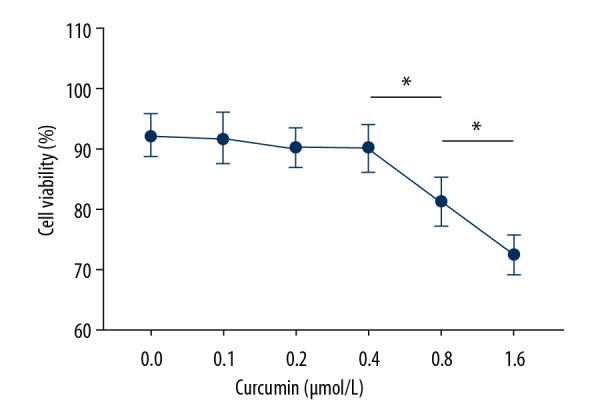
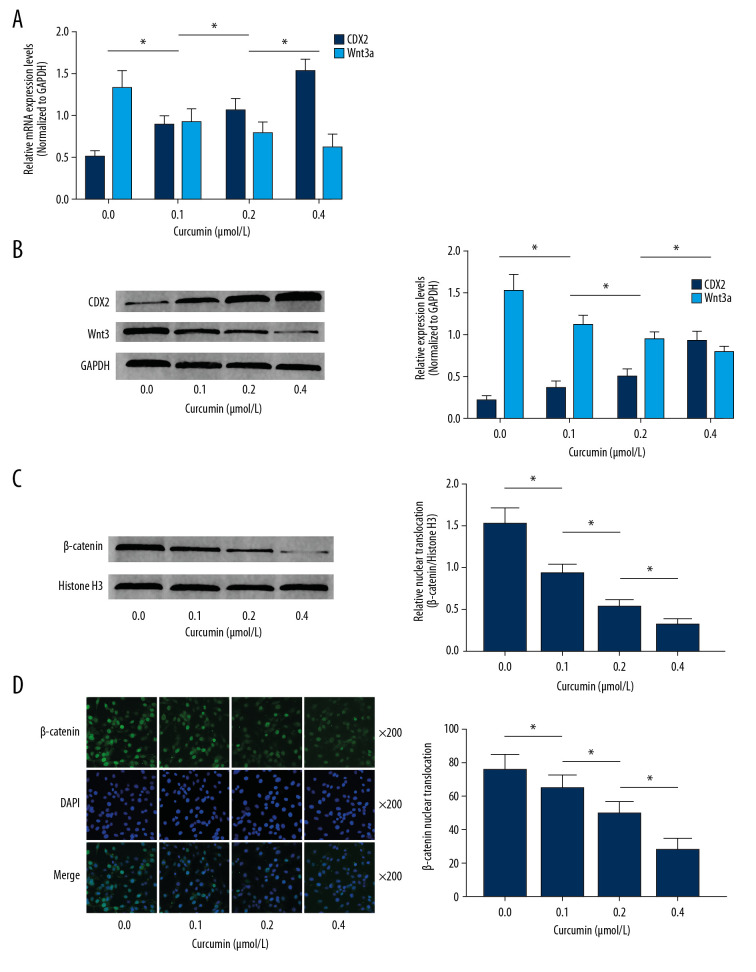
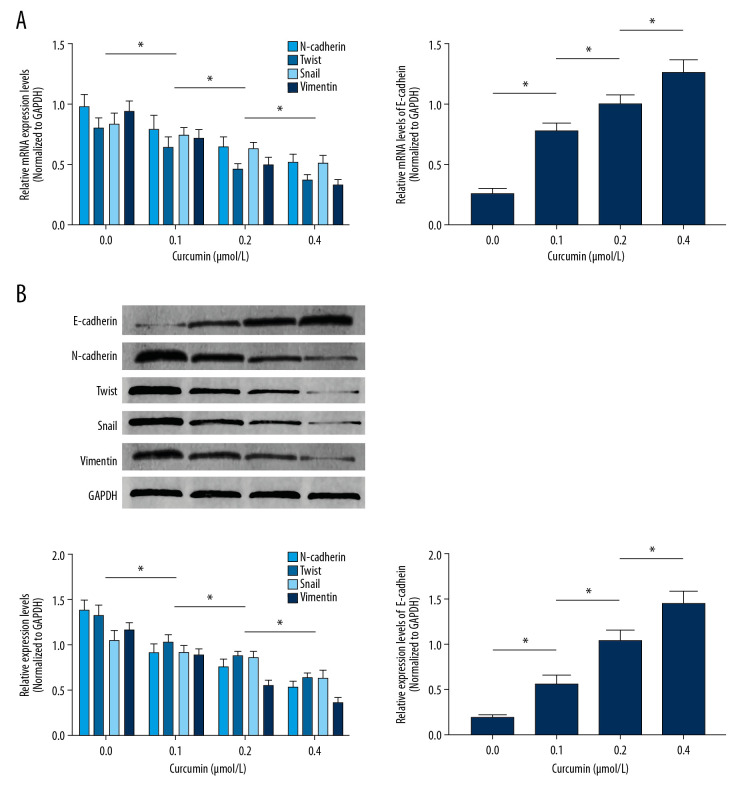
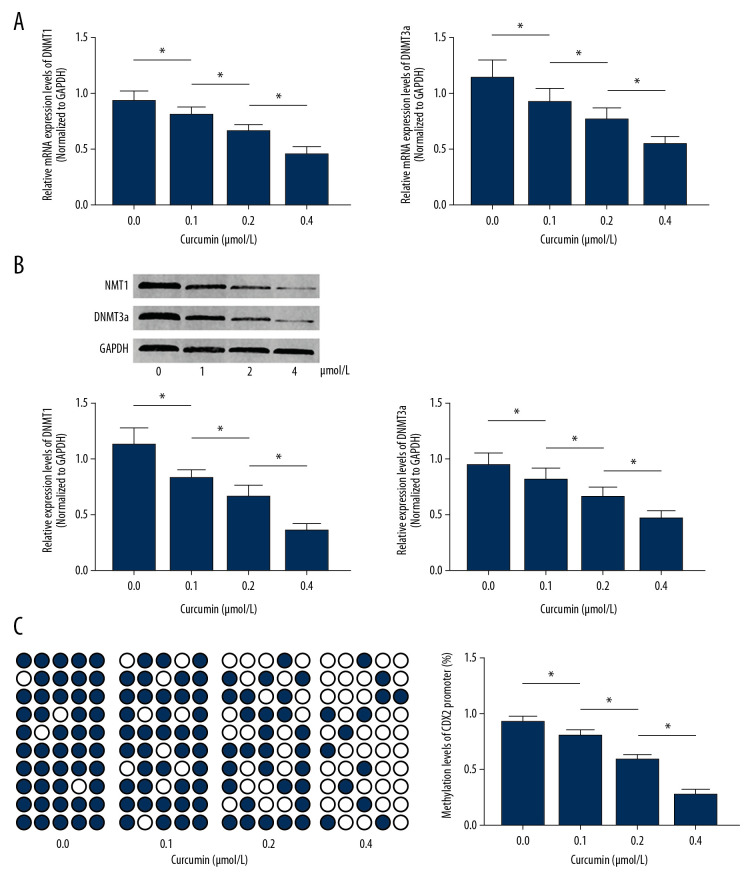
BACKGROUND Curcumin is a component of Curcuma longa with various biological activities. The present study aimed to investigate curcumin's inhibitory effects on epithelial-mesenchymal transition (EMT) in colorectal cancer (CRC) cells and possible mechanisms of action underlying these effects. MATERIAL AND METHODS Human SW480 CRC cells were incubated with curcumin at 0.1, 0.2, 0.4, 0.8, or 1.6 μmol/L. The 3-(4,5-Dimethylthiazol-2-Yl)-2,5-Diphenyltetrazolium Bromide (MTT) assay was utilized to evaluate cell viabilities. The DNA methylation levels of the cdx2 promoter were assessed by bisulfite sequencing polymerase chain reaction (BSP). Real-time quantitative PCR was used to measure the mRNA expression levels. Protein expression levels were evaluated with western blotting. Immunofluorescence staining was used to evaluate the nuclear translocation of ß-catenin. RESULTS Curcumin concentrations of 0.1, 0.2, and 0.4 μmol/L showed no significant association with the viability of SW480 cells, which were chosen for subsequent experiments. Curcumin incubation significantly downregulated expression levels of DNA methyltransferase1 (DNMT1), DNMT3a, and the methylation levels of the cdx2 promoter in a concentration-dependent manner. The expression levels of N-cadherin, Vimentin, Wnt3a, Snail1, and Twist, as well as the nuclear translocation levels of ß-catenin, were reduced in a curcumin concentration-dependent manner. The expression levels of E-cadherin were increased in a curcumin concentration-dependent manner. CONCLUSIONS Curcumin negatively regulated transcription factors promoting EMT in CRC cells by decreasing cdx2 promoter DNA methylation and consequently suppressing the CDX2/Wnt3a/ß-catenin signaling pathway.
姜黄素是姜黄的一种成分,具有多种生物活性。本研究旨在探讨姜黄素对结直肠癌细胞上皮-间充质转化(EMT)的抑制作用及其作用机制。
用 0.1、0.2、0.4、0.8 或 1.6μmol/L 姜黄素孵育人 SW480 结直肠癌细胞。采用 3-(4,5-二甲基噻唑-2-基)-2,5-二苯基四氮唑溴盐(MTT)法检测细胞活力。用亚硫酸氢盐测序聚合酶链反应(BSP)检测 cdx2 启动子的 DNA 甲基化水平。实时定量 PCR 检测 mRNA 表达水平。用 Western blot 检测蛋白表达水平。免疫荧光染色检测 β-catenin 的核转位。
浓度为 0.1、0.2 和 0.4μmol/L 的姜黄素与 SW480 细胞活力无显著相关性,选择其用于后续实验。姜黄素孵育以浓度依赖性方式显著下调 DNA 甲基转移酶 1(DNMT1)、DNMT3a 和 cdx2 启动子的甲基化水平。N-钙黏蛋白、波形蛋白、Wnt3a、Snail1 和 Twist 的表达水平以及 β-catenin 的核转位水平均呈浓度依赖性降低,E-钙黏蛋白的表达水平呈浓度依赖性增加。
姜黄素通过降低 cdx2 启动子 DNA 甲基化,负调控 EMT 促进因子,从而抑制 CDX2/Wnt3a/β-catenin 信号通路,下调 CRC 细胞中 EMT 相关转录因子的表达。