Kennel Club Genetics Centre, Animal Health Trust, Lanwades Park, Newmarket, Suffolk, CB8 7UU, UK.
Department of Veterinary Medicine, University of Cambridge, Cambridge, CB3 0ES, UK.
BMC Genet. 2020 Sep 7;21(1):100. doi: 10.1186/s12863-020-00911-w.
Canine progressive retinal atrophies are a group of hereditary retinal degenerations in dogs characterised by depletion of photoreceptor cells in the retina, which ultimately leads to blindness. PRA in the Lhasa Apso (LA) dog has not previously been clinically characterised or described in the literature, but owners in the UK are advised to have their dog examined through the British Veterinary Association/ Kennel Club/ International Sheep Dog Society (BVA/KC/ISDS) eye scheme annually, and similar schemes that are in operation in other countries. After the exclusion of 25 previously reported canine retinal mutations in LA PRA-affected dogs, we sought to identify the genetic cause of PRA in this breed.
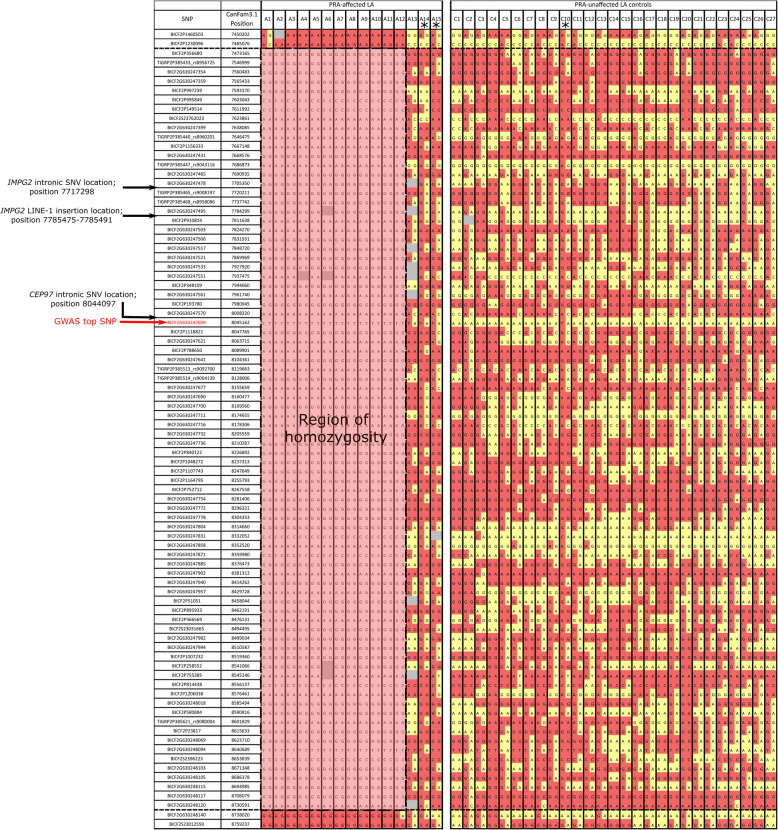
Analysis of whole-exome sequencing data of three PRA-affected LA and three LA without signs of PRA did not identify any exonic or splice site variants, suggesting the causal variant was non-exonic. We subsequently undertook a genome-wide association study (GWAS), which identified a 1.3 Mb disease-associated region on canine chromosome 33, followed by whole-genome sequencing analysis that revealed a long interspersed element-1 (LINE-1) insertion upstream of the IMPG2 gene. IMPG2 has previously been implicated in human retinal disease; however, until now no canine PRAs have been associated with this gene. The identification of this PRA-associated variant has enabled the development of a DNA test for this form of PRA in the breed, here termed PRA4 to distinguish it from other forms of PRA described in other breeds. This test has been used to determine the genotypes of over 900 LA dogs. A large cohort of genotyped dogs was used to estimate the allele frequency as between 0.07-0.1 in the UK LA population.
Through the use of GWAS and subsequent sequencing of a PRA case, we have identified a LINE-1 insertion in the retinal candidate gene IMPG2 that is associated with a form of PRA in the LA dog. Validation of this variant in 447 dogs of 123 breeds determined it was private to LA dogs. We envisage that, over time, the developed DNA test will offer breeders the opportunity to avoid producing dogs affected with this form of PRA.
犬进行性视网膜萎缩症是一组犬的遗传性视网膜退行性疾病,其特征是视网膜感光细胞耗竭,最终导致失明。拉萨犬(LA)的 PRA 以前并未在临床上进行特征描述或在文献中进行描述,但英国的所有者建议每年通过英国兽医协会/养犬俱乐部/国际牧羊犬协会(BVA/KC/ISDS)眼科计划,以及在其他国家运作的类似计划对其狗进行检查。在排除了 25 种先前报道的拉萨犬 PRA 相关犬的视网膜突变后,我们试图确定该品种 PRA 的遗传原因。
对 3 只 PRA 受影响的 LA 和 3 只无 PRA 迹象的 LA 的全外显子组测序数据进行分析,未发现任何外显子或剪接位点变异,提示致病变异是非外显子的。随后,我们进行了全基因组关联研究(GWAS),该研究确定了犬 33 号染色体上一个 1.3Mb 的疾病相关区域,随后进行了全基因组测序分析,揭示了 IMPG2 基因上游的长散布元件-1(LINE-1)插入。IMPG2 先前与人类视网膜疾病有关;然而,到目前为止,没有犬 PRA 与该基因有关。这种 PRA 相关变体的鉴定使我们能够在该品种中开发出一种用于这种形式 PRA 的 DNA 测试,在这里称为 PRA4,以将其与其他品种描述的其他形式 PRA 区分开来。该测试已用于确定 900 多只 LA 犬的基因型。使用大量经基因分型的犬来估计英国 LA 种群中的等位基因频率在 0.07-0.1 之间。
通过使用 GWAS 以及随后对 PRA 病例进行测序,我们在候选视网膜基因 IMPG2 中发现了一个与 LA 犬 PRA 相关的 LINE-1 插入。在 123 个品种的 447 只狗中验证了该变体,发现它是 LA 犬特有的。我们预计,随着时间的推移,开发的 DNA 测试将为饲养者提供避免生产受这种形式 PRA 影响的狗的机会。