Department of Industrial & Systems Engineering, Khalifa University, Abu Dhabi, 127788, United Arab Emirates.
Department of Electrical Engineering and Computer Science, Khalifa University, Abu Dhabi, 127788, United Arab Emirates.
BMC Med Res Methodol. 2020 Sep 7;20(1):224. doi: 10.1186/s12874-020-01109-5.
Clinical Trials (CTs) help in testing and validating the safety and efficacy of newly discovered drugs on specific patient population cohorts. However, these trials usually experience many challenges, such as extensive time frames, high financial cost, regulatory and administrative barriers, and insufficient workforce. In addition, CTs face several data management challenges pertaining to protocol compliance, patient enrollment, transparency, traceability, data integrity, and selective reporting. Blockchain can potentially address such challenges because of its intrinsic features and properties. Although existing literature broadly discusses the applicability of blockchain-based solutions for CTs, only a few studies present their working proof-of-concept.
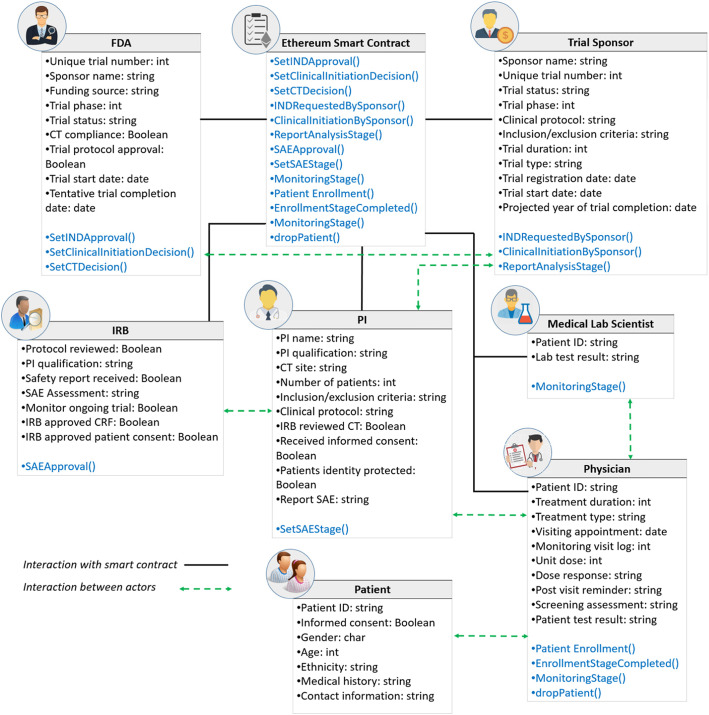
We propose a blockchain-based framework for CT data management, using Ethereum smart contracts, which employs IPFS as the file storage system to automate processes and information exchange among CT stakeholders. CT documents stored in the IPFS are difficult to tamper with as they are given unique cryptographic hashes. We present algorithms that capture various stages of CT data management. We develop the Ethereum smart contract using Remix IDE that is validated under different scenarios.
The proposed framework results are advantageous to all stakeholders ensuring transparency, data integrity, and protocol compliance. Although the proposed solution is tested on the Ethereum blockchain platform, it can be deployed in private blockchain networks using their native smart contract technologies. We make our smart contract code publicly available on Github.
We conclude that the proposed framework can be highly effective in ensuring that the trial abides by the protocol and the functions are executed only by the stakeholders who are given permission. It also assures data integrity and promotes transparency and traceability of information among stakeholders.
临床试验(CT)有助于在特定患者人群队列中测试和验证新发现药物的安全性和有效性。然而,这些试验通常会遇到许多挑战,例如时间框架长、财务成本高、监管和行政障碍以及劳动力不足。此外,临床试验还面临着一些数据管理挑战,涉及协议遵守、患者入组、透明度、可追溯性、数据完整性和选择性报告。区块链由于其固有特性和属性,有可能解决这些挑战。尽管现有文献广泛讨论了基于区块链的解决方案在临床试验中的适用性,但只有少数研究提出了其工作概念验证。
我们提出了一种基于区块链的临床试验数据管理框架,使用以太坊智能合约,并使用 IPFS 作为文件存储系统,以自动化临床试验利益相关者之间的流程和信息交换。存储在 IPFS 中的临床试验文档由于具有独特的加密哈希值,因此难以篡改。我们提出了捕获临床试验数据管理各个阶段的算法。我们使用 Remix IDE 开发了以太坊智能合约,并在不同场景下进行了验证。
所提出的框架对所有利益相关者都有利,确保了透明度、数据完整性和协议遵守。尽管所提出的解决方案是在以太坊区块链平台上进行测试的,但它可以在使用其本地智能合约技术的私有区块链网络中部署。我们将智能合约代码公开在 Github 上。
我们得出结论,所提出的框架可以非常有效地确保试验遵守协议,并且只有获得授权的利益相关者才能执行这些功能。它还确保了数据的完整性,并促进了利益相关者之间信息的透明度和可追溯性。