Department of Physiology, Michigan State University, East Lansing, MI, USA.
Department of Neuroscience, Icahn School of Medicine, Mount Sinai, New York, NY, USA.
Nat Commun. 2020 Sep 8;11(1):4484. doi: 10.1038/s41467-020-17825-x.
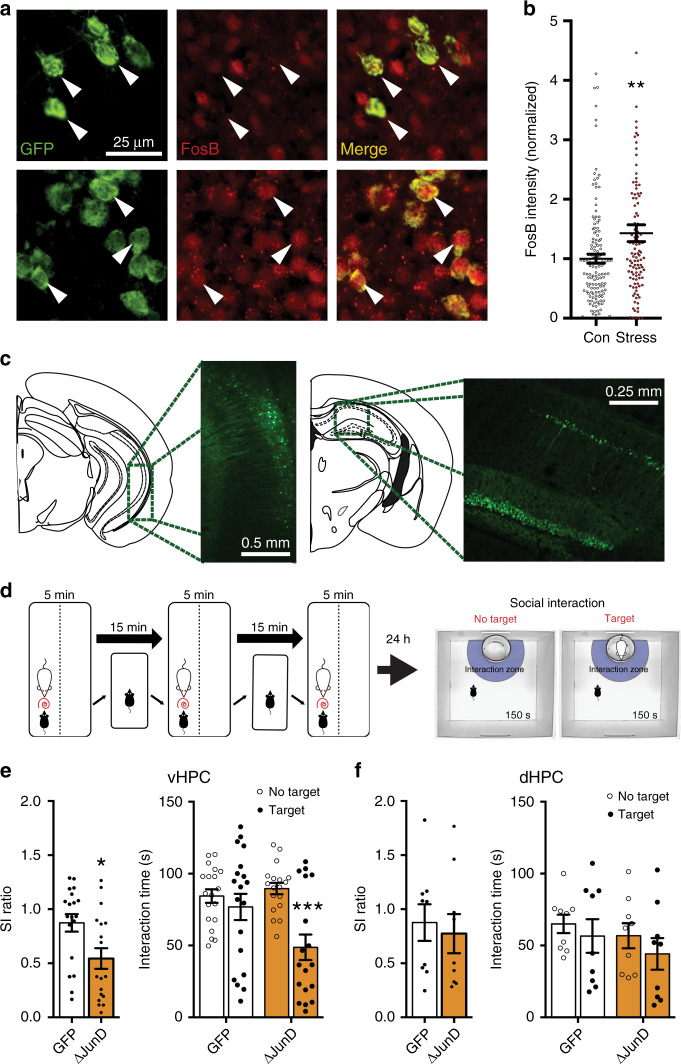
Chronic stress is a key risk factor for mood disorders like depression, but the stress-induced changes in brain circuit function and gene expression underlying depression symptoms are not completely understood, hindering development of novel treatments. Because of its projections to brain regions regulating reward and anxiety, the ventral hippocampus is uniquely poised to translate the experience of stress into altered brain function and pathological mood, though the cellular and molecular mechanisms of this process are not fully understood. Here, we use a novel method of circuit-specific gene editing to show that the transcription factor ΔFosB drives projection-specific activity of ventral hippocampus glutamatergic neurons causing behaviorally diverse responses to stress. We establish molecular, cellular, and circuit-level mechanisms for depression- and anxiety-like behavior in response to stress and use circuit-specific gene expression profiling to uncover novel downstream targets as potential sites of therapeutic intervention in depression.
慢性应激是情绪障碍(如抑郁症)的一个关键风险因素,但导致抑郁症状的大脑回路功能和基因表达的应激诱导变化尚不完全清楚,这阻碍了新疗法的开发。由于其投射到调节奖励和焦虑的大脑区域,腹侧海马体具有独特的优势,可以将压力体验转化为改变的大脑功能和病理性情绪,尽管这一过程的细胞和分子机制尚不完全清楚。在这里,我们使用一种新的特定回路基因编辑方法表明,转录因子 ΔFosB 驱动腹侧海马体谷氨酸能神经元的投射特异性活性,导致对压力的行为反应多样化。我们建立了应激反应下抑郁和焦虑样行为的分子、细胞和回路水平机制,并使用特定回路的基因表达谱分析来揭示潜在的治疗干预靶点,作为治疗抑郁症的潜在靶点。