Center for Clinical Management Research, VA Ann Arbor Healthcare System, Ann Arbor, MI, USA.
National Center for Health Promotion and Disease Prevention, Veterans Health Administration, Washington, DC, USA.
J Gen Intern Med. 2021 Feb;36(2):288-295. doi: 10.1007/s11606-020-06133-1. Epub 2020 Sep 8.
Integrating evidence-based innovations (EBIs) into sustained use is challenging; most implementations in health systems fail. Increasing frontline teams' quality improvement (QI) capability may increase the implementation readiness and success of EBI implementation.
Develop a QI training program ("Learn. Engage. Act. Process." (LEAP)) and evaluate its impact on frontline obesity treatment teams to improve treatment delivered within the Veterans Health Administration (VHA).
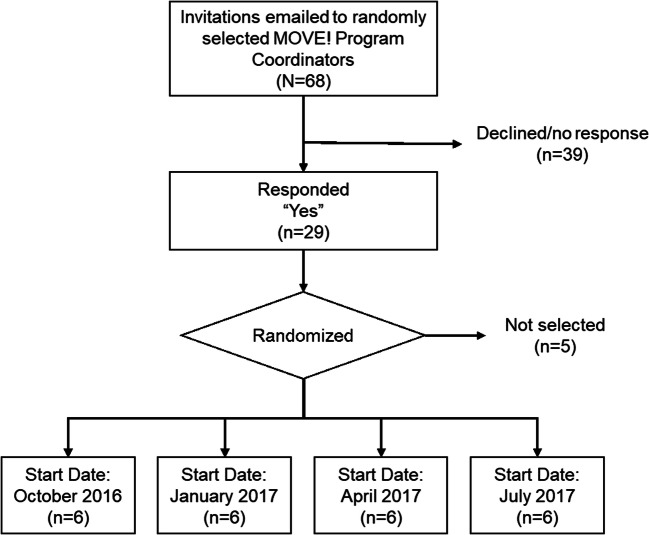
This was a pre-post evaluation of the LEAP program. MOVE! coordinators (N = 68) were invited to participate in LEAP; 24 were randomly assigned to four starting times. MOVE! coordinators formed teams to work on improvement aims. Pre-post surveys assessed team organizational readiness for implementing change and self-rated QI skills. Program satisfaction, assignment completion, and aim achievement were also evaluated.
VHA facility-based MOVE! teams.
LEAP is a 21-week QI training program. Core components include audit and feedback reports, structured curriculum, coaching and learning community, and online platform.
Organizational readiness for implementing change (ORIC); self-rated QI skills before and after LEAP; assignment completion and aim achievement; program satisfaction.
Seventeen of 24 randomized teams participated in LEAP. Participants' self-ratings across six categories of QI skills increased after completing LEAP (p< 0.0001). The ORIC measure showed no statistically significant change overall; the change efficacy subscale marginally improved (p < 0.08), and the change commitment subscale remained the same (p = 0.66). Depending on the assignment, 35 to 100% of teams completed the assignment. Nine teams achieved their aim. Most team members were satisfied or very satisfied (81-89%) with the LEAP components, 74% intended to continue using QI methods, and 81% planned to continue improvement work.
LEAP is scalable and does not require travel or time away from clinical responsibilities. While QI skills improved among participating teams and most completed the work, they struggled to do so amid competing clinical priorities.
将循证创新(EBI)融入持续使用具有挑战性;大多数卫生系统的实施都以失败告终。提高一线团队的质量改进(QI)能力可能会提高 EBI 实施的实施准备度和成功率。
开发一个 QI 培训计划(“学习。参与。行动。处理。”(LEAP)),并评估其对退伍军人健康管理局(VHA)内前线肥胖治疗团队的影响,以改善治疗效果。
这是 LEAP 计划的预-后评估。MOVE!协调员(N = 68)受邀参加 LEAP;24 人被随机分配到四个起始时间。MOVE!协调员组成团队以实现改进目标。预-后调查评估了团队实施变革的组织准备情况和自我评估的质量改进技能。还评估了计划满意度、任务完成情况和目标实现情况。
VHA 基于设施的 MOVE!团队。
LEAP 是一个 21 周的 QI 培训计划。核心组件包括审计和反馈报告、结构化课程、辅导和学习社区以及在线平台。
实施变革的组织准备就绪(ORIC);LEAP 前后自我评估的 QI 技能;任务完成情况和目标实现情况;计划满意度。
24 个随机团队中的 17 个参加了 LEAP。参与者在完成 LEAP 后,在六个类别的 QI 技能方面的自我评分均有所提高(p<0.0001)。ORIC 测量值总体上没有统计学意义上的变化;变化效能子量表略有改善(p < 0.08),而变化承诺子量表保持不变(p = 0.66)。根据任务的不同,35%至 100%的团队完成了任务。九个团队实现了目标。大多数团队成员对 LEAP 组件非常满意或满意(81%-89%),74%的人打算继续使用 QI 方法,81%的人计划继续改进工作。
LEAP 具有可扩展性,不需要旅行或离开临床职责。虽然参与团队的 QI 技能有所提高,并且大多数团队都完成了工作,但他们在应对竞争激烈的临床优先事项时仍难以完成。