Dai Na, Yang Chunyan, Fan Qing, Wang Minmin, Liu Xiaoyue, Zhao Haizhao, Zhao Cuifen
Department of Pediatrics, Qilu Hospital, Shandong University, Jinan, China.
Department of Pediatrics, Jinan Maternity and Child Care Hospital, Jinan, China.
Front Pediatr. 2020 Aug 12;8:451. doi: 10.3389/fped.2020.00451. eCollection 2020.
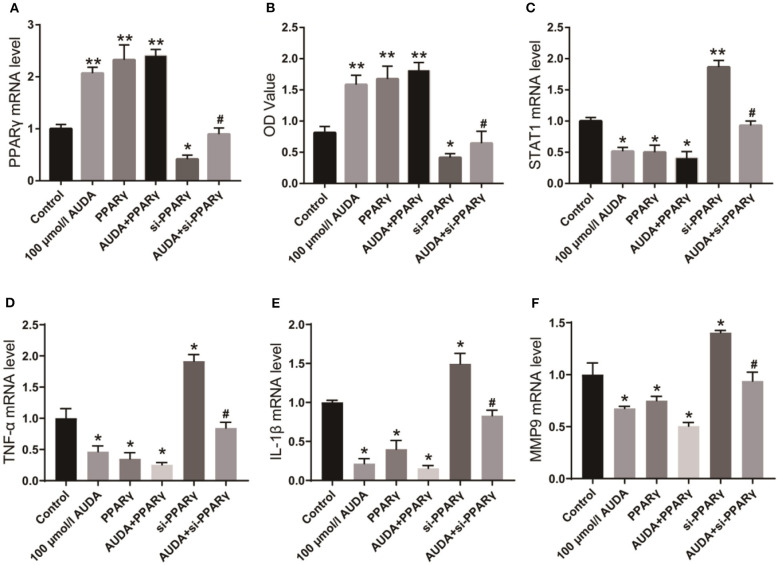
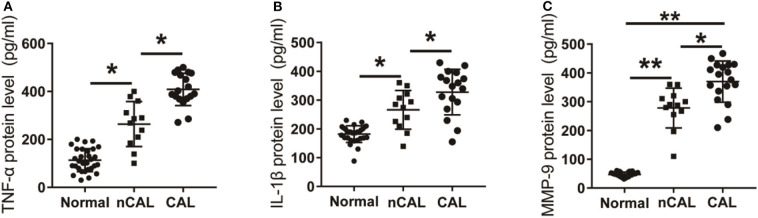
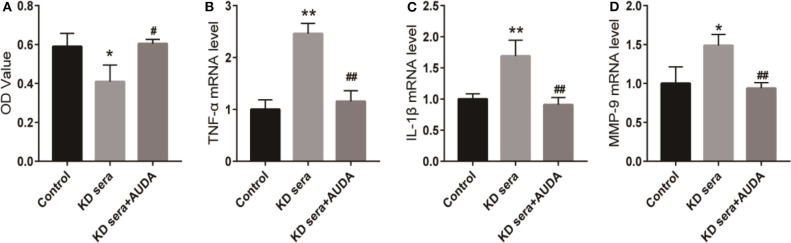
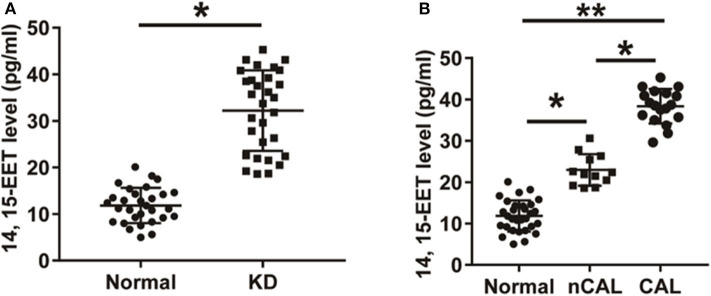
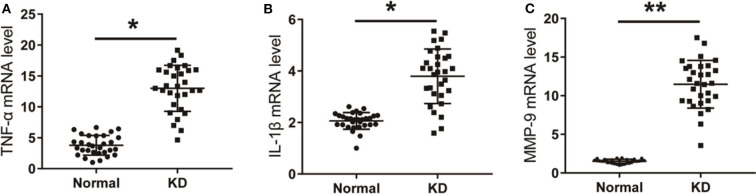
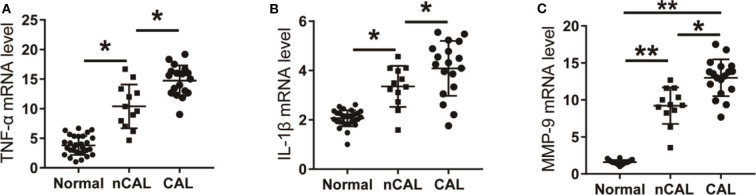
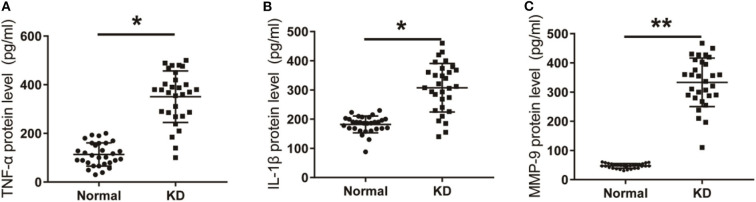
Soluble epoxide hydrolase (sEH) is responsible for rapid degradation of 14, 15-EET, which is one of the isomers of EETs and plays an important role in cardiovascular diseases. In this study, we investigated the mechanism by which sEH inhibitor AUDA played an anti-inflammatory effect in HCAECs. Our results indicated that AUDA treatment promoted PPARγ expression, while knockdown of PPARγ blocked the cell growth and STAT1 expression inhibition induced by 100 μmol/L AUDA in HCAECs. AUDA also inhibited the overexpression of TNF-α, IL-1 β, and MMP-9 induced by KD sera in HCAECs. Moreover, 30 blood samples from children with Kawasaki disease (KD) were collected with 30 healthy children as the control group. QPCR and ELISA assays were used to detect the level of 14, 15-EET, TNF-α, IL-1β, and MMP-9. We found that the level of 14, 15-EET was higher in peripheral blood of children with KD compared with healthy controls ( < 0.05). In comparison to KD children with non-coronary artery lesion (nCAL), the level of 14, 15-EET was higher in peripheral blood of KD children with coronary artery lesion (CAL) ( < 0.05). Compared with healthy control group, the expression levels of TNF-α, IL-1β, and MMP-9 in patients with KD were significantly up-regulated. Compared with nCAL KD children, the expression levels of TNF-α, IL-1β, and MMP-9 in CAL children were abnormally high ( < 0.05). Our study indicated that AUDA played an anti-inflammatory effect in HCAECs through PPARγ/STAT1 signaling pathway, and 14, 15-EET is up-regulated in children with KD, suggesting that 14, 15-EET involved in the progression of KD.
可溶性环氧化物水解酶(sEH)负责14,15-环氧二十碳三烯酸(14,15-EET)的快速降解,14,15-EET是环氧二十碳三烯酸(EETs)的异构体之一,在心血管疾病中起重要作用。在本研究中,我们探究了sEH抑制剂AUDA在人冠状动脉内皮细胞(HCAECs)中发挥抗炎作用的机制。我们的结果表明,AUDA处理可促进过氧化物酶体增殖物激活受体γ(PPARγ)表达,而敲低PPARγ可阻断100μmol/L AUDA诱导的HCAECs细胞生长抑制和信号转导与转录激活因子1(STAT1)表达抑制。AUDA还可抑制川崎病(KD)患者血清诱导的HCAECs中肿瘤坏死因子-α(TNF-α)、白细胞介素-1β(IL-1β)和基质金属蛋白酶-9(MMP-9)的过表达。此外,收集了30例KD患儿的血样,并以30例健康儿童作为对照组。采用实时定量聚合酶链反应(QPCR)和酶联免疫吸附测定(ELISA)法检测14,15-EET、TNF-α、IL-1β和MMP-9的水平。我们发现,与健康对照组相比,KD患儿外周血中14,15-EET水平较高(<0.05)。与非冠状动脉病变(nCAL)的KD患儿相比,冠状动脉病变(CAL)的KD患儿外周血中14,15-EET水平更高(<0.05)。与健康对照组相比,KD患者中TNF-α、IL-1β和MMP-9的表达水平显著上调。与nCAL的KD患儿相比,CAL患儿中TNF-α、IL-1β和MMP-9的表达水平异常升高(<0.05)。我们的研究表明,AUDA通过PPARγ/STAT1信号通路在HCAECs中发挥抗炎作用,且KD患儿中14,15-EET上调,提示14,15-EET参与了KD的进展。