Moreno-Duarte Ingrid, Ghadimi Kamrouz
Department of Anesthesiology & Critical Care, Duke University School of Medicine, DUMC Box 3094, Durham, NC 27710 USA.
Curr Anesthesiol Rep. 2020;10(4):501-511. doi: 10.1007/s40140-020-00405-6. Epub 2020 Aug 29.
This review will illustrate the importance of heparin-induced thrombocytopenia in the intraoperative and critical care settings.
Heparin-induced thrombocytopenia (HIT) occurs more frequently in surgical patients compared with medical patients due to the inflammatory release of platelet factor 4 and perioperative heparin exposure. Recognition of this disease requires a high index of suspicion. Diagnostic tools and therapeutic strategies have been expanded and refined in recent years.
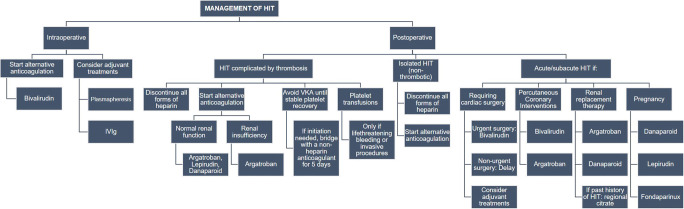
HIT is a condition where antibodies against the heparin/platelet factor 4 complex interact with platelet receptors to promote platelet activation, aggregation, and thrombus formation. Our review will focus on intraoperative and postoperative considerations related to HIT to help the clinician better manage this rare but often devastating hypercoagulable disease process.
本综述将阐述肝素诱导的血小板减少症在术中及重症监护环境中的重要性。
与内科患者相比,外科患者因血小板因子4的炎性释放和围手术期肝素暴露,肝素诱导的血小板减少症(HIT)更为常见。认识这种疾病需要高度的怀疑指数。近年来,诊断工具和治疗策略已得到扩展和完善。
HIT是一种针对肝素/血小板因子4复合物的抗体与血小板受体相互作用以促进血小板活化、聚集和血栓形成的病症。我们的综述将聚焦于与HIT相关的术中及术后注意事项,以帮助临床医生更好地管理这种罕见但往往具有破坏性的高凝疾病过程。