Department of Medical and Surgical Sciences, Nephrology Dialysis and Transplantation Unit, University of Foggia, Foggia, Italy.
Department of Emergency and Organ Transplantation, Nephrology, Dialysis and Transplantation Unit, University of Bari "A. Moro," Bari, Italy.
Clin J Am Soc Nephrol. 2020 Oct 7;15(10):1474-1483. doi: 10.2215/CJN.02870320. Epub 2020 Sep 9.
Active antibody-mediated rejection is the main cause of kidney transplant loss, sharing with SLE the alloimmune response and the systemic activation of the IFN- pathway. IgE-mediated immune response plays a key role in the development of SLE nephritis and is associated with IFN- secretion. The aim of our study was to investigate IgE-mediated immune response in antibody-mediated rejection.
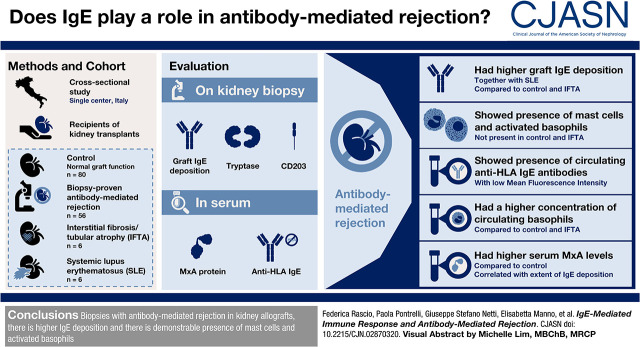
DESIGN, SETTING, PARTICIPANTS, & MEASUREMENTS: This was a cross-sectional study of 56 biopsy-proven antibody-mediated rejection study participants, 80 recipients with normal graft function/histology (control), 16 study participants with interstitial fibrosis/tubular atrophy, and six participants with SLE. We evaluated graft IgE deposition, tryptase (a mast cell marker), and CD203 (a specific marker of activated basophils) by immunofluorescence/confocal microscopy. In addition, we measured serum concentration of human myxovirus resistance protein 1, an IFN-induced protein, and anti-HLA IgE.
We observed a significantly higher IgE deposition in tubules and glomeruli in antibody-mediated rejection (1766±79 pixels) and SLE (1495±43 pixels) compared with interstitial fibrosis/tubular atrophy (582±122 pixels) and control (253±50 pixels). Patients with antibody-mediated rejection, but not control patients and patients with interstitial fibrosis/tubular atrophy, presented circulating anti-HLA IgE antibodies, although with a low mean fluorescence intensity. In addition, immunofluorescence revealed the presence of both mast cells and activated basophils in antibody-mediated rejection but not in control and interstitial fibrosis/tubular atrophy. The concentration of circulating basophils was significantly higher in antibody-mediated rejection compared with control and interstitial fibrosis/tubular atrophy. MxA serum levels were significantly higher in antibody-mediated rejection compared with control and correlated with the extent of IgE deposition.
Our data suggest that IgE deposition and the subsequent recruitment of basophils and mast cells within the kidney transplant might play a role in antibody-mediated rejection.
主动抗体介导的排斥反应是肾移植丢失的主要原因,与系统性红斑狼疮(SLE)共享同种免疫反应和 IFN-途径的全身激活。IgE 介导的免疫反应在狼疮肾炎的发展中起着关键作用,并与 IFN-的分泌有关。我们研究的目的是探讨抗体介导的排斥反应中的 IgE 介导的免疫反应。
设计、设置、参与者和测量方法:这是一项对 56 例经活检证实的抗体介导的排斥反应研究参与者、80 例肾功能/组织学正常的移植受者(对照组)、16 例间质纤维化/肾小管萎缩研究参与者和 6 例系统性红斑狼疮(SLE)患者的横断面研究。我们通过免疫荧光/共聚焦显微镜评估移植物 IgE 沉积、类胰蛋白酶(肥大细胞标志物)和 CD203(活化嗜碱性粒细胞的特异性标志物)。此外,我们测量了人流感病毒耐药蛋白 1(IFN 诱导蛋白)和抗 HLA IgE 的血清浓度。
与间质纤维化/肾小管萎缩(582±122 像素)和对照组(253±50 像素)相比,我们观察到抗体介导的排斥反应(1766±79 像素)和 SLE(1495±43 像素)中肾小管和肾小球中 IgE 沉积显著增加。抗体介导的排斥反应患者存在循环抗 HLA IgE 抗体,尽管平均荧光强度较低,但对照组患者和间质纤维化/肾小管萎缩患者则不存在。此外,免疫荧光显示抗体介导的排斥反应中存在肥大细胞和活化的嗜碱性粒细胞,但对照组和间质纤维化/肾小管萎缩中则不存在。与对照组和间质纤维化/肾小管萎缩相比,抗体介导的排斥反应患者循环嗜碱性粒细胞的浓度显著升高。抗体介导的排斥反应患者的 MxA 血清水平显著高于对照组,并与 IgE 沉积程度相关。
我们的数据表明,IgE 沉积以及随后在肾移植中招募嗜碱性粒细胞和肥大细胞可能在抗体介导的排斥反应中发挥作用。