Edwin L. Steele Laboratories, Department of Radiation Oncology, Massachusetts General Hospital and Harvard Medical School, Boston, MA 02114.
Department of Data Sciences, Dana-Farber Cancer Institute, Boston, MA 02215.
Proc Natl Acad Sci U S A. 2020 Sep 22;117(38):23684-23694. doi: 10.1073/pnas.2002806117. Epub 2020 Sep 9.
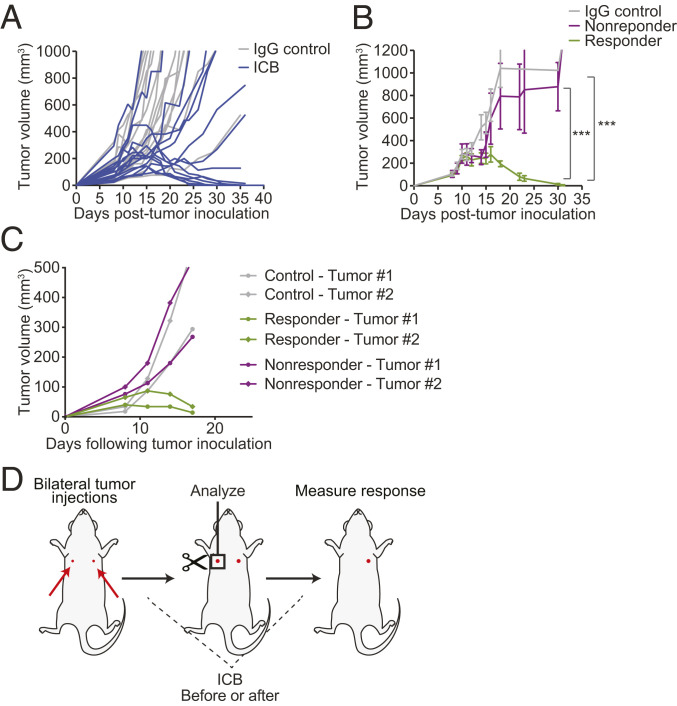
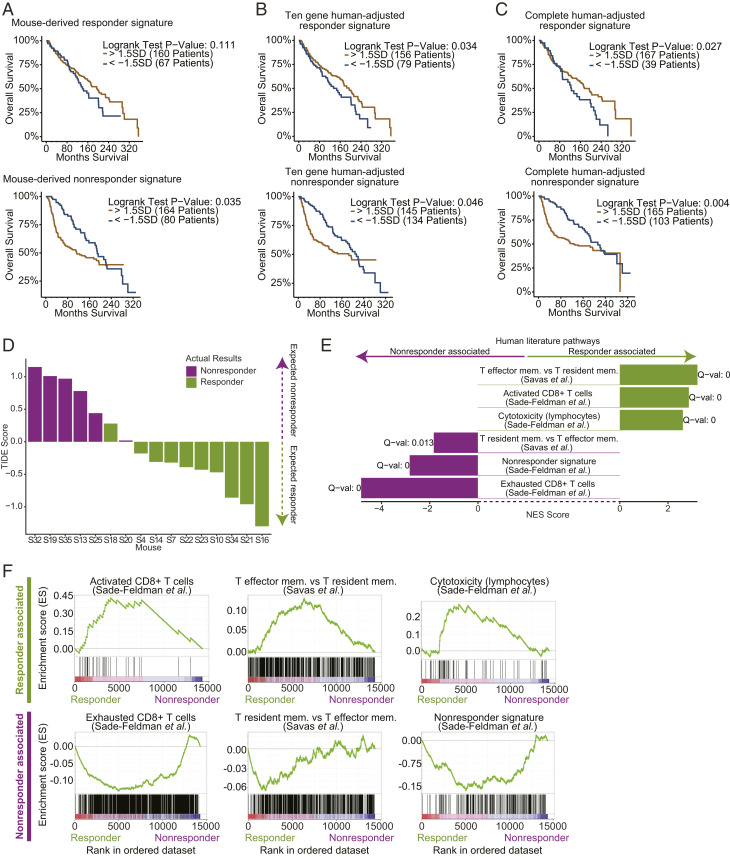
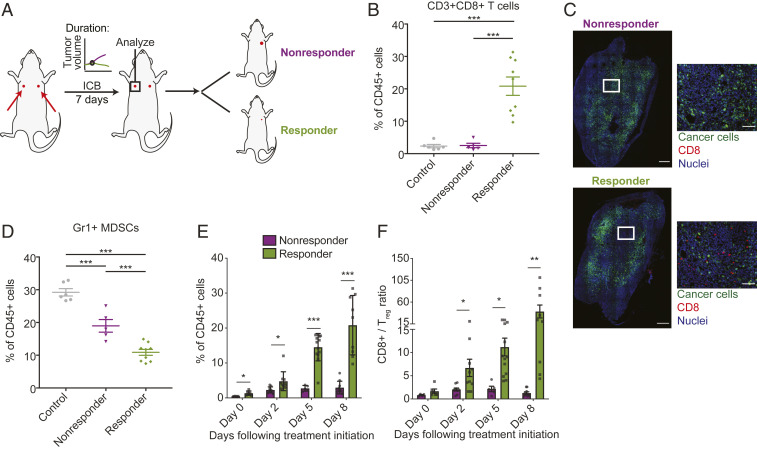
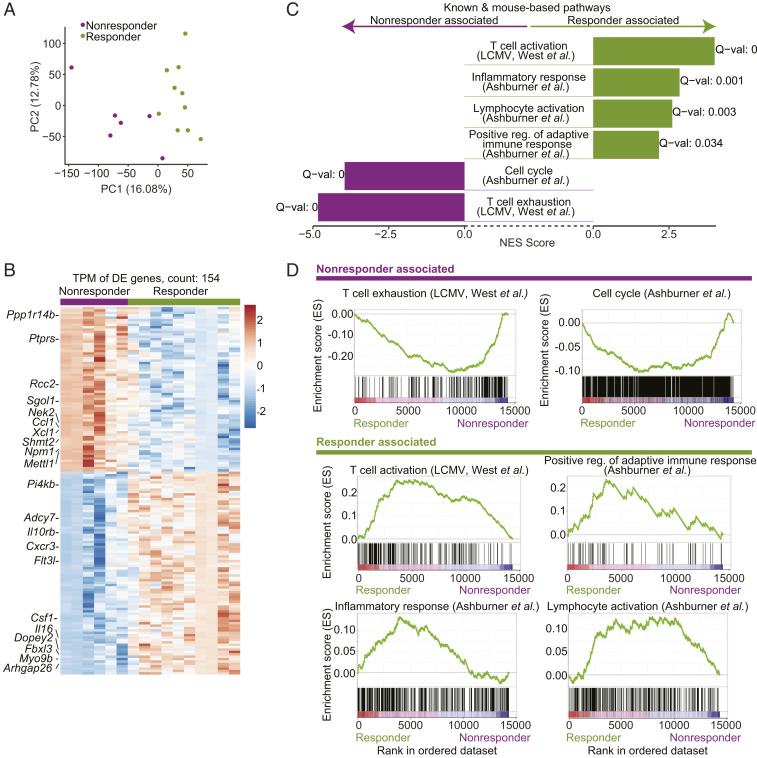
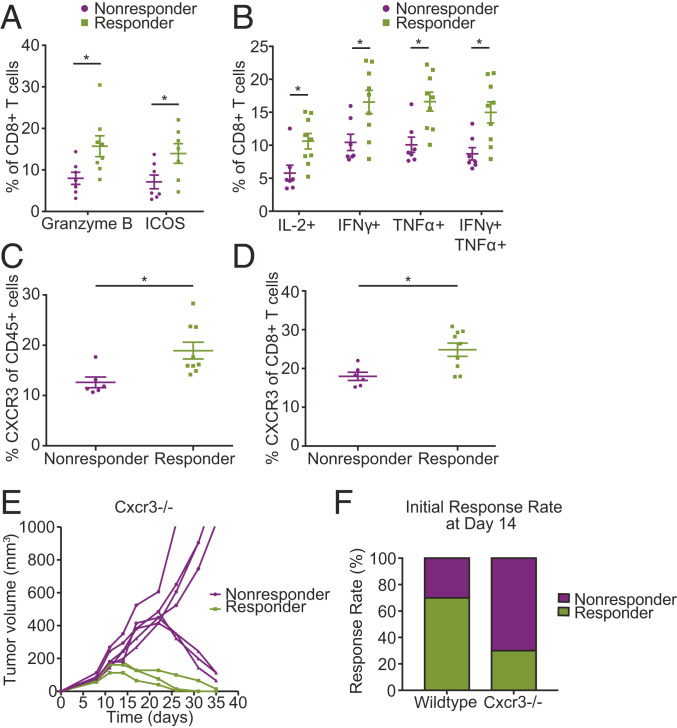
Immune checkpoint blockade (ICB) is efficacious in many diverse cancer types, but not all patients respond. It is important to understand the mechanisms driving resistance to these treatments and to identify predictive biomarkers of response to provide best treatment options for all patients. Here we introduce a resection and response-assessment approach for studying the tumor microenvironment before or shortly after treatment initiation to identify predictive biomarkers differentiating responders from nonresponders. Our approach builds on a bilateral tumor implantation technique in a murine metastatic breast cancer model (E0771) coupled with anti-PD-1 therapy. Using our model, we show that tumors from mice responding to ICB therapy had significantly higher CD8 T cells and fewer Gr1CD11b myeloid-derived suppressor cells (MDSCs) at early time points following therapy initiation. RNA sequencing on the intratumoral CD8 T cells identified the presence of T cell exhaustion pathways in nonresponding tumors and T cell activation in responding tumors. Strikingly, we showed that our derived response and resistance signatures significantly segregate patients by survival and associate with patient response to ICB. Furthermore, we identified decreased expression of CXCR3 in nonresponding mice and showed that tumors grown in mice had an elevated resistance rate to anti-PD-1 treatment. Our findings suggest that the resection and response tumor model can be used to identify response and resistance biomarkers to ICB therapy and guide the use of combination therapy to further boost the antitumor efficacy of ICB.
免疫检查点阻断(ICB)在许多不同类型的癌症中都有效,但并非所有患者都有反应。了解导致这些治疗耐药的机制,并确定反应的预测性生物标志物,为所有患者提供最佳治疗方案,这一点非常重要。在这里,我们介绍了一种在开始治疗前后进行肿瘤微环境切除和反应评估的方法,以确定区分应答者和无应答者的预测性生物标志物。我们的方法基于在小鼠转移性乳腺癌模型(E0771)中进行的双侧肿瘤植入技术,结合抗 PD-1 治疗。使用我们的模型,我们表明,对 ICB 治疗有反应的小鼠肿瘤在治疗开始后早期具有显著更高的 CD8 T 细胞和更少的 Gr1CD11b 髓源抑制细胞(MDSCs)。对肿瘤内 CD8 T 细胞进行 RNA 测序表明,非应答性肿瘤存在 T 细胞衰竭途径,而应答性肿瘤存在 T 细胞激活。引人注目的是,我们发现我们推导的反应和耐药特征显著地根据生存情况将患者分类,并与患者对 ICB 的反应相关联。此外,我们发现非应答性小鼠中 CXCR3 的表达降低,并表明在 小鼠中生长的肿瘤对抗 PD-1 治疗的耐药率升高。我们的研究结果表明,切除和反应肿瘤模型可用于识别 ICB 治疗的反应和耐药生物标志物,并指导联合治疗的使用,以进一步提高 ICB 的抗肿瘤疗效。