Liu Wei, Fan Yihua, Tian Chunying, Jin Yue, Du Shaopeng, Zeng Ping, Wang Aihua
Department of Rheumatism and Immunity, First Teaching Hospital of Tianjin University of Traditional Chinese Medicine, Tianjin 300193, China.
Tianjin University of Traditional Chinese Medicine, Tianjin 301617, China.
Evid Based Complement Alternat Med. 2020 Aug 26;2020:7151634. doi: 10.1155/2020/7151634. eCollection 2020.
Huangqi Guizhi Wuwu Decoction (HGWD) has been applied in the treatment of joint pain for more than 1000 years in China. Currently, most physicians use HGWD to treat rheumatoid arthritis (RA), and it has proved to have high efficacy. Therefore, it is necessary to explore the potential mechanism of action of HGWD in RA treatment based on network pharmacology and molecular docking methods.
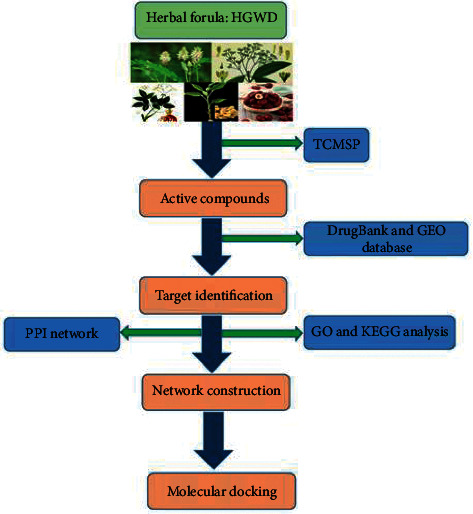
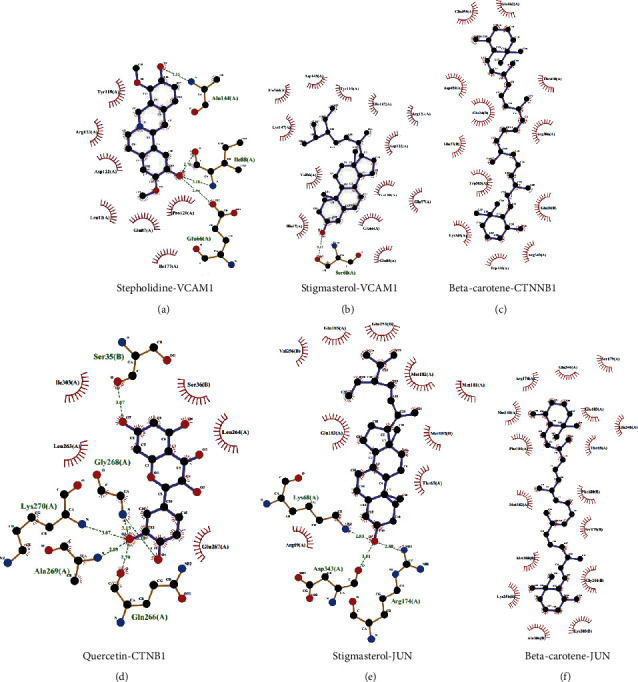
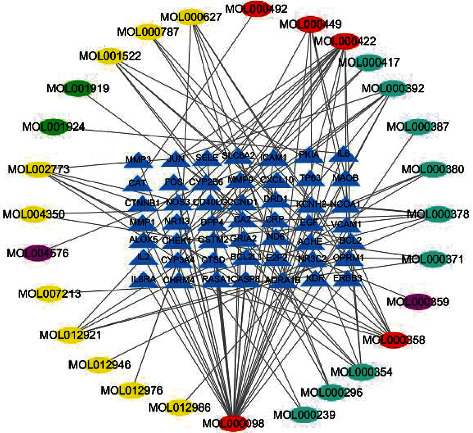
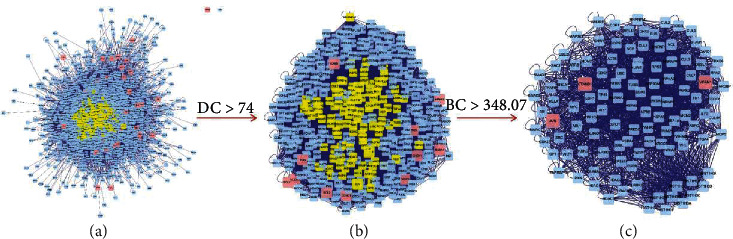
The active compounds of HGWD were collected, and their targets were identified from the Traditional Chinese Medicine Systems Pharmacology Database (TCMSP) and DrugBank database, respectively. The RA-related targets were retrieved by analyzing the differentially expressed genes between RA patients and healthy individuals. Subsequently, the compound-target network of HGWD was constructed and visualized through Cytoscape 3.8.0 software. Protein-protein interaction (PPI) network was constructed to explore the potential mechanisms of HGWD on RA using the plugin BisoGenet of Cytoscape 3.8.0 software. Gene ontology (GO) analysis and Kyoto Encyclopedia of Genes and Genomes (KEGG) were performed in R software (Bioconductor, clusterProfiler). Afterward, molecular docking was used to analyze the binding force of the top 10 active compounds with target proteins of VCAM1, CTNNB1, and JUN.
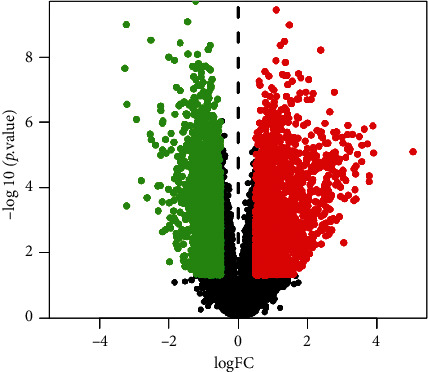
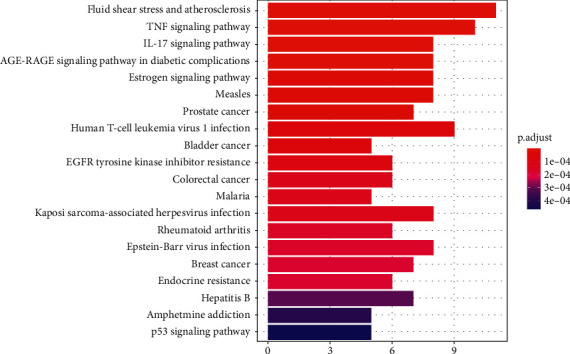
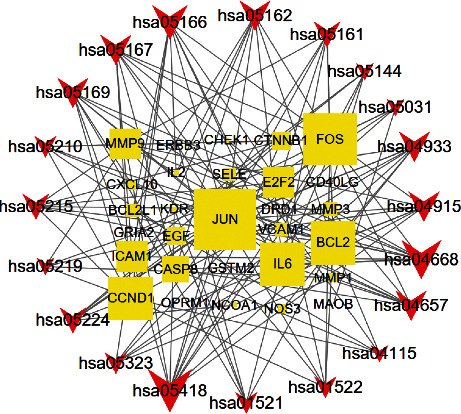
Cumulatively, 790 active compounds and 1006 targets of HGWD were identified. A total of 4570 differentially expressed genes of RA with a value <0.05 and |log 2(fold change)| > 0.5 were collected. Moreover, 739 GO entries of HGWD on RA were identified, and 79 pathways were screened based on GO and KEGG analysis. The core target gene of HGWD in RA treatment was JUN. Other key target genes included FOS, CCND1, IL6, E2F2, and ICAM1. It was confirmed that the TNF signaling pathway and IL-17 signaling pathway are important pathways of HGWD in the treatment of RA. The molecular docking results revealed that the top 10 active compounds of HGWD had a strong binding to the target proteins of VCAM1, CTNNB1, and JUN.
HGWD has important active compounds such as quercetin, kaempferol, and beta-sitosterol, which exert its therapeutic effect on multiple targets and multiple pathways.
黄芪桂枝五物汤在中国应用于关节疼痛治疗已有1000多年历史。目前,大多数医生使用黄芪桂枝五物汤治疗类风湿关节炎(RA),且已证明其疗效显著。因此,有必要基于网络药理学和分子对接方法探索黄芪桂枝五物汤治疗RA的潜在作用机制。
收集黄芪桂枝五物汤的活性成分,分别从中药系统药理学数据库(TCMSP)和DrugBank数据库中鉴定其靶点。通过分析RA患者与健康个体之间的差异表达基因检索RA相关靶点。随后,利用Cytoscape 3.8.0软件构建并可视化黄芪桂枝五物汤的化合物-靶点网络。使用Cytoscape 3.8.0软件的插件BisoGenet构建蛋白质-蛋白质相互作用(PPI)网络,以探索黄芪桂枝五物汤对RA的潜在作用机制。在R软件(Bioconductor,clusterProfiler)中进行基因本体(GO)分析和京都基因与基因组百科全书(KEGG)分析。之后,采用分子对接分析黄芪桂枝五物汤排名前10的活性成分与血管细胞黏附分子1(VCAM1)、β-连环蛋白1(CTNNB1)和原癌基因蛋白c-Jun(JUN)的靶蛋白的结合力。
累计鉴定出黄芪桂枝五物汤的790种活性成分和1006个靶点。共收集到4570个RA差异表达基因,其P值<0.05且|log₂(fold change)|>0.5。此外,鉴定出黄芪桂枝五物汤对RA的739个GO条目,并基于GO和KEGG分析筛选出79条通路。黄芪桂枝五物汤治疗RA的核心靶基因是JUN。其他关键靶基因包括原癌基因蛋白c-Fos(FOS)、细胞周期蛋白D1(CCND1)、白细胞介素6(IL6)、E2F转录因子2(E2F2)和细胞间黏附分子1(ICAM1)。证实肿瘤坏死因子(TNF)信号通路和白细胞介素17(IL-17)信号通路是黄芪桂枝五物汤治疗RA的重要通路。分子对接结果显示,黄芪桂枝五物汤排名前10 的活性成分与VCAM1、CTNNB1和JUN的靶蛋白具有较强的结合力。
黄芪桂枝五物汤含有槲皮素、山奈酚和β-谷甾醇等重要活性成分,通过多靶点、多通路发挥治疗作用。