Bloom Joshua S, Sathe Laila, Munugala Chetan, Jones Eric M, Gasperini Molly, Lubock Nathan B, Yarza Fauna, Thompson Erin M, Kovary Kyle M, Park Jimin, Marquette Dawn, Kay Stephania, Lucas Mark, Love TreQuan, Booeshaghi A Sina, Brandenberg Oliver F, Guo Longhua, Boocock James, Hochman Myles, Simpkins Scott W, Lin Isabella, LaPierre Nathan, Hong Duke, Zhang Yi, Oland Gabriel, Choe Bianca Judy, Chandrasekaran Sukantha, Hilt Evann E, Butte Manish J, Damoiseaux Robert, Kravit Clifford, Cooper Aaron R, Yin Yi, Pachter Lior, Garner Omai B, Flint Jonathan, Eskin Eleazar, Luo Chongyuan, Kosuri Sriram, Kruglyak Leonid, Arboleda Valerie A
Department of Human Genetics, David Geffen School of Medicine, UCLA.
Howard Hughes Medical Institute, HHMI.
medRxiv. 2021 Mar 9:2020.08.04.20167874. doi: 10.1101/2020.08.04.20167874.
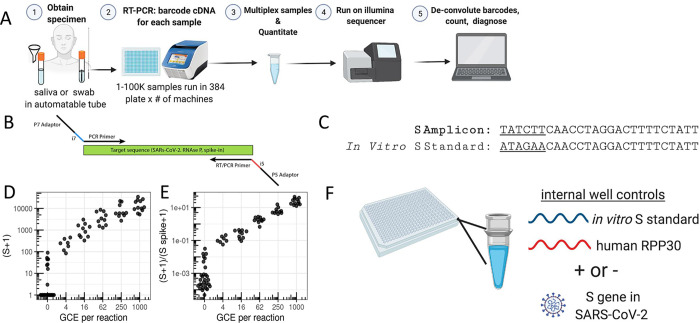
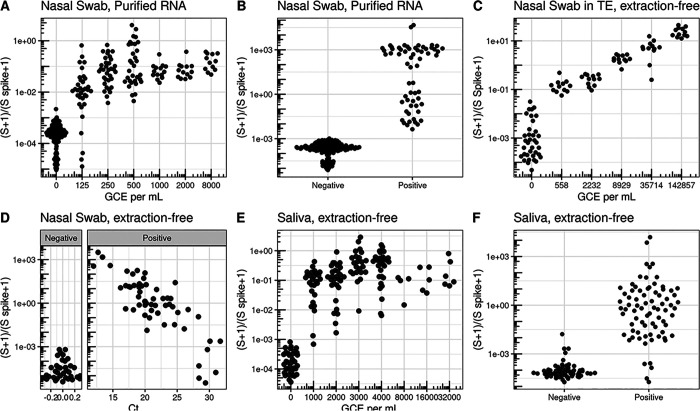
The rapid spread of severe acute respiratory syndrome coronavirus 2 (SARS-CoV-2) is due to the high rates of transmission by individuals who are asymptomatic at the time of transmission. Frequent, widespread testing of the asymptomatic population for SARS-CoV-2 is essential to suppress viral transmission. Despite increases in testing capacity, multiple challenges remain in deploying traditional reverse transcription and quantitative PCR (RT-qPCR) tests at the scale required for population screening of asymptomatic individuals. We have developed SwabSeq, a high-throughput testing platform for SARS-CoV-2 that uses next-generation sequencing as a readout. SwabSeq employs sample-specific molecular barcodes to enable thousands of samples to be combined and simultaneously analyzed for the presence or absence of SARS-CoV-2 in a single run. Importantly, SwabSeq incorporates an RNA standard that mimics the viral amplicon, but can be distinguished by sequencing. This standard allows for end-point rather than quantitative PCR, improves quantitation, reduces requirements for automation and sample-to-sample normalization, enables purification-free detection, and gives better ability to call true negatives. After setting up SwabSeq in a high-complexity CLIA laboratory, we performed more than 80,000 tests for COVID-19 in less than two months, confirming in a real world setting that SwabSeq inexpensively delivers highly sensitive and specific results at scale, with a turn-around of less than 24 hours. Our clinical laboratory uses SwabSeq to test both nasal and saliva samples without RNA extraction, while maintaining analytical sensitivity comparable to or better than traditional RT-qPCR tests. Moving forward, SwabSeq can rapidly scale up testing to mitigate devastating spread of novel pathogens.
严重急性呼吸综合征冠状病毒2(SARS-CoV-2)的快速传播是由于在传播时无症状的个体具有高传播率。对无症状人群进行频繁、广泛的SARS-CoV-2检测对于抑制病毒传播至关重要。尽管检测能力有所提高,但在以无症状个体群体筛查所需规模部署传统逆转录和定量PCR(RT-qPCR)检测方面仍存在多重挑战。我们开发了SwabSeq,这是一种用于SARS-CoV-2的高通量检测平台,它使用下一代测序作为读出方式。SwabSeq采用样本特异性分子条形码,使数千个样本能够合并,并在一次运行中同时分析是否存在SARS-CoV-2。重要的是,SwabSeq纳入了一种RNA标准,该标准模仿病毒扩增子,但可通过测序加以区分。这种标准允许进行终点而非定量PCR,提高了定量准确性,减少了对自动化和样本间标准化的要求,实现了无需纯化的检测,并具有更好的判定真阴性的能力。在一个高复杂性的CLIA实验室建立SwabSeq后,我们在不到两个月的时间里对COVID-19进行了超过80000次检测,在实际环境中证实SwabSeq能够大规模地以低成本提供高度敏感和特异的结果,周转时间不到24小时。我们的临床实验室使用SwabSeq对鼻拭子和唾液样本进行检测,无需进行RNA提取,同时保持与传统RT-qPCR检测相当或更好的分析灵敏度。展望未来,SwabSeq可以迅速扩大检测规模,以减轻新型病原体的毁灭性传播。