Rossix AB, Mölndal, Sweden.
Colorado Coagulation, Laboratory Corporation of America Holdings, Englewood, CO.
Blood. 2020 Nov 26;136(22):2524-2534. doi: 10.1182/blood.2020005683.
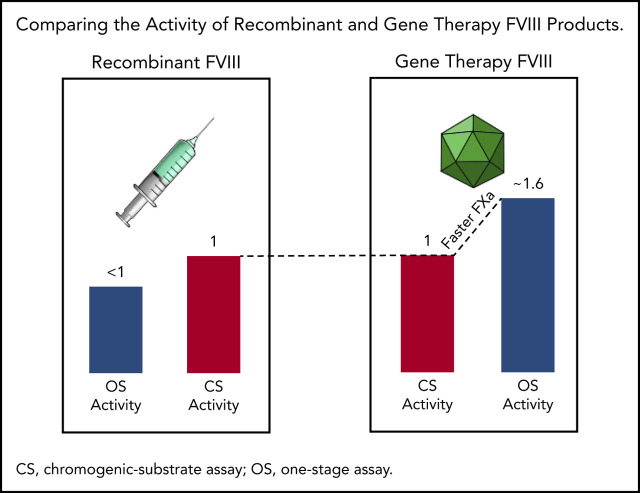
Adeno-associated virus (AAV)-based gene therapies can restore endogenous factor VIII (FVIII) expression in hemophilia A (HA). AAV vectors typically use a B-domain-deleted FVIII transgene, such as human FVIII-SQ in valoctocogene roxaparvovec (AAV5-FVIII-SQ). Surprisingly, the activity of transgene-produced FVIII-SQ was between 1.3 and 2.0 times higher in one-stage clot (OS) assays than in chromogenic-substrate (CS) assays, whereas recombinant FVIII-SQ products had lower OS than CS activity. Transgene-produced and recombinant FVIII-SQ showed comparable specific activity (international units per milligram) in the CS assay, demonstrating that the diverging activities arise in the OS assay. Higher OS activity for transgene-produced FVIII-SQ was observed across various assay kits and clinical laboratories, suggesting that intrinsic molecular features are potential root causes. Further experiments in 2 participants showed that transgene-produced FVIII-SQ accelerated early factor Xa and thrombin formation, which may explain the higher OS activity based on a kinetic bias between OS and CS assay readout times. Despite the faster onset of coagulation, global thrombin levels were unaffected. A correlation with joint bleeds suggested that both OS and CS assay remained clinically meaningful to distinguish hemophilic from nonhemophilic FVIII activity levels. During clinical development, the CS activity was chosen as a surrogate end point to conservatively assess hemostatic efficacy and enable comparison with recombinant FVIII-SQ products. Relevant trials are registered on clinicaltrials.gov as #NCT02576795 and #NCT03370913 and, respectively, on EudraCT (European Union Drug Regulating Authorities Clinical Trials Database; https://eudract.ema.europa.eu) as #2014-003880-38 and #2017-003215-19.
腺相关病毒 (AAV) 为基础的基因疗法可以恢复血友病 A (HA) 患者内源性因子 VIII (FVIII) 的表达。AAV 载体通常使用 B 结构域缺失的 FVIII 转基因,如 valoctocogene roxaparvovec 中的人 FVIII-SQ (AAV5-FVIII-SQ)。令人惊讶的是,在一期凝块 (OS) 测定中,转基因产生的 FVIII-SQ 的活性比显色底物 (CS) 测定中的活性高 1.3 到 2.0 倍,而重组 FVIII-SQ 产品的 OS 活性比 CS 活性低。在 CS 测定中,转基因产生的和重组的 FVIII-SQ 具有相似的比活性(国际单位/毫克),表明在 OS 测定中出现的活性差异来自于不同的测定方法。在各种测定试剂盒和临床实验室中,都观察到转基因产生的 FVIII-SQ 的 OS 活性较高,这表明内在的分子特征可能是潜在的根本原因。在 2 名参与者中的进一步实验表明,转基因产生的 FVIII-SQ 加速了早期因子 Xa 和凝血酶的形成,这可能基于 OS 和 CS 测定读取时间之间的动力学偏差来解释更高的 OS 活性。尽管凝血的起始更快,但总体凝血酶水平不受影响。与关节出血的相关性表明,OS 和 CS 测定都具有临床意义,可以区分血友病和非血友病 FVIII 活性水平。在临床开发过程中,CS 活性被选为替代终点,以保守地评估止血效果,并能够与重组 FVIII-SQ 产品进行比较。相关试验分别在 clinicaltrials.gov 上注册为 #NCT02576795 和 #NCT03370913,并在 EudraCT(欧洲联盟药物监管机构临床试验数据库;https://eudract.ema.europa.eu)上注册为 #2014-003880-38 和 #2017-003215-19。