Georgiou Theodoros, Islam Riasat, Holland Simon, van der Linden Janet, Price Blaine, Mulholland Paul, Perry Allan
School of Mathematical and Computer Sciences, Heriot-Watt University, Edinburgh, United Kingdom.
School of Computing and Communications, The Open University, Milton Keynes, United Kingdom.
JMIR Rehabil Assist Technol. 2020 Sep 14;7(2):e18589. doi: 10.2196/18589.
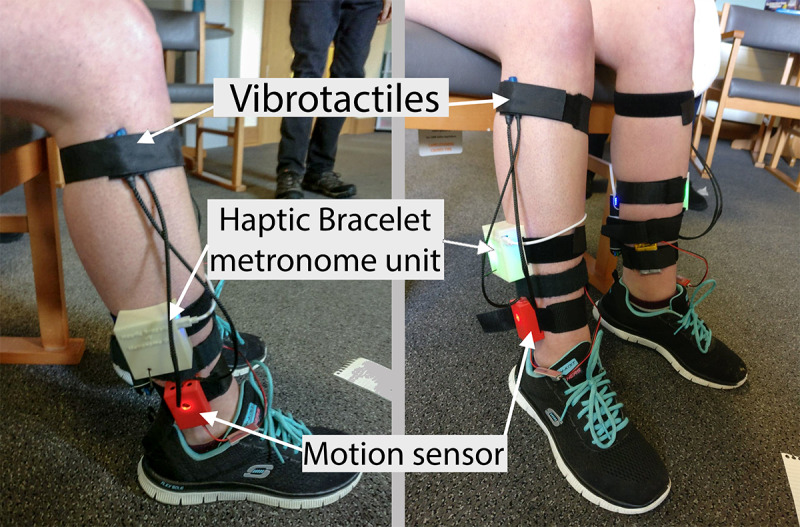
Huntington disease (HD) is an inherited genetic disorder that results in the death of brain cells. HD symptoms generally start with subtle changes in mood and mental abilities; they then degenerate progressively, ensuing a general lack of coordination and an unsteady gait, ultimately resulting in death. There is currently no cure for HD. Walking cued by an external, usually auditory, rhythm has been shown to steady gait and help with movement coordination in other neurological conditions. More recently, work with other neurological conditions has demonstrated that haptic (ie, tactile) rhythmic cues, as opposed to audio cues, offer similar improvements when walking. An added benefit is that less intrusive, more private cues are delivered by a wearable device that leaves the ears free for conversation, situation awareness, and safety. This paper presents a case study where rhythmic haptic cueing (RHC) was applied to one person with HD. The case study has two elements: the gait data we collected from our wearable devices and the comments we received from a group of highly trained expert physiotherapists and specialists in HD.
The objective of this case study was to investigate whether RHC can be applied to improve gait coordination and limb control in people living with HD. While not offering a cure, therapeutic outcomes may delay the onset or severity of symptoms, with the potential to improve and prolong quality of life.
The approach adopted for this study includes two elements, one quantitative and one qualitative. The first is a repeated-measures design with three conditions: before haptic rhythm (ie, baseline), with haptic rhythm, and after exposure to haptic rhythm. The second element is an in-depth interview with physiotherapists observing the session.
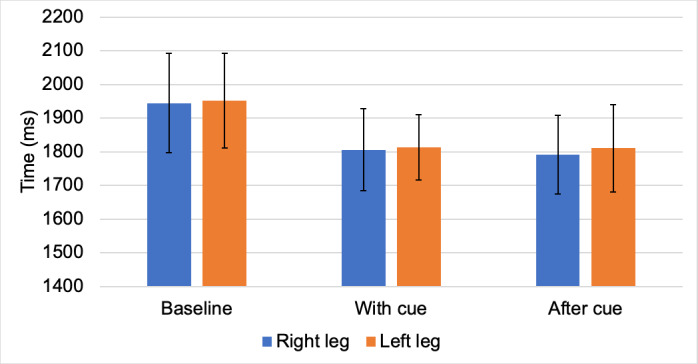
In comparison to the baseline, the physiotherapists noted a number of improvements to the participant's kinematics during her walk with the haptic cues. These improvements continued in the after-cue condition, indicating some lasting effects. The quantitative data obtained support the physiotherapists' observations.
The findings from this small case study, with a single participant, suggest that a haptic metronomic rhythm may have immediate, potentially therapeutic benefits for the walking kinematics of people living with HD and warrants further investigation.
亨廷顿舞蹈症(HD)是一种遗传性基因疾病,会导致脑细胞死亡。HD的症状通常始于情绪和心理能力的细微变化;随后逐渐恶化,进而导致普遍的协调性缺失和步态不稳,最终导致死亡。目前尚无治愈HD的方法。在其他神经系统疾病中,由外部(通常是听觉)节奏引导的行走已被证明可以稳定步态并帮助运动协调。最近,针对其他神经系统疾病的研究表明,与音频提示相反,触觉(即触感)节奏提示在行走时也能带来类似的改善。一个额外的好处是,可穿戴设备传递的提示干扰性更小、更私密,能让耳朵空出来用于交谈、情况感知和保障安全。本文介绍了一个将节奏性触觉提示(RHC)应用于一名HD患者的案例研究。该案例研究有两个部分:我们从可穿戴设备收集的步态数据,以及我们从一组训练有素的HD专家物理治疗师和专科医生那里收到的意见。
本案例研究的目的是调查RHC是否可用于改善HD患者的步态协调性和肢体控制。虽然不能治愈,但治疗结果可能会延迟症状的发作或严重程度,有可能改善和延长生活质量。
本研究采用的方法包括两个部分,一个是定量的,一个是定性的。第一部分是一个重复测量设计,有三种情况:触觉节奏之前(即基线)、有触觉节奏时、接触触觉节奏之后。第二部分是对观察该过程的物理治疗师进行深入访谈。
与基线相比,物理治疗师指出,在参与者行走时使用触觉提示的过程中,其运动学有了一些改善。这些改善在提示之后的情况下仍持续存在,表明有一些持久的效果。获得的定量数据支持了物理治疗师的观察结果。
这个针对单一参与者的小型案例研究结果表明,触觉节拍节奏可能对HD患者的行走运动学有即时的、潜在的治疗益处,值得进一步研究。