Jain Neeraj, Singh Satishkumar, Laliotis Georgios, Hart Amber, Muhowski Elizabeth, Kupcova Kristyna, Chrbolkova Tereza, Khashab Tamer, Chowdhury Sayan Mullick, Sircar Anuvrat, Shirazi Fazal, Singh Ram Kumar, Alinari Lapo, Zhu Jiangjiang, Havranek Ondrej, Tsichlis Philip, Woyach Jennifer, Baiocchi Robert, Samaniego Felipe, Sehgal Lalit
Department of Lymphoma and Myeloma, The University of Texas MD Anderson Cancer Center, Houston, TX.
Department of Medical Oncology and Hematology, All India Institute of Medical Sciences, Rishikesh, India.
Blood Adv. 2020 Sep 22;4(18):4382-4392. doi: 10.1182/bloodadvances.2020001685.
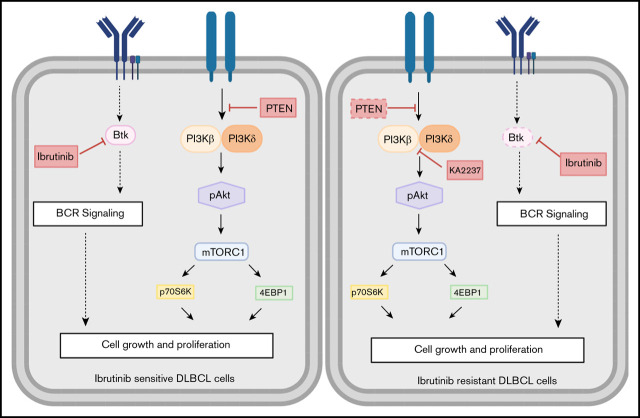
Diffuse large B-cell lymphoma (DLBCL) is the most common subtype of non-Hodgkin lymphoma; 40% of patients relapse after a complete response or are refractory to therapy. To survive, the activated B-cell (ABC) subtype of DLBCL relies upon B-cell receptor signaling, which can be modulated by the activity of Bruton tyrosine kinase (BTK). Targeting BTK with ibrutinib, an inhibitor, provides a therapeutic approach for this subtype of DLBCL. However, non-Hodgkin lymphoma is often resistant to ibrutinib or acquires resistance soon after exposure. We explored how this resistance develops. We generated 3 isogenic ibrutinib-resistant DLBCL cell lines and investigated the deregulated pathways known to be associated with tumorigenic properties. Reduced levels of BTK and enhanced phosphatidylinositol 3-kinase (PI3K)/AKT signaling were hallmarks of these ibrutinib-resistant cells. Upregulation of PI3K-β expression was demonstrated to drive resistance in ibrutinib-resistant cells, and resistance was reversed by the blocking activity of PI3K-β/δ. Treatment with the selective PI3K-β/δ dual inhibitor KA2237 reduced both tumorigenic properties and survival-based PI3K/AKT/mTOR signaling of these ibrutinib-resistant cells. In addition, combining KA2237 with currently available chemotherapeutic agents synergistically inhibited metabolic growth. This study elucidates the compensatory upregulated PI3K/AKT axis that emerges in ibrutinib-resistant cells.
弥漫性大B细胞淋巴瘤(DLBCL)是非霍奇金淋巴瘤最常见的亚型;40%的患者在完全缓解后复发或对治疗耐药。为了存活,DLBCL的活化B细胞(ABC)亚型依赖于B细胞受体信号传导,而布鲁顿酪氨酸激酶(BTK)的活性可以调节该信号传导。用抑制剂依鲁替尼靶向BTK为这种DLBCL亚型提供了一种治疗方法。然而,非霍奇金淋巴瘤通常对依鲁替尼耐药或在接触后很快产生耐药性。我们探究了这种耐药性是如何产生的。我们构建了3个对依鲁替尼耐药的同基因DLBCL细胞系,并研究了已知与致瘤特性相关的失调通路。BTK水平降低和磷脂酰肌醇3激酶(PI3K)/AKT信号增强是这些对依鲁替尼耐药细胞的特征。PI3K-β表达上调被证明可驱动对依鲁替尼耐药细胞的耐药性,而PI3K-β/δ的阻断活性可逆转耐药性。用选择性PI3K-β/δ双重抑制剂KA2237治疗可降低这些对依鲁替尼耐药细胞的致瘤特性和基于存活的PI3K/AKT/mTOR信号传导。此外,将KA2237与目前可用的化疗药物联合使用可协同抑制代谢生长。本研究阐明了在对依鲁替尼耐药的细胞中出现的代偿性上调的PI3K/AKT轴。