Department of Radiation Oncology, National Cancer Center/National Clinical Research Center for Cancer/Cancer Hospital, Chinese Academy of Medical Sciences and Peking Union Medical College, No. 17 South Panjiayuan lane, Chaoyang District, Beijing, 100021, China.
Department of Thoracic Surgery, National Cancer Center/National Clinical Research Center for Cancer/Cancer Hospital, Chinese Academy of Medical Sciences and Peking Union Medical College, Beijing, China.
BMC Cancer. 2020 Sep 14;20(1):877. doi: 10.1186/s12885-020-07315-0.
Currently, adjuvant therapy is not recommended for patients with thoracic esophageal squamous cell cancer (TESCC) after radical surgery, and a proportion of these patients go on to develop locoregional recurrence (LRR) within 2 years. Besides, there is no evidence for salvage chemoradiation therapy (CRT) in patients with residual tumor after esophagectomy (R1/R2 resection). In addition, factors like different failure patterns and relationship with normal organs influence the decision for salvage strategy. Here, we aimed to design a modularized salvage CRT strategy for patients without a chance of salvage surgery according to different failure patterns (including R1/R2 resection), and further evaluated its efficacy and safety.
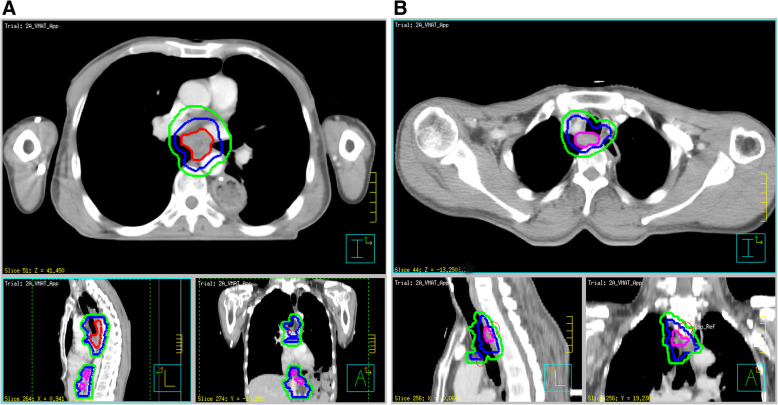
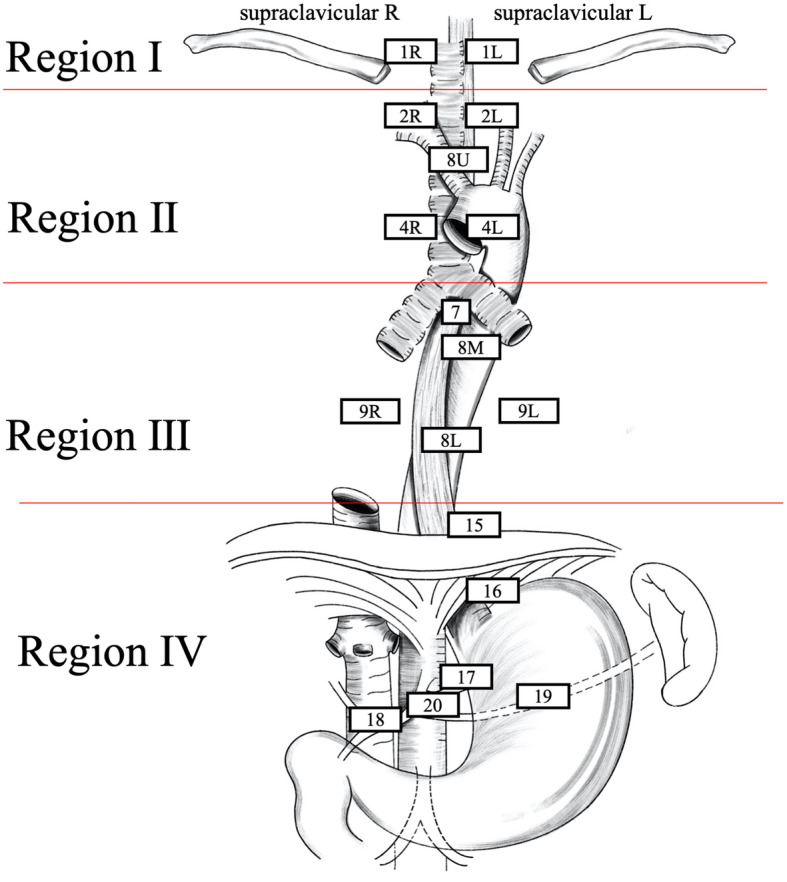
Our study was designed as a one arm, multicenter, prospective clinical trial. All enrolled patients were stratified in a stepwise manner based on the nature of surgery (R0 or R1/2), recurrent lesion diameter, involved regions, and time-to-recurrence, and were further assigned to undergo either elective nodal irradiation or involved field irradiation. Then, radiation technique and dose prescription were modified according to the distance from the recurrent lesion to the thoracic stomach or intestine. Ultimately, four treatment plans were established.
This prospective study provided high-level evidence for clinical salvage management in patients with TESCC who developed LRR after radical surgery or those who underwent R1/R2 resection.
Prospectively Registered. ClinicalTrials.gov NCT03731442 , Registered November 6, 2018.
目前,根治性手术后的胸段食管鳞癌(TESCC)患者不推荐辅助治疗,其中一部分患者在 2 年内会发生局部区域复发(LRR)。此外,对于食管切除术后(R1/R2 切除)仍有肿瘤残留的患者,尚无挽救性放化疗(CRT)的证据。此外,不同的失败模式和与正常器官的关系等因素影响着挽救策略的决策。在这里,我们旨在根据不同的失败模式(包括 R1/R2 切除)为没有挽救手术机会的患者设计一种模块化的挽救性 CRT 策略,并进一步评估其疗效和安全性。
我们的研究设计为单臂、多中心、前瞻性临床试验。所有入组患者均根据手术性质(R0 或 R1/2)、复发病灶直径、受累区域和复发时间进行分层,并进一步分为选择性淋巴结照射或受累野照射。然后,根据复发病灶与胸胃或肠的距离,修改放射技术和剂量处方。最终,建立了四个治疗计划。
这项前瞻性研究为根治性手术后发生 LRR 的 TESCC 患者或接受 R1/R2 切除的患者提供了挽救性管理的高级别循证医学证据。
前瞻性注册。ClinicalTrials.gov NCT03731442,于 2018 年 11 月 6 日注册。