State Key Laboratory of Veterinary Etiological Biology, National Foot and Mouth Disease Reference Laboratory, Key Laboratory of Animal Virology of Ministry of Agriculture, Lanzhou Veterinary Research Institute, Chinese Academy of Agricultural Sciences, No. 1 Xujiaping, Yanchangbao, Lanzhou, Gansu, 730046, PR China.
Virol J. 2020 Sep 14;17(1):137. doi: 10.1186/s12985-020-01379-x.
Recent study has shown that the C-terminal portion of 3A (amino acids (aa) 81-153) is not essential for foot-and-mouth disease virus replication in cell culture, however, the complete C-terminal portion (aa 77-153) of 3A is highly variable and prone to occur deletions and mutations, therefore, we presume that this region plays a very limited role and probablely is completely nonessential for virus viability.
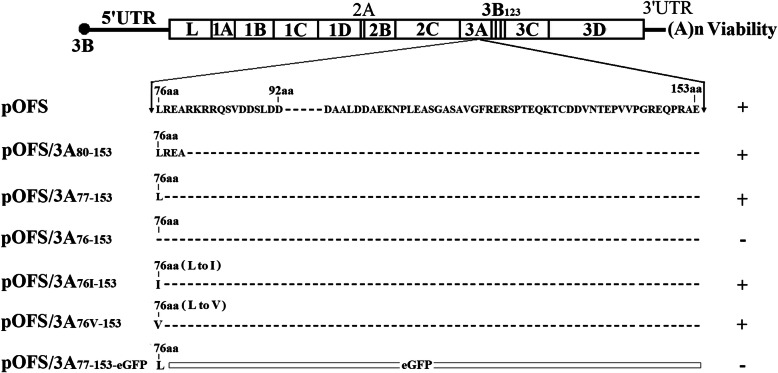
In this study, to identify the largest non-essential region of the C-terminal portion in 3A for FMDV viability, several deletions containing aa 80-153, 77-153 and 76-153 of 3A protein were introduced into an FMDV full-length infectious cDNA clone pOFS by the overlapping extension PCR. Additionally, to explore the importance of the highly conserved residue 76 L of 3A for the FMDV of Cathay topotype, two mutants containing 3A L76I and 3A L76V were generated based on the 3A deletion mutant by point mutation. We also introduced the enhanced green fluorescent protein (eGFP) into one of the 3A deletion mutants by the extension PCR to investigate the genetic flexibility of 3A to express foreign genes. All linearized full plasmids were transfected into BSR/T7 cells to rescue infectious foot-and-mouth disease viruses. The rescused viruses were analyzed by RT-PCR, nucleotide sequencing, immunofluorescence assay and western blot and were characterized by plaque assays and one-step growth kinetics.
The results demonstrated that the deletion of aa 80-153 and aa 77-153 and the substitutions of 3A L76I and 3A L76V did not affect the production of infectious virus, while the fusion of the eGFP gene to the C-terminus of 3A resulted in nonviable FMDV.
Our results firstly reported that the aa 77-153 rather than aa 81-153 of 3A protein was dispensable for FMDV replication in cell culture. This study is of great significance for development of FMD marker vaccine and foreign gene expression in the future.
最近的研究表明,3A(氨基酸(aa)81-153)的 C 末端部分对于口蹄疫病毒在细胞培养中的复制不是必需的,然而,3A 的完整 C 末端部分(aa 77-153)高度可变,容易发生缺失和突变,因此,我们推测该区域的作用非常有限,可能对病毒的生存能力完全不重要。
在这项研究中,为了确定 3A 中 C 末端对于 FMDV 生存能力的最大非必需区域,通过重叠延伸 PCR 将包含 3A 蛋白的 aa80-153、77-153 和 76-153 的几个缺失引入 FMDV 全长感染性 cDNA 克隆 pOFS 中。此外,为了探索高度保守的 3A 残基 76L 对中国流行型口蹄疫病毒的重要性,基于 3A 缺失突变体通过点突变生成了包含 3A L76I 和 3A L76V 的两个突变体。我们还通过延伸 PCR 将增强型绿色荧光蛋白(eGFP)引入其中一个 3A 缺失突变体中,以研究 3A 表达外源基因的遗传灵活性。所有线性化全长质粒均转染 BSR/T7 细胞以拯救感染性口蹄疫病毒。通过 RT-PCR、核苷酸测序、免疫荧光分析和 Western blot 分析拯救的病毒,并通过噬斑试验和一步生长动力学进行表征。
结果表明,aa80-153 和 aa77-153 的缺失以及 3A L76I 和 3A L76V 的替换并不影响感染性病毒的产生,而 eGFP 基因与 3A 的 C 末端融合导致 FMDV 失去活力。
我们的研究结果首次报道,3A 蛋白的 aa77-153 而不是 aa81-153 对于细胞培养中的 FMDV 复制是可有可无的。这项研究对口蹄疫标记疫苗的开发和未来外源基因的表达具有重要意义。