Pediatrics, Stanford University School of Medicine, Stanford, California, USA
Stanford University, Stanford Cancer Institute, Stanford California, USA.
J Immunother Cancer. 2020 Sep;8(2). doi: 10.1136/jitc-2020-001073.
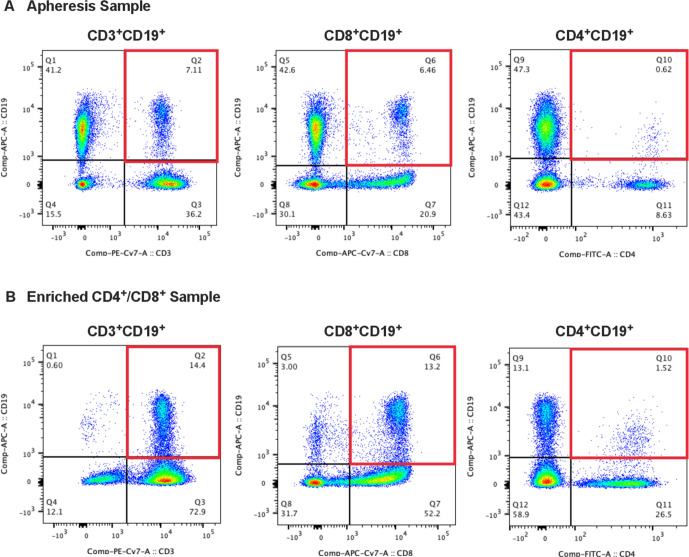
Chimeric antigen receptor (CAR) therapy and hematopoietic stem cell transplantation (HSCT) are therapeutics for relapsed acute lymphocytic leukemia (ALL) that are increasingly being used in tandem. We identified a non-physiologic CD19+/CD3+ T-cell population in the leukapheresis product of a patient undergoing CAR T-cell manufacturing who previously received a haploidentical HSCT, followed by infusion of a genetically engineered T-cell addback product. We confirm and report the origin of these CD19+/CD3+ T cells that have not previously been described in context of CAR T-cell manufacturing. We additionally interrogate the fate of these CD19-expressing cells as they undergo transduction to express CD19-specific CARs.
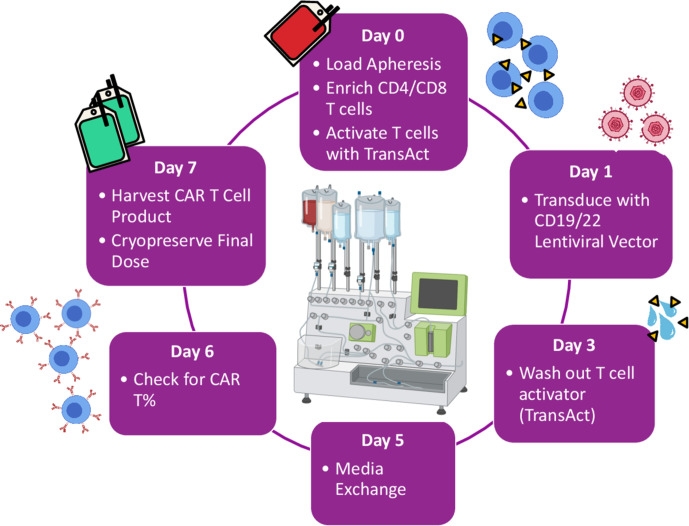
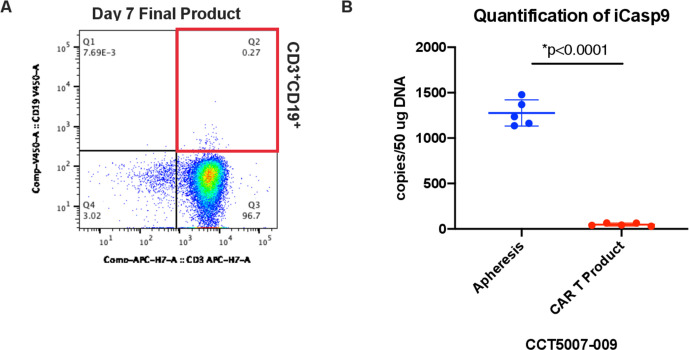
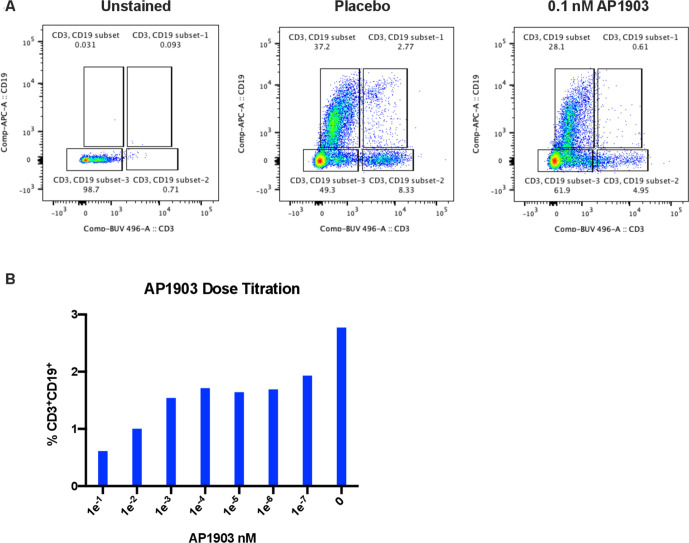
We describe the case of a preteen male with multiply relapsed B-ALL who was treated with sequential cellular therapies. He received an αβ T-cell depleted haploidentical HSCT followed by addback of donor-derived T cells genetically modified with a suicide gene for iCaspase9 and truncated CD19 for cell tracking (RivoCel). He relapsed 6 months following HSCT and underwent leukapheresis and CAR T-cell manufacturing. During manufacturing, we identified an aberrant T-cell population dually expressing CD19 and CD3. We hypothesized that these cells were RivoCel cells and confirmed using flow cytometry and PCR that the identified cells were in fact RivoCel cells and were eliminated with iCaspase9 activation. We additionally tracked these cells through CD19-specific CAR transduction and notably did not detect T cells dually positive for CD19 and CD19-directed CARs. The most likely rationale for this is in vitro fratricide of the CD19+ 'artificial' T-cell population by the CD19-specific CAR+ T cells in culture.
We report the identification of CD19+/CD3+ cells in an apheresis product undergoing CAR transduction derived from a patient previously treated with a haploidentical transplant followed by RivoCel addback. We aim to bring attention to this cell phenotype that may be recognized with greater frequency as CAR therapy and engineered αβhaplo-HSCT are increasingly coupled. We additionally suggest consideration towards using alternative markers to CD19 as a synthetic identifier for post-transplant addback products, as CD19-expression on effector T cells may complicate subsequent treatment using CD19-directed therapy.
嵌合抗原受体(CAR)疗法和造血干细胞移植(HSCT)是治疗复发急性淋巴细胞白血病(ALL)的方法,越来越多地被联合应用。我们在接受 CAR T 细胞制造的患者的白细胞分离产物中发现了一种非生理的 CD19+/CD3+T 细胞群体,该患者先前接受了半相合 HSCT,随后输注了基因工程的 T 细胞添加物。我们确认并报告了这些 CD19+/CD3+T 细胞的来源,这些细胞在 CAR T 细胞制造过程中以前没有被描述过。我们还研究了这些表达 CD19 的细胞在转导表达 CD19 特异性 CAR 时的命运。
我们描述了一名患有多发性复发 B-ALL 的青少年男性患者的病例,他接受了序贯细胞治疗。他接受了αβT 细胞耗尽的半相合 HSCT,随后添加了经自杀基因 iCaspase9 和截断 CD19 修饰的供体衍生 T 细胞,用于细胞追踪(RivoCel)。他在 HSCT 后 6 个月复发,并进行了白细胞分离和 CAR T 细胞制造。在制造过程中,我们发现了一种异常的 T 细胞群体,同时表达 CD19 和 CD3。我们假设这些细胞是 RivoCel 细胞,并通过流式细胞术和 PCR 证实,鉴定出的细胞实际上是 RivoCel 细胞,并通过 iCaspase9 激活消除了这些细胞。我们还通过 CD19 特异性 CAR 转导跟踪了这些细胞,值得注意的是,没有检测到同时对 CD19 和 CD19 导向的 CAR 呈阳性的 T 细胞。最可能的原因是在体外培养中,CD19 特异性 CAR+T 细胞对 CD19+“人工”T 细胞群体的同种细胞杀伤。
我们报告了在接受 CAR 转导的白细胞分离产物中发现 CD19+/CD3+细胞的情况,这些细胞来自先前接受半相合移植并添加 RivoCel 的患者。我们旨在引起人们对这种细胞表型的关注,因为 CAR 治疗和工程化的αβ半相合 HSCT 越来越多地结合在一起,这种细胞表型可能会被更频繁地识别。我们还建议考虑使用替代 CD19 的标记物作为移植后添加物的合成标识符,因为效应 T 细胞上的 CD19 表达可能会使随后使用 CD19 导向的治疗复杂化。