Department of Pharmaceutical Sciences, College of Pharmacy, University of Oklahoma Health Sciences Center, Oklahoma City, OK, USA.
Oklahoma Center for Neuroscience, University of Oklahoma Health Sciences Center, Oklahoma City, OK, USA.
Cell Mol Neurobiol. 2021 Jul;41(5):1009-1018. doi: 10.1007/s10571-020-00962-8. Epub 2020 Sep 15.
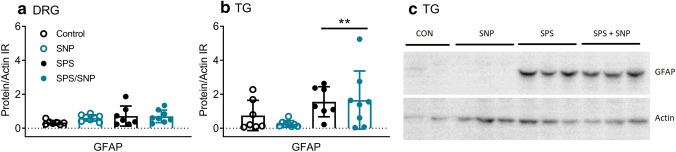
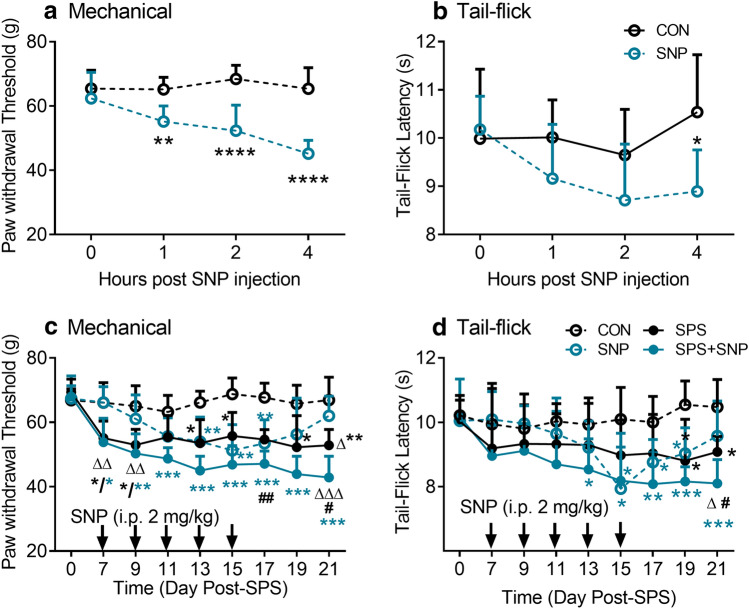
Chronic headache pain is one of the most commonly reported comorbid pain conditions with post-traumatic stress disorder (PTSD) patients and resistant to effective treatment, yet no combined preclinical model of the two disorders has been reported. Here, we used a modified chronic headache pain model to investigate the contribution of single prolonged stress (SPS) model of PTSD with sodium nitroprusside (SNP)-induced hyperalgesia. Injection of SNP (2 mg/kg, i.p.) occurred every other day from day 7 to day 15 after initiation of SPS in rats. Paw withdrawal threshold (PWT) to von Frey stimuli and tail flick latencies (TFL) dramatically decreased as early as 7 days after SPS and lasted until at least day 21. Basal PWT and TFL also significantly decreased during the SNP treatment period. The lower nociceptive thresholds recovered in 6 days following the final SNP injection in SNP group, but not in SPS + SNP group. Elevated nociceptin/OFQ (N/OFQ) levels observed in cerebrospinal fluid of SPS rats were even higher in SPS + SNP group. Glial fibrillary acidic protein (GFAP) and N/OFQ peptide (NOP) receptor mRNA expression increased in dorsal root ganglia (DRG) 21 days after SPS exposure; mRNA increases in the SPS/SNP group was more pronounced than SPS or SNP alone. GFAP protein expression was upregulated in trigeminal ganglia by SPS. Our results indicate that traumatic stress exaggerated chronic SNP-induced nociceptive hypersensitivity, and that N/OFQ and activated satellite glia cells may play an important role in the interaction between both conditions.
慢性头痛是创伤后应激障碍(PTSD)患者最常见的共病疼痛之一,且对有效治疗有抵抗力,但尚无这两种疾病的联合临床前模型。在这里,我们使用改良的慢性头痛疼痛模型来研究 PTSD 的单一延长压力(SPS)模型与硝普钠(SNP)诱导的痛觉过敏的贡献。在 SPS 开始后第 7 天至第 15 天,每天给大鼠注射 2 mg/kg 的 SNP。SNP 处理期间,足底机械刺激撤回阈值(PWT)和尾巴拍打潜伏期(TFL)明显降低,早在 SPS 后 7 天就开始,并持续至少 21 天。基础 PWT 和 TFL 在 SNP 处理期间也显著降低。SNP 组在最后一次 SNP 注射后 6 天内恢复了较低的痛觉阈值,但 SPS+SNP 组则没有。在 SPS 大鼠的脑脊液中观察到的升高的神经肽/孤啡肽(N/OFQ)水平在 SPS+SNP 组中甚至更高。在 SPS 暴露 21 天后,背根神经节(DRG)中的神经胶质纤维酸性蛋白(GFAP)和 N/OFQ 肽(NOP)受体 mRNA 表达增加;SPS/SNP 组的 mRNA 增加比 SPS 或 SNP 单独增加更为明显。SPS 上调三叉神经节中的 GFAP 蛋白表达。我们的结果表明,创伤应激加重了慢性 SNP 诱导的痛觉过敏,N/OFQ 和激活的卫星神经胶质细胞可能在这两种情况的相互作用中发挥重要作用。