School of Pharmaceutical Sciences, Jiangnan University, Wuxi, 214122, China.
National Engineering Laboratory for Cereal Fermentation Technology, Jiangnan University, Wuxi, Jiangsu, China.
Cell Commun Signal. 2020 Sep 15;18(1):151. doi: 10.1186/s12964-020-00610-0.
Hepatic fibrosis is a pathological response of the liver to a variety of chronic stimuli. Hepatic stellate cells (HSCs) are the major source of myofibroblasts in the liver. Follistatin like 1 (Fstl1) is a secreted glycoprotein induced by transforming growth factor-β1 (TGF-β1). However, the precise functions and regulation mechanisms of Fstl1 in liver fibrogenesis remains unclear.
Hepatic stellate cell (HSC) line LX-2 stimulated by TGF-β1, primary culture of mouse HSCs and a model of liver fibrosis induced by CCl4 in mice was used to assess the effect of Fstl1 in vitro and in vivo.
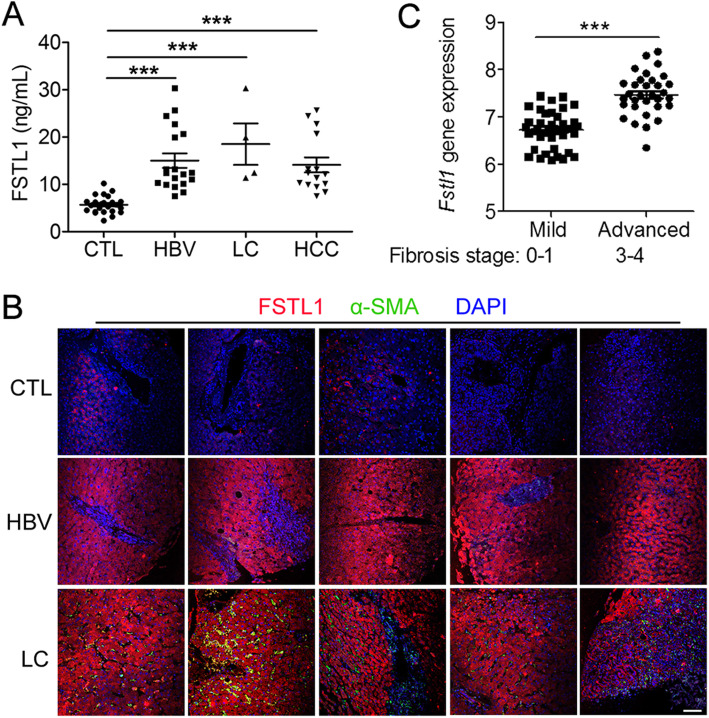
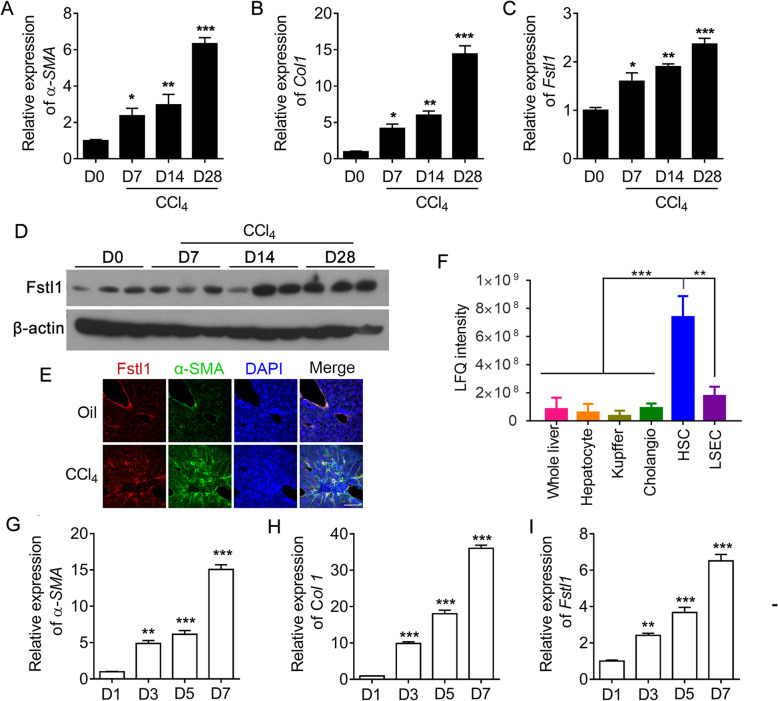
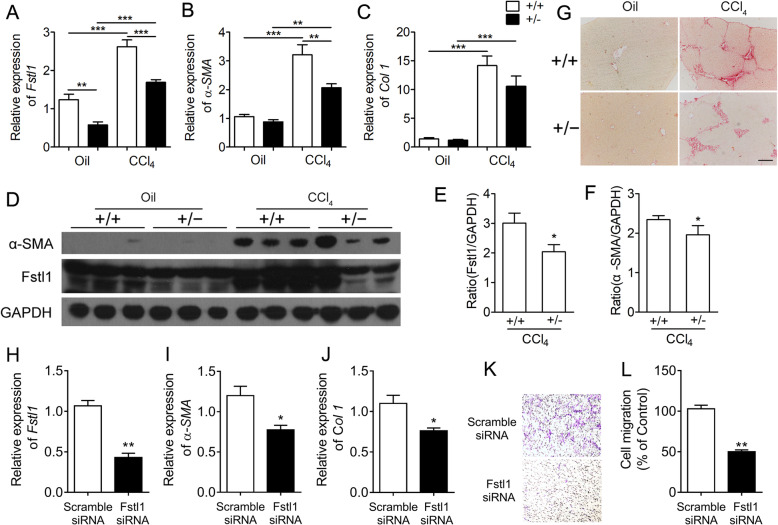
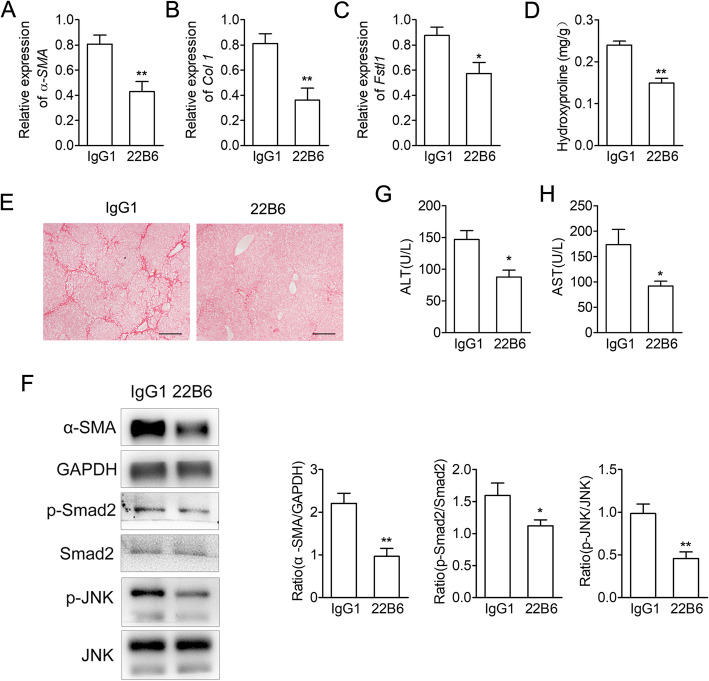
Here, we found that Fstl1 was significantly up regulated in human and mouse fibrotic livers, as well as activated HSCs. Haplodeficiency of Fstl1 or blockage of Fstl1 with a neutralizing antibody 22B6 attenuated CCl-induced liver fibrosis in vivo. Fstl1 modulates TGF-β1 classic Samd2 and non-classic JNK signaling pathways. Knockdown of Fstl1 in HSCs significantly ameliorated cell activation, cell migration, chemokines C-C Motif Chemokine Ligand 2 (CCL2) and C-X-C Motif Chemokine Ligand 8 (CXCL8) secretion and extracellular matrix (ECM) production, and also modulated microRNA-29a (miR29a) expression. Furthermore, we identified that Fstl1 was a target gene of miR29a. And TGF-β1 induction of Fstl1 expression was partially through down regulation of miR29a in HSCs.
Our data suggests TGF-β1-miR29a-Fstl1 regulatory circuit plays a key role in regulation the HSC activation and ECM production, and targeting Fstl1 may be a strategy for the treatment of liver fibrosis. Video Abstract.
肝纤维化是肝脏对各种慢性刺激的病理性反应。肝星状细胞(HSCs)是肝脏中肌成纤维细胞的主要来源。卵泡抑素样 1(Fstl1)是转化生长因子-β1(TGF-β1)诱导的一种分泌糖蛋白。然而,Fstl1 在肝纤维化中的精确功能和调控机制尚不清楚。
使用 TGF-β1 刺激的肝星状细胞(HSC)系 LX-2、原代培养的小鼠 HSCs 和 CCl4 诱导的小鼠肝纤维化模型,评估 Fstl1 在体外和体内的作用。
我们发现 Fstl1 在人肝纤维化和小鼠纤维化肝脏以及活化的 HSCs 中均显著上调。Fstl1 单倍体缺陷或用中和抗体 22B6 阻断 Fstl1 可减轻体内 CCl4 诱导的肝纤维化。Fstl1 调节 TGF-β1 经典的 Samd2 和非经典的 JNK 信号通路。在 HSCs 中敲低 Fstl1 可显著改善细胞活化、细胞迁移、趋化因子 C-C 基序趋化因子配体 2(CCL2)和 C-X-C 基序趋化因子配体 8(CXCL8)的分泌和细胞外基质(ECM)的产生,并调节 microRNA-29a(miR29a)的表达。此外,我们确定 Fstl1 是 miR29a 的靶基因。TGF-β1 诱导 Fstl1 表达部分是通过下调 HSCs 中的 miR29a 实现的。
我们的数据表明,TGF-β1-miR29a-Fstl1 调控回路在调节 HSC 活化和 ECM 产生中起着关键作用,靶向 Fstl1 可能是治疗肝纤维化的一种策略。