Department of Radiation Oncology, Fudan University Shanghai Cancer Center, 270 DongAn Road, Shanghai, 200032, China.
Department of Oncology, Shanghai Medical College, Fudan University, Shanghai, 200032, China.
J Exp Clin Cancer Res. 2020 Sep 15;39(1):188. doi: 10.1186/s13046-020-01693-w.
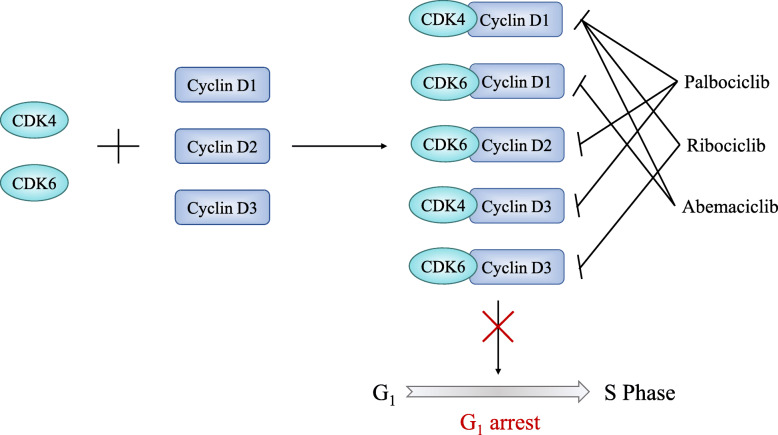
Recently, the focus of enhancing tumor radiosensitivity has shifted from chemotherapeutics to targeted therapies. Cyclin-dependent kinase 4 and 6 (CDK4/6) inhibitors are a novel class of selective cell cycle therapeutics that target the cyclin D-CDK4/6 complex and induce G1 phase arrest. These agents have demonstrated favorable effects when used as monotherapy or combined with endocrine therapy and targeted inhibitors, stimulating further explorations of other combination strategies. Multiple preclinical studies have indicated that CDK4/6 inhibitors exhibit a synergistic effect with radiotherapy both in vitro and in vivo. The principal mechanisms of radiosensitization effects include inhibition of DNA damage repair, enhancement of apoptosis, and blockade of cell cycle progression, which provide the rationale for clinical use. CDK4/6 inhibitors also induce cellular senescence and promote anti-tumor immunity, which might represent potential mechanisms for radiosensitization. Several small sample clinical studies have preliminarily indicated that the combination of CDK4/6 inhibitors and radiotherapy exhibited well-tolerated toxicity and promising efficacy. However, most clinical trials in combined therapy remain in the recruitment stage. Further work is required to seek optimal radiotherapy-drug combinations. In this review, we describe the effects and underlying mechanisms of CDK4/6 inhibitors as a radiosensitizer and discuss previous clinical studies to evaluate the prospects and challenges of this combination.
近年来,提高肿瘤放射敏感性的焦点已经从化疗药物转移到了靶向治疗。细胞周期蛋白依赖性激酶 4 和 6(CDK4/6)抑制剂是一类新型的选择性细胞周期治疗药物,其作用靶点是细胞周期蛋白 D-CDK4/6 复合物,可诱导 G1 期阻滞。这些药物作为单一疗法或与内分泌治疗和靶向抑制剂联合使用时,效果良好,进一步激发了对其他联合策略的探索。多项临床前研究表明,CDK4/6 抑制剂在体外和体内均与放射治疗具有协同作用。放射增敏作用的主要机制包括抑制 DNA 损伤修复、增强细胞凋亡和阻断细胞周期进程,这为临床应用提供了依据。CDK4/6 抑制剂还可诱导细胞衰老并促进抗肿瘤免疫,这可能是放射增敏的潜在机制。几项小型临床试验初步表明,CDK4/6 抑制剂与放射治疗联合使用具有良好的耐受性和有前途的疗效。然而,大多数联合治疗的临床试验仍处于招募阶段。需要进一步研究以寻找最佳的放疗药物联合方案。在本文中,我们描述了 CDK4/6 抑制剂作为放射增敏剂的作用和潜在机制,并讨论了以前的临床研究,以评估这种联合治疗的前景和挑战。