Economics team, NHS Improvement, London, UK
Economics team, NHS Improvement, London, UK.
Emerg Med J. 2020 Dec;37(12):781-786. doi: 10.1136/emermed-2019-208849. Epub 2020 Sep 15.
Long lengths of stay (also called waiting times) in emergency departments (EDs) are associated with higher patient mortality and worse outcomes.
To add to the literature using high-frequency data from a large number of hospitals to analyse factors associated with long waiting times, including exploring non-linearities for 'tipping points'.
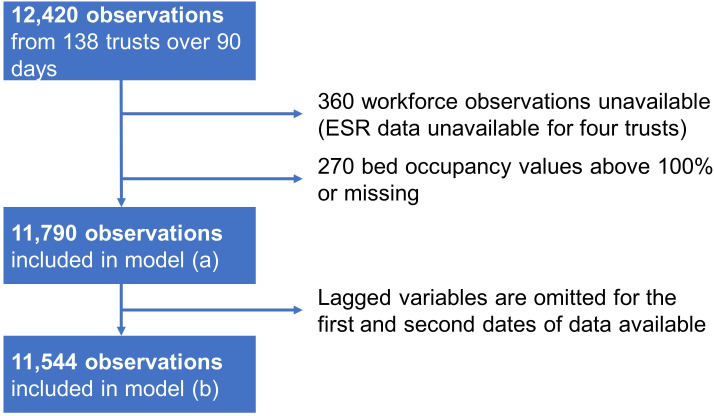
Multivariate ordinary least squares regressions with fixed effects were used to analyse factors associated with the proportion of patients in EDs in England waiting more than 4 hours to be seen, treated and admitted or discharged. Daily situation reports (Sitrep), hospital episode statistics and electronic staffing records data over 90 days between December 2016 and February 2017 were used for all 138 English NHS healthcare providers with a major ED.
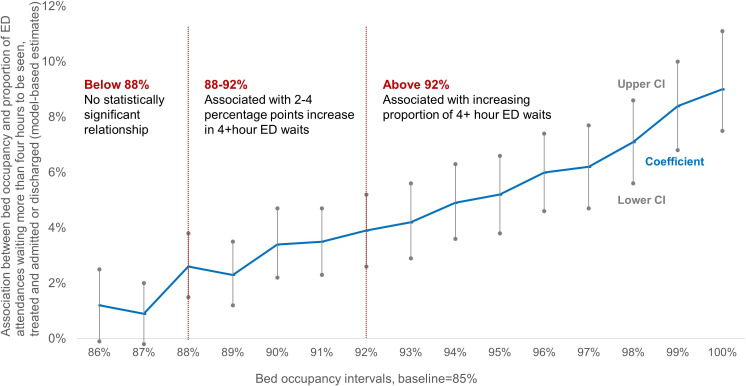
Higher inpatient bed occupancy was correlated with longer ED waiting times, with a non-linear association. In a full hospital, with 100% bed occupancy, the proportion of patients who remained in the ED for more than 4 hours was 9 percentage points higher (95% CI 7.5% to 11.1%) than with an 85% occupancy level. For each percentage point change in the following factors, the proportion of ED stays over 4 hours also increased: more inpatients with hospital length of stay over 21 days (0.07%, 95% CI 0.008% to 0.13%); higher emergency admissions (0.08%, 95% CI 0.06% to 0.10%); and lower discharges relative to admissions on the same day (0.04%, 95% CI 0.02% to 0.06%), the following day (0.05%, 95% CI 0.03% to 0.06%) and at 2 days (0.05%, 95% CI 0.04% to 0.07%).
These results suggest that tackling patient flow and capacity in the wider hospital, particularly very high bed occupancy levels and patient discharge, is important to reduce ED waiting times and improve patient outcomes.
急诊部(ED)的长时间停留(也称为等待时间)与更高的患者死亡率和更差的结果相关。
利用来自大量医院的高频数据来分析与长时间等待相关的因素,包括探索“临界点”的非线性。
使用具有固定效应的多元普通最小二乘回归来分析与英格兰 ED 中等待超过 4 小时接受检查、治疗和入院或出院的患者比例相关的因素。使用 2016 年 12 月至 2017 年 2 月期间 90 天的每日情况报告(Sitrep)、医院事件统计数据和电子人员配备记录数据,对所有 138 家具有主要 ED 的英格兰国民保健服务(NHS)医疗保健提供者进行分析。
更高的住院病床占用率与 ED 等待时间延长相关,呈非线性关系。在一家满负荷运营的医院中,当床位占用率达到 100%时,在 ED 停留超过 4 小时的患者比例比床位占用率为 85%时高出 9 个百分点(95%置信区间 7.5%至 11.1%)。对于以下因素的每一个百分点变化,ED 停留时间超过 4 小时的比例也会增加:住院时间超过 21 天的住院患者比例增加(0.07%,95%置信区间 0.008%至 0.13%);急症入院人数增加(0.08%,95%置信区间 0.06%至 0.10%);与当天(0.04%,95%置信区间 0.02%至 0.06%)、次日(0.05%,95%置信区间 0.03%至 0.06%)和 2 天(0.05%,95%置信区间 0.04%至 0.07%)相比,出院人数相对减少。
这些结果表明,解决更广泛的医院内的患者流动和容量问题,特别是非常高的床位占用率和患者出院率,对于减少 ED 等待时间和改善患者结局非常重要。