Institute of Paleobiology, Polish Academy of Sciences, Warsaw, Poland.
Faculty of Natural Sciences, University of Silesia in Katowice, Sosnowiec, Poland.
Sci Rep. 2020 Sep 15;10(1):15147. doi: 10.1038/s41598-020-72116-1.
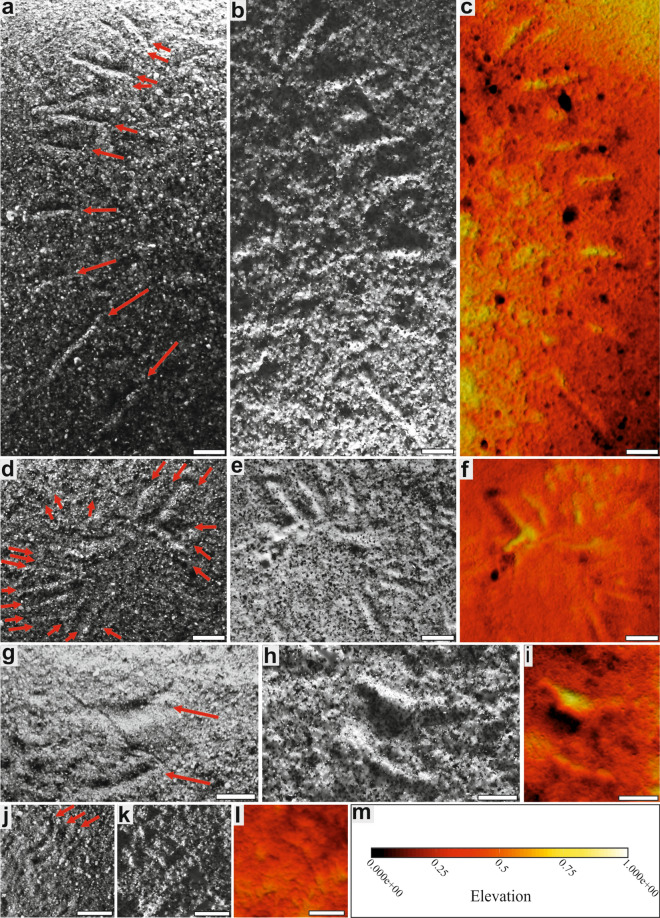
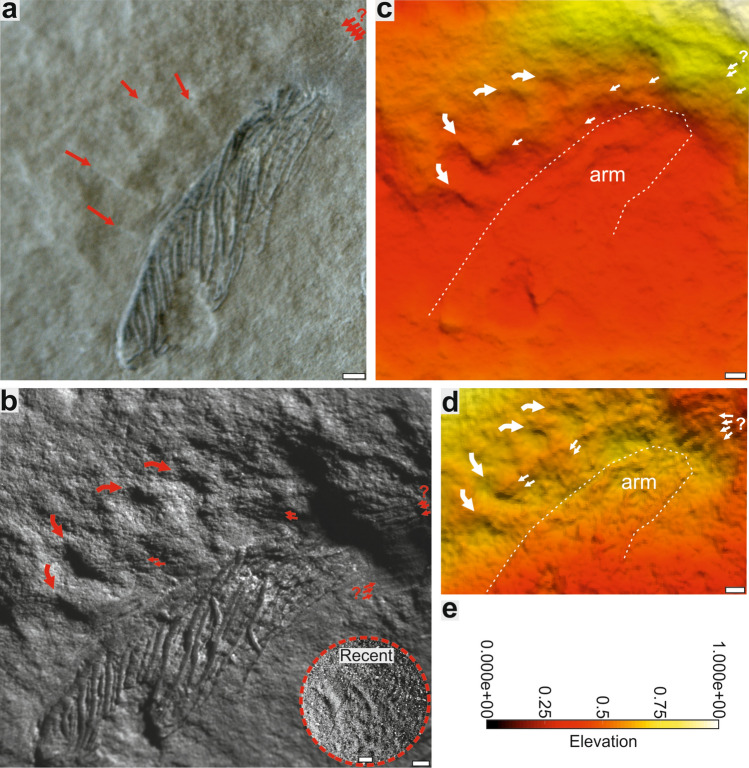
Echinoderms exhibit remarkable powers of autotomy. For instance, crinoids can shed arm and stalk portions when attacked by predators. In some species, it has been reported that the autotomized arms display vigorous movements, which are thought to divert the attention of predators. This phenomenon, however, has not been well explored. Here we present results of experiments using the shallowest water species of living stalked crinoid (Metacrinus rotundus) collected at 140 m depth. A wide range of movements of detached arms, from sluggish writhing to violent flicks, was observed. Interestingly, autotomized arms produce distinct traces on the sediment surface. They are composed of straight or arched grooves usually arranged in radiating groups and shallow furrows. Similar traces were found associated with detached arms of the oldest (Early Triassic) stem-group isocrinid (Holocrinus). This finding may suggest that the origins of autotomy-related thrashing behaviour in crinoids could be traced back to at least the Early Triassic, underscoring the magnitude of anti-predatory traits that occurred during the Mesozoic Marine Revolution. A new ethological category, autotomichnia, is proposed for the traces produced by thrashing movements of shed appendages.
棘皮动物表现出惊人的自切能力。例如,海百合类动物在受到捕食者攻击时可以脱落臂和茎部。在一些物种中,据报道,自切的臂部会表现出剧烈的运动,这被认为可以转移捕食者的注意力。然而,这种现象还没有得到很好的研究。在这里,我们介绍了在 140 米深处采集的最浅水域生活的有柄海百合(Metacrinus rotundus)的实验结果。观察到脱落的臂部有广泛的运动,从缓慢的扭动到剧烈的弹动。有趣的是,自切的臂部在沉积物表面留下明显的痕迹。它们由通常呈辐射状排列的直的或弧形的凹槽和浅沟组成。在最古老的(早三叠世)茎系海百合(Holocrinus)的脱落臂部也发现了类似的痕迹。这一发现可能表明,海百合的自切相关摆动行为起源至少可以追溯到早三叠世,突显了中生代海洋革命中发生的反捕食特征的重要性。我们提出了一个新的行为学类别,即自切迹,用于描述脱落附肢的摆动运动所产生的痕迹。