
分化型甲状腺癌大量功能性转移灶摄取碘导致对诊断性或治疗后放射性碘扫描产生“肿瘤陷闭效应”,影响较小转移灶或残余甲状腺组织的摄取:甲状腺癌诊疗中一种罕见但可能出现的现象。
"Tumour sink effect" on the diagnostic or posttreatment radioiodine scan due to sequestration into large-volume functioning metastasis of differentiated thyroid carcinoma influencing uptake in smaller metastatic sites or remnant thyroid tissue: An uncommon but possible phenomenon in thyroid cancer practice.
作者信息
Basu Sandip, Ranade Rohit, Abhyankar Amit
机构信息
Radiation Medicine Centre, Bhabha Atomic Research Centre, Tata Memorial Hospital Annexe, Mumbai, Maharashtra, India.
Homi Bhabha National Institute, Mumbai, Maharashtra, India.
出版信息
World J Nucl Med. 2020 Jan 17;19(2):141-143. doi: 10.4103/wjnm.WJNM_54_19. eCollection 2020 Apr-Jun.
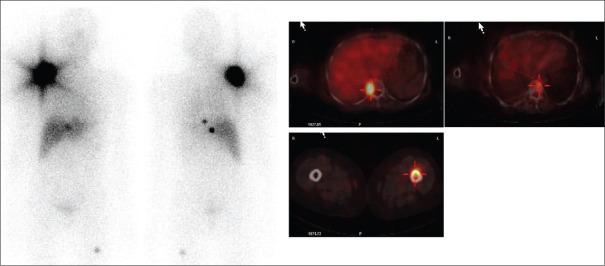
Two patients of differentiated thyroid carcinoma are illustrated demonstrating "sink effect" in posttherapeutic and diagnostic radioiodine (I-131) study: (a) in the first case, it masked the other small-volume metastatic sites (pulmonary and paratracheal nodes) in the posttreatment scan, which were clarified following metastatectomy of the large-volume skeletal metastatic lesion, and (b) in the second, interestingly, it masked the remnant thyroid uptake in the first postoperative diagnostic radioiodine study. In both the situations, large-volume highly functioning skeletal metastasis was the cause for the observed "sink effect" and is presented as learning illustrations to the attending physicians. Although uncommon, this is a possible phenomenon in thyroid cancer practice.
展示了2例分化型甲状腺癌患者在治疗后及诊断性放射性碘(I - 131)研究中的“汇聚效应”:(a)在第一例中,它在治疗后扫描中掩盖了其他小体积转移部位(肺和气管旁淋巴结),在对大体积骨骼转移病灶进行转移灶切除术后这些部位得以明确;(b)在第二例中,有趣的是,它在首次术后诊断性放射性碘研究中掩盖了残余甲状腺的摄取。在这两种情况下,大体积高功能骨骼转移是观察到的“汇聚效应”的原因,并作为示教病例呈现给主治医生。虽然不常见,但这是甲状腺癌诊疗中一种可能出现的现象。


 Zotero 插件