Department of Neurology, Chubu Rosai Hospital, Japan Organization of Occupational Health and Safety, Nagoya, Japan.
Department of Radiology, Chubu Rosai Hospital, Japan Organization of Occupational Health and Safety Nagoya, Japan.
PLoS One. 2020 Sep 17;15(9):e0238456. doi: 10.1371/journal.pone.0238456. eCollection 2020.
Cerebral microbleeds (CMBs) are a magnetic resonance imaging (MRI) marker for cerebral small vessel disease. Existing CMBs and those that newly develop are associated with the risks of stroke incidence and recurrence. The purpose of the present study was to investigate the association of oral anticoagulant (OAC) use and the development of new CMBs in cardioembolic stroke patients with atrial fibrillation.
We prospectively followed cardioembolic stroke patients with atrial fibrillation who had been hospitalized in the stroke center of our hospital, had been prescribed anticoagulants at discharge, and underwent repeated brain MRI with an interval of at least one year from the baseline MRI. Assessing the presence, number and location of CMBs using T2*-weighted gradient-recalled echo MRI, we used logistic regression models to investigate the associations between OAC use and the incidence of new CMBs. We also examined associations of subsequent stroke with OACs and CMBs during the follow-up.
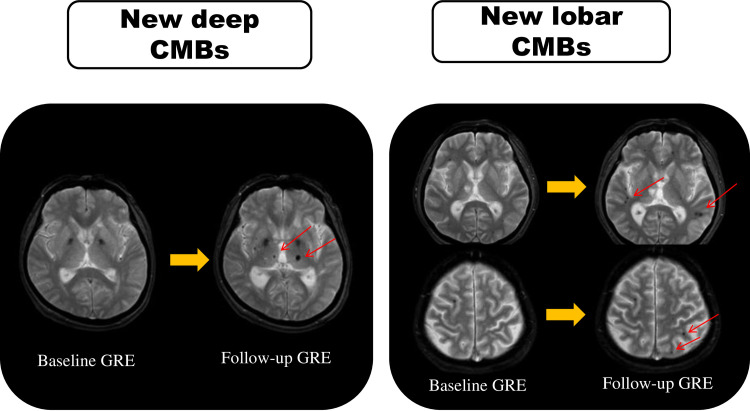
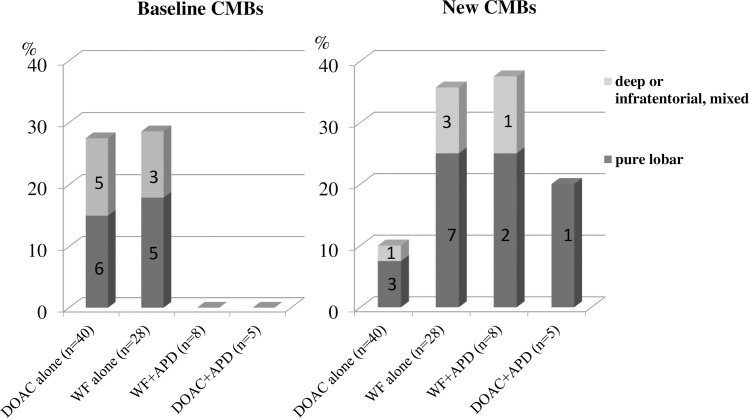
A total of 81 patients, consisting of 45 patients receiving direct oral anticoagulants (DOACs) and 36 patients receiving warfarin (WF), were analyzed in the present study. Baseline CMBs were observed in 19/81 patients (23.5%) and new CMBs in 18/81 patients (22.2%) on follow-up MRI (median interval, 34 months). Of the 31 new CMBs, 25 (80.6%) developed in the lobar location and 6 (19.4%) in the deep or infratentorial location. New CMBs occurred in 4 patients (10.0%) taking DOACs alone, in 10 patients (35.7%) taking WF alone, in 3 patients (37.5%) taking WF plus antiplatelet agents and in 1 patient (20.0%) taking DOAC plus antiplatelet agent. Regarding location, the new CMBs were the lobar type in 7 of the 10 patients taking WF alone, as well as in 3 of the 4 patients taking DOACs alone. In multivariate analysis, the presence of CMBs at baseline and WF use (vs. DOAC use) were associated with new CMBs (CMB presence at baseline: OR 4.16, 95% CI 1.19-14.44; WF use: OR 3.38, 95% CI 1.02-11.42). The presence of ≥ 2 CMBs at baseline was related to a higher risk of subsequent stroke (OR 7.25, 95% CI 1.01-52.35, P = 0.048).
Our findings suggest that DOAC compared with WF use at discharge is associated with a lower incidence of new CMBs in cardioembolic stroke patients with atrial fibrillation. Further prospective studies in the clinical setting are needed to confirm our exploratory data.
脑微出血(CMBs)是脑小血管疾病的磁共振成像(MRI)标志物。现有的 CMBs 和新出现的 CMBs与中风发病率和复发风险相关。本研究的目的是探讨口服抗凝剂(OAC)的使用与伴有心房颤动的心源性栓塞性中风患者新出现 CMBs 的关系。
我们前瞻性随访了我院卒中中心住院的伴有心房颤动的心源性栓塞性中风患者,这些患者出院时接受了抗凝治疗,且在基线 MRI 后至少一年重复进行了脑部 MRI。使用 T2*-加权梯度回波 MRI 评估 CMBs 的存在、数量和位置,我们使用逻辑回归模型来研究 OAC 使用与新 CMBs 发生率之间的关系。我们还在随访期间检查了 OACs 和 CMBs 与随后发生的中风之间的关系。
本研究共分析了 81 例患者,其中 45 例患者接受直接口服抗凝剂(DOACs)治疗,36 例患者接受华法林(WF)治疗。在后续 MRI 上观察到 19/81 例患者(23.5%)有基线 CMBs,18/81 例患者(22.2%)有新 CMBs(中位随访时间为 34 个月)。在 31 个新发 CMBs 中,25 个(80.6%)位于脑叶部位,6 个(19.4%)位于深部或幕下部位。新发 CMBs 出现在 4 例(10.0%)单独服用 DOACs 的患者中,10 例(35.7%)单独服用 WF 的患者中,3 例(37.5%)服用 WF 加抗血小板药物的患者中,以及 1 例(20.0%)服用 DOAC 加抗血小板药物的患者中。在部位方面,10 例单独服用 WF 的患者中,有 7 例出现新的 CMBs,4 例单独服用 DOACs 的患者中也有 3 例出现新的 CMBs。多变量分析显示,基线 CMBs 存在和 WF 使用(与 DOAC 使用相比)与新 CMBs 相关(基线 CMBs 存在:OR 4.16,95%CI 1.19-14.44;WF 使用:OR 3.38,95%CI 1.02-11.42)。基线时存在≥2 个 CMBs 与随后中风的风险增加相关(OR 7.25,95%CI 1.01-52.35,P=0.048)。
我们的研究结果表明,与 WF 相比,DOAC 在出院时的使用与伴有心房颤动的心源性栓塞性中风患者新出现 CMBs 的发生率较低有关。需要在临床环境中进行进一步的前瞻性研究来证实我们的探索性数据。