Peyrony Olivier, Hutin Alice, Truchot Jennifer, Borie Raphaël, Calvet David, Albaladejo Adrien, Baadj Yousrah, Cailleaux Pierre-Emmanuel, Flamant Martin, Martin Clémence, Messika Jonathan, Meunier Alexandre, Mirabel Mariana, Tea Victoria, Treton Xavier, Chevret Sylvie, Lebeaux David, Roux Damien
Department of Emergency Medicine, Saint-Louis University Hospital, Assistance Publique-Hôpitaux de Paris, 1 avenue Claude Vellefaux, 75010, Paris, France.
SAMU de Paris, SMUR Necker, Necker Enfants Malades University Hospital, Assistance Publique-Hôpitaux de Paris, Paris, France.
BMC Med Educ. 2020 Sep 17;20(1):313. doi: 10.1186/s12909-020-02243-w.
The evaluation process of French medical students will evolve in the next few years in order to improve assessment validity. Script concordance testing (SCT) offers the possibility to assess medical knowledge alongside clinical reasoning under conditions of uncertainty. In this study, we aimed at comparing the SCT scores of a large cohort of undergraduate medical students, according to the experience level of the reference panel.
In 2019, the authors developed a 30-item SCT and sent it to experts with varying levels of experience. Data analysis included score comparisons with paired Wilcoxon rank sum tests and concordance analysis with Bland & Altman plots.
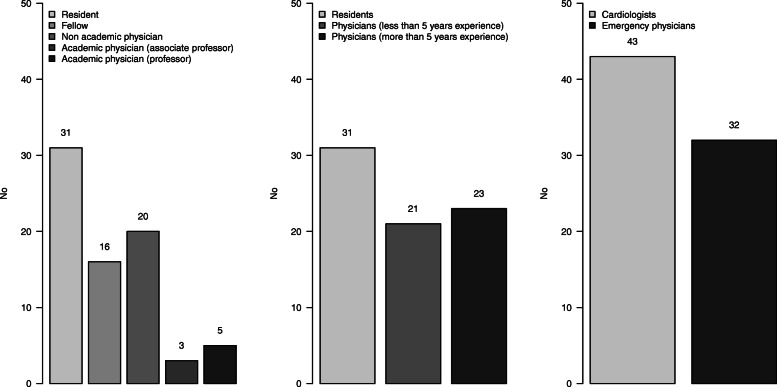
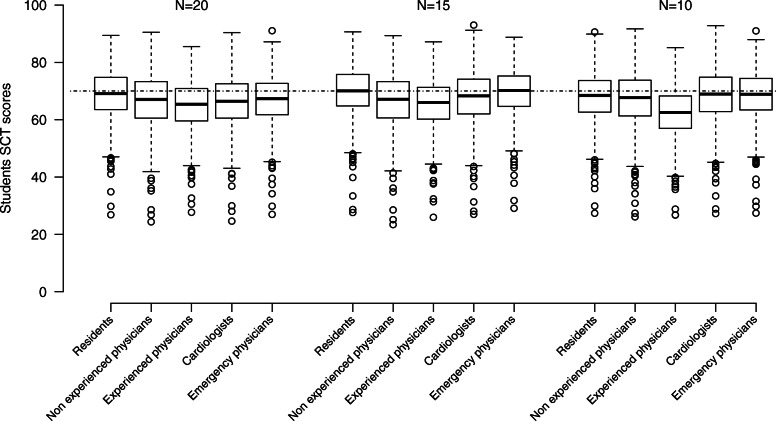
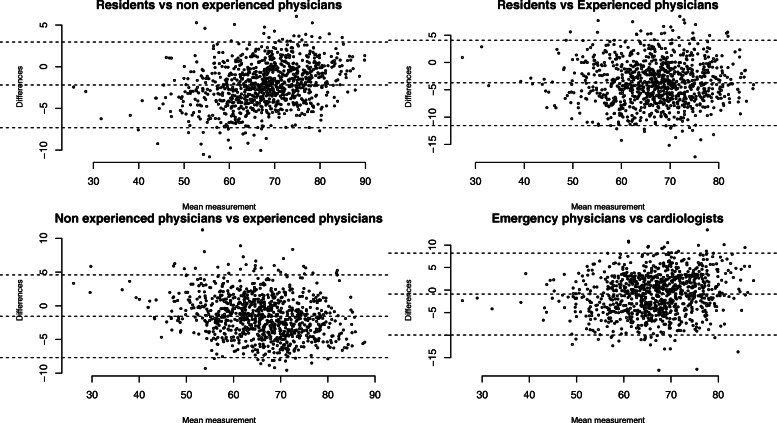
A panel of 75 experts was divided into three groups: 31 residents, 21 non-experienced physicians (NEP) and 23 experienced physicians (EP). Among each group, random samples of N = 20, 15 and 10 were selected. A total of 985 students from nine different medical schools participated in the SCT examination. No matter the size of the panel (N = 20, 15 or 10), students' SCT scores were lower with the NEP group when compared to the resident panel (median score 67.1 vs 69.1, p < 0.0001 if N = 20; 67.2 vs 70.1, p < 0.0001 if N = 15 and 67.7 vs 68.4, p < 0.0001 if N = 10) and with EP compared to NEP (65.4 vs 67.1, p < 0.0001 if N = 20; 66.0 vs 67.2, p < 0.0001 if N = 15 and 62.5 vs 67.7, p < 0.0001 if N = 10). Bland & Altman plots showed good concordances between students' SCT scores, whatever the experience level of the expert panel.
Even though student SCT scores differed statistically according to the expert panels, these differences were rather weak. These results open the possibility of including less-experienced experts in panels for the evaluation of medical students.
法国医学生的评估过程在未来几年将有所发展,以提高评估的有效性。脚本一致性测试(SCT)提供了在不确定性条件下评估医学知识以及临床推理能力的可能性。在本研究中,我们旨在根据参考小组的经验水平,比较一大群本科医学生的SCT分数。
2019年,作者编制了一份包含30个项目的SCT,并将其发送给具有不同经验水平的专家。数据分析包括使用配对Wilcoxon秩和检验进行分数比较,以及使用Bland & Altman图进行一致性分析。
75名专家组成的小组被分为三组:31名住院医师、21名无经验医师(NEP)和23名有经验医师(EP)。在每组中,分别随机抽取了N = 20、15和10个样本。共有来自9所不同医学院的985名学生参加了SCT考试。无论小组规模如何(N = 20、15或10),与住院医师小组相比,学生在NEP小组中的SCT分数更低(中位数分数分别为67.1对69.1,N = 20时p < 0.0001;67.2对70.1,N = 15时p < 0.0001;67.7对68.4,N = 10时p < 0.0001),与EP相比,NEP的分数也更低(分别为65.4对67.1,N = 20时p < 0.0001;66.0对67.2,N = 15时p < 0.0001;62.5对67.7,N = 10时p < 0.0001)。Bland & Altman图显示,无论专家小组的经验水平如何,学生的SCT分数之间都具有良好的一致性。
尽管根据专家小组不同,学生的SCT分数在统计学上存在差异,但这些差异相当小。这些结果表明,有可能将经验较少的专家纳入医学生评估小组。