Department of Psychiatry, Yeouido St. Mary's Hospital, College of Medicine, The Catholic University of Korea, 10, 63-ro, Yeongdeungpo-gu, Seoul, Republic of Korea.
Department of Hematology, Seoul St. Mary's Hospital, College of Medicine, The Catholic University of Korea, Seoul, Republic of Korea.
Sci Rep. 2020 Sep 17;10(1):15265. doi: 10.1038/s41598-020-71208-2.
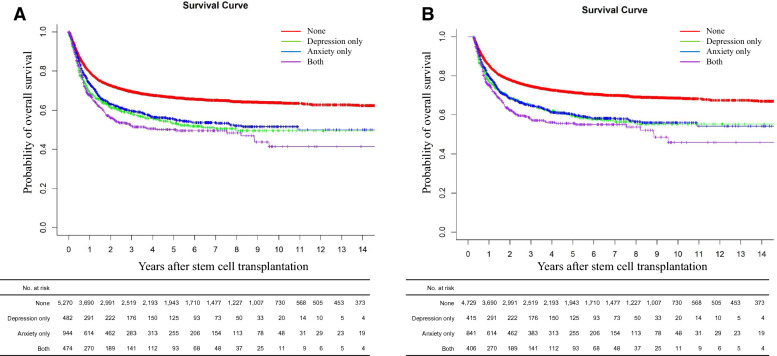
Studies investigating association of depression with overall survival (OS) after allogeneic hematopoietic stem cell transplantation (allo-HSCT) yielded conflicting results. A nationwide cohort study, which included all adult patients [n = 7,170; depression group, 13.3% (N = 956); non-depression group, 86.7% (N = 6,214)] who received allo-HSCT from 2002 to 2018 in South Korea, analyzed risk of pre-transplant depression in OS of allo-HSCT. Subjects were followed from the day they received allo-HSCT, to occurrence of death, or last follow-up day (December 31, 2018). Median age at allo-HSCT for depression and non-depression groups were 50 and 45 (p < 0.0001), respectively. Two groups also differed in rate of females (depression group, 55.8%; non-depression group, 43.8%; p < 0.0001) and leukemia (depression group, 61.4%; non-depression group, 49.7%; p < 0.0001). After a median follow-up of 29.1 months, 5-year OS rate was 63.1%. Cox proportional-hazard regression evaluated an adjusted risk of post-transplant mortality related to depression: OS decreased sequentially from no depression (adjusted hazard ratio [aHR] = 1) to pre-transplant depression only (aHR = 1.167, CI: 1.007-1.352, p = 0.04), and to having both depression and anxiety disorder (aHR = 1.202, CI: 1.038-1.393, p = 0.014) groups. Pre-transplant anxiety (anxiety only) did not have significant influence in OS. Additional medical and psychiatric care might be necessary in patients who experienced depression, especially with anxiety, before allo-HSCT.
研究表明,在异基因造血干细胞移植(allo-HSCT)后,抑郁与总生存率(OS)之间存在关联,但结果存在争议。本项全国性队列研究纳入了 2002 年至 2018 年期间在韩国接受 allo-HSCT 的所有成年患者[n=7170;抑郁组,13.3%(N=956);非抑郁组,86.7%(N=6214)],分析了移植前抑郁对 allo-HSCT 患者 OS 的影响。研究对象从接受 allo-HSCT 之日起开始随访,直至死亡或最后一次随访日(2018 年 12 月 31 日)。抑郁组和非抑郁组 allo-HSCT 时的中位年龄分别为 50 岁和 45 岁(p<0.0001)。两组在女性比例(抑郁组 55.8%,非抑郁组 43.8%;p<0.0001)和白血病比例(抑郁组 61.4%,非抑郁组 49.7%;p<0.0001)上也存在差异。中位随访 29.1 个月后,5 年 OS 率为 63.1%。Cox 比例风险回归评估了移植后抑郁与死亡相关的调整后死亡风险:OS 依次从无抑郁(调整后风险比[aHR]=1)下降到仅存在移植前抑郁(aHR=1.167,95%CI:1.007-1.352,p=0.04),再到同时存在抑郁和焦虑障碍(aHR=1.202,95%CI:1.038-1.393,p=0.014)。移植前焦虑(仅有焦虑)对 OS 没有显著影响。在 allo-HSCT 之前经历过抑郁,特别是伴有焦虑的患者,可能需要额外的医疗和精神科护理。