Trauma Surgery Div, Dept. of Surgery, School of Medicine, University of Puerto Rico Medical Sciences Campus, San Juan, PR, USA.
Eur J Trauma Emerg Surg. 2022 Apr;48(2):891-900. doi: 10.1007/s00068-020-01487-x. Epub 2020 Sep 18.
Although trauma represents a leading cause of morbidity and mortality worldwide, there is limited and heterogeneous evidence regarding trauma recidivism and its outcomes. This analysis determined the rate and independent risk factors of trauma recidivism and compared the first and second injury episode among recidivists.
An IRB-approved retrospective cohort study was performed with data from the Puerto Rico Trauma Hospital Registry. Bivariate analyses were done using Pearson's Chi squared, Wilcoxon rank-sum, McNemar, Stuart-Maxwell or Wilcoxon signed-rank tests, as appropriate. Independent predictors for recidivism were determined through a logistic regression model. Statistical significance was set at p < 0.05.
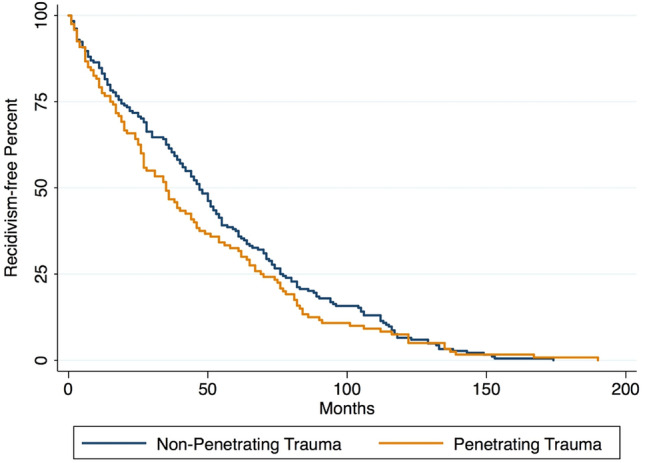
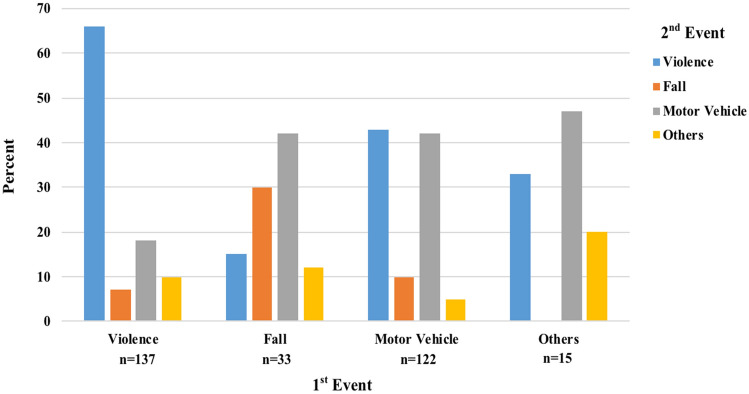
24,650 patients were admitted to the hospital during 2000-2017. Recidivism rate was 14 per 1,000 patients discharged alive. Males and individuals aged 15-24 years old were 3.88 (95% CI: 2.21-6.80) and 3.80 (95% CI: 2.24-6.46) times more likely to be recidivists, respectively. Contrariwise, an ISS [Formula: see text] 25 [adjusted odds ratio (AOR) = 0.44; 95% CI: 0.28-0.68] and a GCS [Formula: see text] 8 (AOR = 0.56; 95% CI 0.34-0.92) were protective factors. Furthermore, recidivists exhibited less in-hospital mortality than their non-recidivist counterparts (7.2% vs. 10.7%; p = 0.045). For recidivists, the median (interquartile range) time to reinjury was 42 (59) months; and the second injury episode was more severe than the first one, as the proportion of patients with ISS [Formula: see text] 25 increased (7.9% vs. 14.1%; p = 0.022).
The independent predictors of trauma recidivism and the median time to reinjury identified in this study provide valuable information to the development of prevention strategies aimed at reducing the burden of injury.
尽管创伤是全球发病率和死亡率的主要原因之一,但关于创伤再入院及其结果的证据有限且存在异质性。本分析旨在确定创伤再入院率及其独立危险因素,并比较再入院患者的首次和再次损伤事件。
这项经机构审查委员会批准的回顾性队列研究,利用了波多黎各创伤医院登记处的数据。使用 Pearson's Chi 平方检验、Wilcoxon 秩和检验、McNemar 检验、Stuart-Maxwell 检验或 Wilcoxon 符号秩检验,根据需要进行了双变量分析。通过逻辑回归模型确定了再入院的独立预测因素。统计显著性设定为 p<0.05。
2000 年至 2017 年期间,共有 24650 名患者入住该医院。再入院率为每 1000 名出院存活患者中有 14 人。男性和年龄在 15-24 岁的个体再入院的可能性分别是女性和年龄大于 24 岁的个体的 3.88 倍(95%CI:2.21-6.80)和 3.80 倍(95%CI:2.24-6.46)。相反,ISS [Formula: see text] 25(调整后的优势比(AOR)=0.44;95%CI:0.28-0.68)和 GCS [Formula: see text] 8(AOR=0.56;95%CI 0.34-0.92)是保护性因素。此外,再入院患者的院内死亡率低于非再入院患者(7.2%比 10.7%;p=0.045)。对于再入院患者,再损伤的中位(四分位间距)时间为 42(59)个月;并且第二次损伤事件比第一次更严重,因为 ISS [Formula: see text] 25 的患者比例增加(7.9%比 14.1%;p=0.022)。
本研究确定的创伤再入院的独立预测因素和再损伤的中位时间为制定旨在降低创伤负担的预防策略提供了有价值的信息。