Tétu Pauline, Sirven-Villaros Lila, Cuzzubbo Stefania, Ursu Renata, Baroudjian Barouyr, Delyon Julie, Nataf François, De Margerie-Mellon Constance, Allayous Clara, Lefevre Wendy, Carpentier Antoine F, Lebbé Céleste
Assitance Publique des Hôpitaux de Paris Dermatology, Department of Dermatology, Hôpital Saint-Louis, 75010 Paris, France.
INSERM U976, Paris 7 Diderot University, 75475 Paris, France.
Cancers (Basel). 2020 Sep 16;12(9):2635. doi: 10.3390/cancers12092635.
Few data are available on patients with leptomeningeal disease (LM) from melanoma treated with new systemic therapies.
To gain a better understanding of patients, disease characteristics, and therapeutic interventions in melanoma patients with LM in the era of new systemic treatment.
Clinical characteristics, treatments, and survival of melanoma patients diagnosed with LM, isolated or associated with brain metastases, were collected. The Cox regression model assessed the influence of patient and melanoma characteristics on survival.
Monocentric, retrospective, real-life cohort of patients with LM from melanoma.
All patients followed up at Saint-Louis University Hospital and diagnosed with LM between December 2013 and February 2020 were included. For each patient identified, a central review by dermato-oncologist and neuro-oncologist experts was performed to confirm the diagnosis of LM.
Impact of new systemic therapies and radiotherapy.
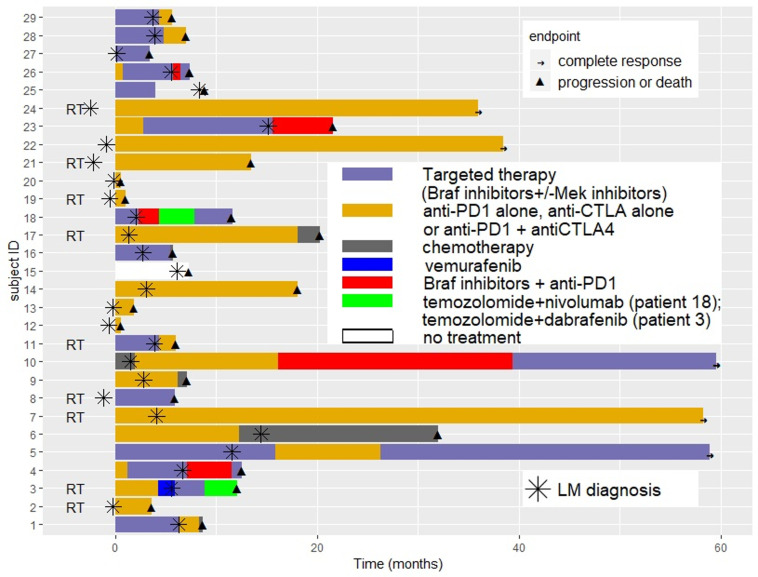
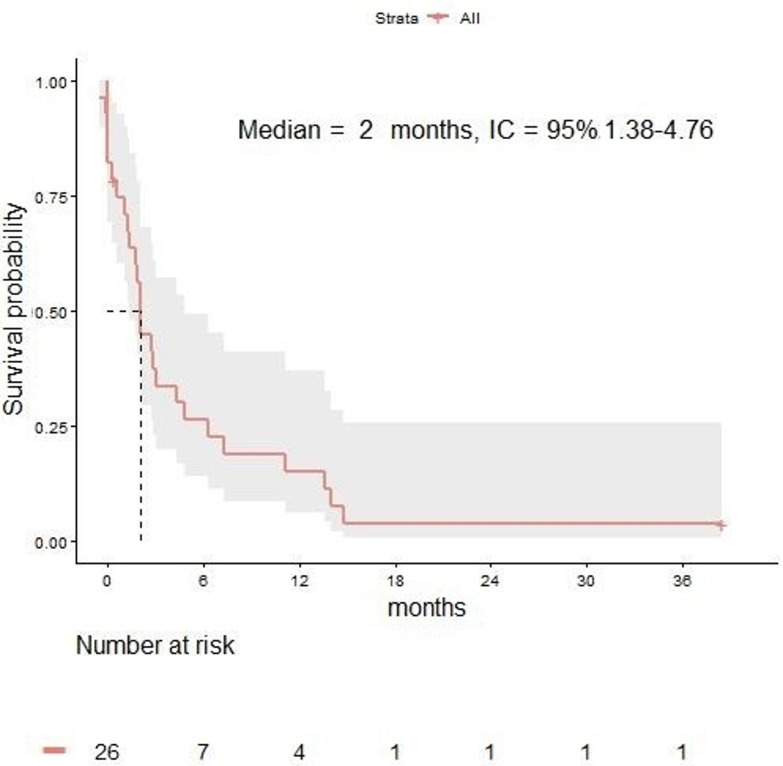
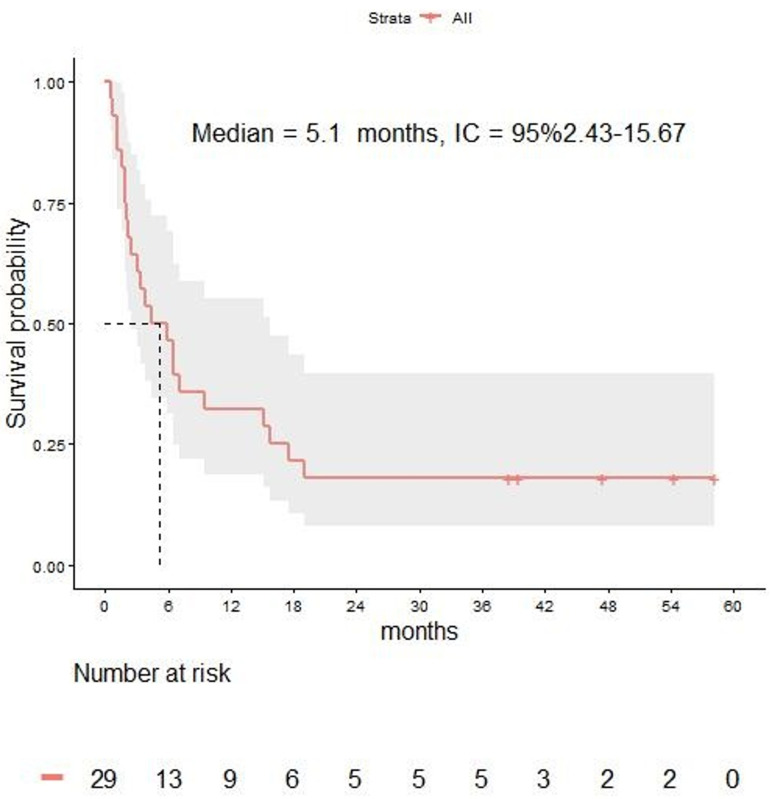
Among the 452 advanced melanoma patients followed at St Louis Hospital between 2013 and 2020, 41 patients with LM from melanoma were identified. Among them, 29 patients with a diagnosis of LM "confirmed" or "probable" after central neuro-oncologists reviewing were included. Nineteen patients had known melanoma brain metastases at LM diagnosis. Among the 27 patients treated with systemic therapy, 17 patients were treated with immunotherapy, 5 patients received targeted therapy, 1 was treated with chemotherapy, and 4 patients were treated with anti-PD-1 in combination with BRAF inhibitor. The median overall survival (OS) from LM diagnosis was 5.1 months. Median OS was 7.1 months for the 9 patients receiving systemic therapy combined with radiotherapy, and 3.2 months for the 20 patients not receiving combined radiotherapy. Elevated serum lactate dehydrogenase (LDH) (HR 1.44, 95% CI 1.09-1.90, < 0.01) and presence of neurological symptoms at LM diagnosis (HR 2.96, 95% CI 1.25-6.99, = 0.01) were associated with poor survival. At the time of data analysis, five patients were still alive with a median follow-up of 47.4 months and had persistent complete response.
Targeted therapy and immunotherapy are promising new treatment options in LM from melanoma that can increase overall survival, and may induce long lasting remission in some patients.
关于接受新型全身治疗的黑色素瘤软脑膜疾病(LM)患者的数据很少。
更好地了解新型全身治疗时代黑色素瘤合并LM患者的情况、疾病特征和治疗干预措施。
收集诊断为LM(孤立性或合并脑转移)的黑色素瘤患者的临床特征、治疗方法和生存情况。Cox回归模型评估患者和黑色素瘤特征对生存的影响。
黑色素瘤LM患者的单中心、回顾性、真实队列研究。
纳入2013年12月至2020年2月期间在圣路易大学医院接受随访并诊断为LM的所有患者。对于每例确诊患者,由皮肤肿瘤学家和神经肿瘤学家专家进行中心审查以确认LM诊断。
新型全身治疗和放疗的影响。
在2013年至2020年期间在圣路易医院随访的452例晚期黑色素瘤患者中,确定了41例黑色素瘤合并LM患者。其中,29例经神经肿瘤学家中心审查后诊断为“确诊”或“可能”的LM患者被纳入研究。19例患者在LM诊断时已知有黑色素瘤脑转移。在接受全身治疗的27例患者中,17例接受免疫治疗,5例接受靶向治疗,1例接受化疗,4例接受抗PD-1联合BRAF抑制剂治疗。从LM诊断开始的中位总生存期(OS)为5.1个月。接受全身治疗联合放疗的9例患者的中位OS为7.1个月,未接受联合放疗的20例患者的中位OS为3.2个月。血清乳酸脱氢酶(LDH)升高(HR 1.44,95%CI 1.09-1.90,P<0.01)和LM诊断时出现神经症状(HR 2.96,95%CI 1.25-6.99,P=0.01)与生存不良相关。在数据分析时,5例患者仍存活,中位随访时间为47.4个月,且持续完全缓解。
靶向治疗和免疫治疗是黑色素瘤LM中有前景的新治疗选择,可提高总生存期,并可能使部分患者获得持久缓解。