Department of Medical Oncology, Dana-Farber Cancer Institute.
Division of Hematology, Department of Medicine, Brigham and Women's Hospital.
Blood. 2020 Dec 24;136(26):3051-3055. doi: 10.1182/blood.2020008206.
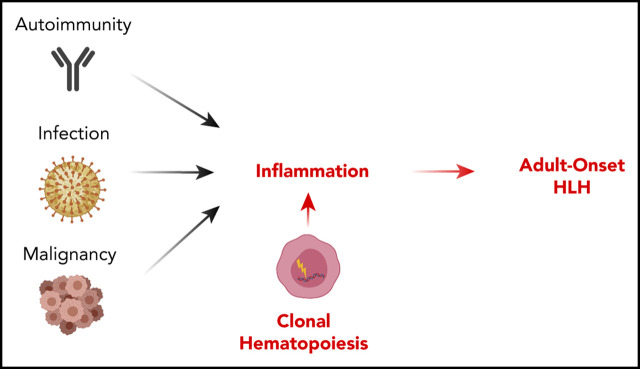
Adult-onset hemophagocytic lymphohistiocytosis (HLH) is a rare, life-threatening disease of immune hyperactivation. Unlike pediatric HLH, adult HLH is rarely driven by germline genetic variants. Although numerous precipitating etiologies have been identified, the reason that HLH occurs in only a subset of individuals and how other factors contribute to the disease remains unknown. We hypothesized that clonal hematopoiesis (CH), a state in which somatic mutations in blood cells cause an expanded population of mutant hematopoietic cells and drive an aberrant inflammatory state, could contribute to adult-onset HLH. In a highly annotated cohort of older adults with HLH we found that CH was more prevalent than in control cohorts. Using the adult-onset HLH mouse model in which repeated treatments of the TLR9 agonist, ODN1826, was delivered to the mouse, we observed that macrophages carrying mutations in Tet2, one of the most commonly mutated genes in CH, have an enhanced inflammatory response to TLR9 agonism. Finally, mice carrying Tet2 mutations in the hematopoietic compartment (a common model for CH) displayed an exaggerated response to TLR9 agonism, including worse splenomegaly and anemia. Our data suggest that CH is more common in individuals with adult-onset HLH and can contribute to the pathophysiology of this disease.
成人起病噬血细胞性淋巴组织细胞增生症(HLH)是一种罕见的、危及生命的免疫过度激活性疾病。与儿科 HLH 不同,成人 HLH 很少由种系基因突变驱动。尽管已经确定了许多诱发病因,但 HLH 仅在一部分个体中发生的原因以及其他因素如何导致该疾病仍不清楚。我们假设克隆性造血(CH),即血细胞中的体细胞突变导致突变造血细胞群体扩张并驱动异常炎症状态的状态,可能导致成人起病 HLH。在一个具有高度注释的 HLH 老年患者队列中,我们发现 CH 的患病率高于对照组。在使用重复给予 TLR9 激动剂 ODN1826 的成年 HLH 小鼠模型中,我们观察到携带 Tet2 突变的巨噬细胞(CH 中最常见的突变基因之一)对 TLR9 激动剂的炎症反应增强。最后,在造血细胞中携带 Tet2 突变的小鼠(CH 的常见模型)对 TLR9 激动剂表现出过度反应,包括更严重的脾肿大和贫血。我们的数据表明,CH 在成人起病 HLH 患者中更为常见,并可能导致该疾病的病理生理学改变。