Perkowski Zbigniew, Czabak Mariusz, Grzeszczyk Stefania, Frączek Daniel, Tatara Karolina, Matuszek-Chmurowska Aneta, Jurowski Krystian, Jędraszak Bronisław
Department of Physics of Materials, Faculty of Civil Engineering and Architecture, Opole University of Technology, Katowicka 48, 45-061 Opole, Poland.
Department of Building Materials Engineering, Faculty of Civil Engineering and Architecture, Opole University of Technology, Katowicka 48, 45-061 Opole, Poland.
Materials (Basel). 2020 Sep 19;13(18):4173. doi: 10.3390/ma13184173.
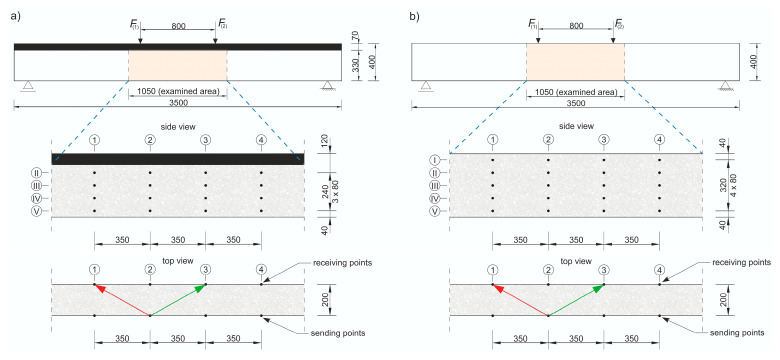
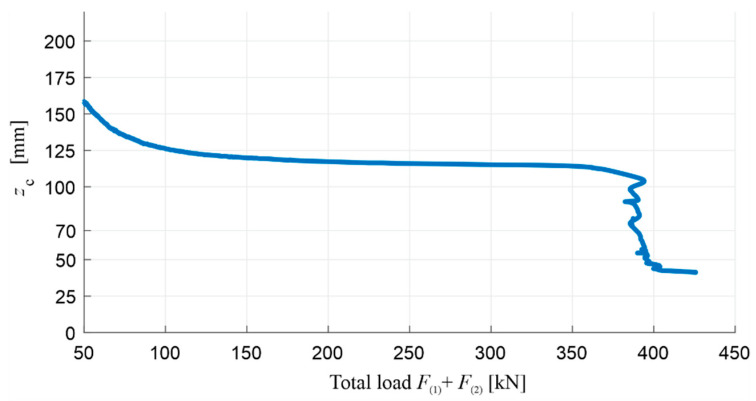
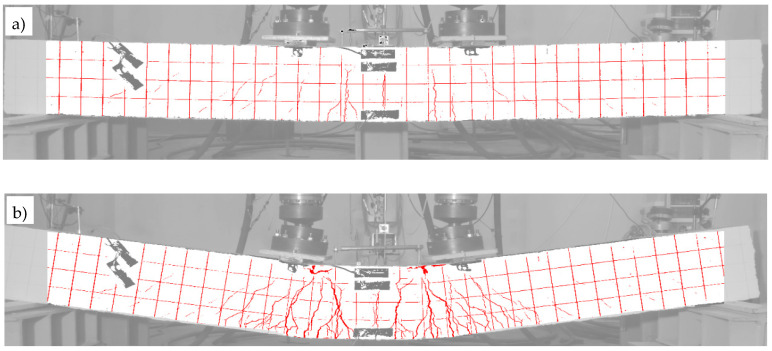
The article describes four-point bending tests of three reinforced concrete beams with identical cross-sections, spans, and high-ductility steel reinforcement systems. Two beams were strengthened in the compressed section with a thin layer of reactive powder concrete (RPC) bonded with evenly spaced stirrups. Their remaining sections, and the third reference beam, were made of ordinary concrete. Measurements of their deflections, strains and axis curvature; ultrasonic tests; and a photogrammetric analysis of the beams are the main results of the study. For one of the beams with the RPC, the load was increased in one stage. For the two remaining beams, the load was applied in four stages, increasing the maximum load from stage to stage in order to allow the analysis of the damage evolution before reaching the bending resistance. The most important effect observed was the stable behaviour of the strengthened beams in the post-critical state, as opposed to the reference beam, which had about two to three times less energy-absorbing capacity in this range. Moreover, thanks to the use of the RPC layer, the process of concrete cover delamination in the compression zone was significantly reduced, the high ductility of the rebars was fully utilized during the formation of plastic hinges, and the bending capacity was increased by approximately 12%.
本文描述了三根具有相同横截面、跨度和高延性钢筋增强系统的钢筋混凝土梁的四点弯曲试验。两根梁在受压区用一层薄的活性粉末混凝土(RPC)进行加固,并用均匀间隔的箍筋粘结。它们的其余部分以及第三根参考梁由普通混凝土制成。测量它们的挠度、应变和轴线曲率;超声测试;以及对梁的摄影测量分析是该研究的主要成果。对于其中一根采用RPC的梁,荷载在一个阶段内增加。对于其余两根梁,荷载分四个阶段施加,逐阶段增加最大荷载,以便在达到抗弯强度之前分析损伤演变情况。观察到的最重要的效果是,与参考梁相比,加固梁在临界后状态下表现出稳定的性能,参考梁在该范围内的能量吸收能力约为加固梁的两到三倍。此外,由于使用了RPC层,受压区混凝土保护层的分层过程显著减少,在形成塑性铰的过程中充分利用了钢筋的高延性,抗弯能力提高了约12%。