Duan Yu, Yu Zi-You, Yang Li, Zheng Li-Rong, Zhang Chu-Tian, Yang Xiao-Tu, Gao Fei-Yue, Zhang Xiao-Long, Yu Xingxing, Liu Ren, Ding Hong-He, Gu Chao, Zheng Xu-Sheng, Shi Lei, Jiang Jun, Zhu Jun-Fa, Gao Min-Rui, Yu Shu-Hong
Division of Nanomaterials and Chemistry, Hefei National Laboratory for Physical Sciences at the Microscale, Institute of Energy, Hefei Comprehensive National Science Center, CAS Center for Excellence in Nanoscience, Department of Chemistry, Institute of Biomimetic Materials and Chemistry, University of Science and Technology of China, 230026, Hefei, China.
Hefei National Laboratory for Physical Sciences at the Microscale, CAS Center for Excellence in Nanoscience, School of Chemistry and Materials Science, University of Science and Technology of China, 230026, Hefei, China.
Nat Commun. 2020 Sep 22;11(1):4789. doi: 10.1038/s41467-020-18585-4.
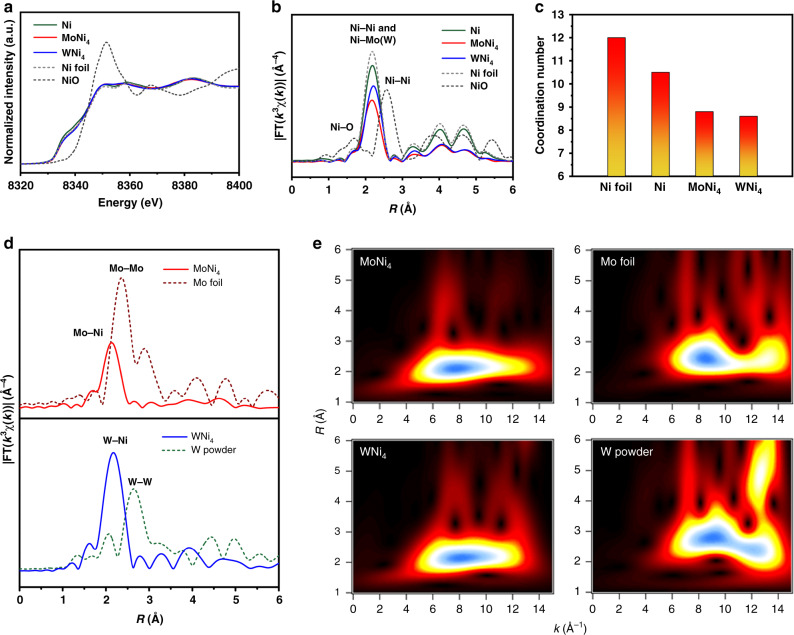
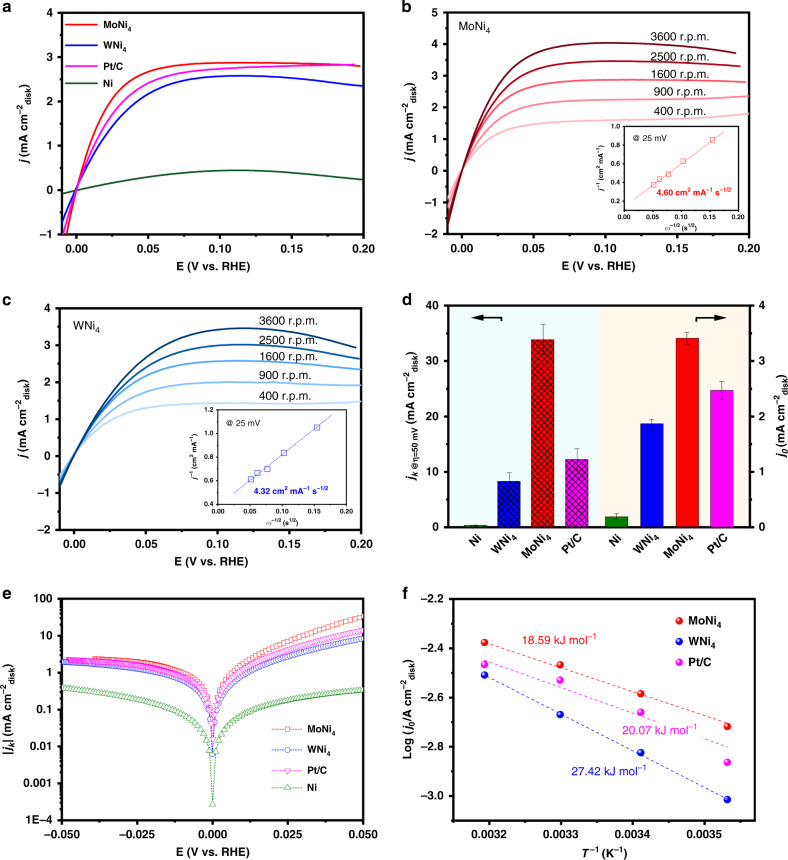
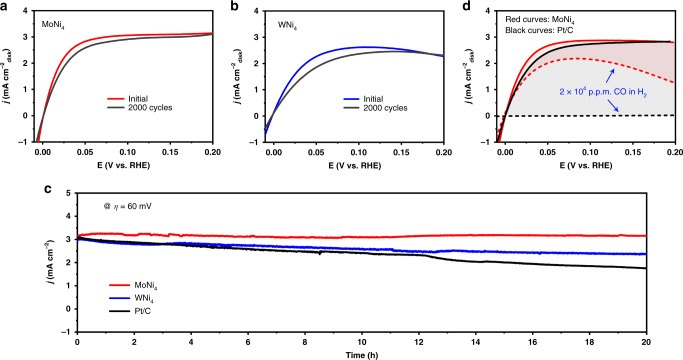
Hydroxide exchange membrane fuel cells offer possibility of adopting platinum-group-metal-free catalysts to negotiate sluggish oxygen reduction reaction. Unfortunately, the ultrafast hydrogen oxidation reaction (HOR) on platinum decreases at least two orders of magnitude by switching the electrolytes from acid to base, causing high platinum-group-metal loadings. Here we show that a nickel-molybdenum nanoalloy with tetragonal MoNi phase can catalyze the HOR efficiently in alkaline electrolytes. The catalyst exhibits a high apparent exchange current density of 3.41 milliamperes per square centimeter and operates very stable, which is 1.4 times higher than that of state-of-the-art Pt/C catalyst. With this catalyst, we further demonstrate the capability to tolerate carbon monoxide poisoning. Marked HOR activity was also observed on similarly designed WNi catalyst. We attribute this remarkable HOR reactivity to an alloy effect that enables optimum adsorption of hydrogen on nickel and hydroxyl on molybdenum (tungsten), which synergistically promotes the Volmer reaction.
氢氧化物交换膜燃料电池提供了采用无铂族金属催化剂来应对缓慢的氧还原反应的可能性。不幸的是,通过将电解质从酸性切换到碱性,铂上的超快氢氧化反应(HOR)至少降低了两个数量级,导致铂族金属负载量很高。在此我们表明,具有四方MoNi相的镍 - 钼纳米合金能够在碱性电解质中高效催化氢氧化反应。该催化剂表现出每平方厘米3.41毫安的高表观交换电流密度,并且运行非常稳定,这比目前最先进的Pt/C催化剂高1.4倍。使用这种催化剂,我们进一步证明了其耐受一氧化碳中毒的能力。在类似设计的WNi催化剂上也观察到了显著的氢氧化反应活性。我们将这种显著的氢氧化反应活性归因于一种合金效应,该效应使得氢在镍上以及羟基在钼(钨)上实现最佳吸附,从而协同促进了伏尔默反应。