Division of Medical Oncology, Yonsei Cancer Center, Yonsei University College of Medicine, Seoul, Korea.
JE-UK Institute for Cancer Research, JEUK Co., Ltd, Gumi-City, Kyungbuk, Korea.
Br J Cancer. 2020 Dec;123(12):1720-1729. doi: 10.1038/s41416-020-01074-2. Epub 2020 Sep 23.
Recurrent and/or metastatic squamous cell carcinoma of head and neck (R/M SCCHN) is a common cancer with high recurrence and mortality. Current treatments have low response rates (RRs).
Fifty-three patients with R/M SCCHN received continuous oral buparlisib. In parallel, patient-derived xenografts (PDXs) were established in mice to evaluate resistance mechanisms and efficacy of buparlisib/cetuximab combination. Baseline and on-treatment tumour genomes and transcriptomes were sequenced. Based on the integrated clinical and PDX data, 11 patients with progression under buparlisib monotherapy were treated with a combination of buparlisib and cetuximab.
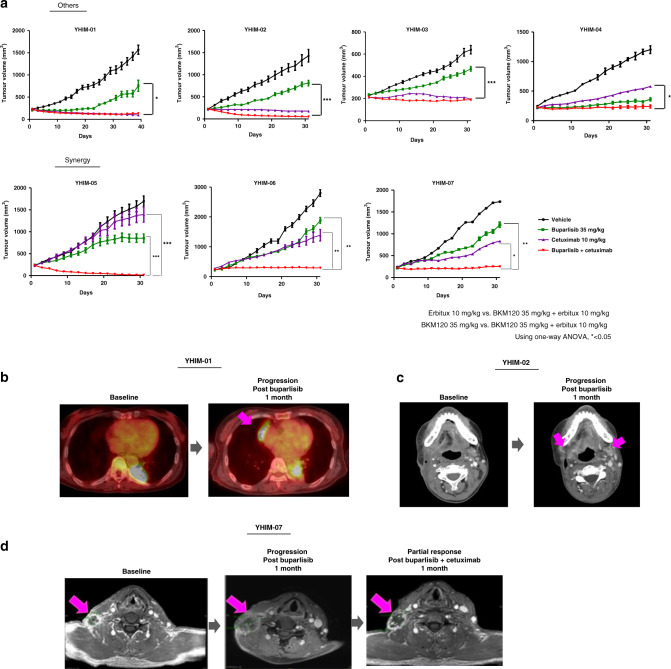
For buparlisib monotherapy, disease control rate (DCR) was 49%, RR was 3% and median progression-free survival (PFS) and overall survival (OS) were 63 and 143 days, respectively. For combination therapy, DCR was 91%, RR was 18% and median PFS and OS were 111 and 206 days, respectively. Four PDX models were originated from patients enrolled in the current clinical trial. While buparlisib alone did not inhibit tumour growth, combination therapy achieved tumour inhibition in three of seven PDXs. Genes associated with apoptosis and cell-cycle arrest were expressed at higher levels with combination treatment than with buparlisib or cetuximab alone.
The buparlisib/cetuximab combination has significant promise as a treatment strategy for R/M SCCHN.
NCT01527877.
复发性和/或转移性头颈部鳞状细胞癌(R/M SCCHN)是一种常见的癌症,具有较高的复发率和死亡率。目前的治疗方法反应率(RR)较低。
53 例 R/M SCCHN 患者接受连续口服玻玛西林治疗。同时,在小鼠中建立了患者来源的异种移植物(PDX),以评估玻玛西林/西妥昔单抗联合治疗的耐药机制和疗效。对基线和治疗中的肿瘤基因组和转录组进行测序。基于整合的临床和 PDX 数据,对 11 例在玻玛西林单药治疗下进展的患者采用玻玛西林和西妥昔单抗联合治疗。
玻玛西林单药治疗的疾病控制率(DCR)为 49%,RR 为 3%,中位无进展生存期(PFS)和总生存期(OS)分别为 63 和 143 天。联合治疗的 DCR 为 91%,RR 为 18%,中位 PFS 和 OS 分别为 111 和 206 天。本临床试验纳入的 4 例患者起源于 7 例 PDX 模型。虽然玻玛西林单独治疗不能抑制肿瘤生长,但联合治疗在 7 例 PDX 中的 3 例中实现了肿瘤抑制。与玻玛西林或西妥昔单抗单独治疗相比,联合治疗时凋亡和细胞周期阻滞相关基因的表达水平更高。
玻玛西林/西妥昔单抗联合治疗作为复发性和/或转移性头颈部鳞状细胞癌的治疗策略具有很大的潜力。
NCT01527877。