Chang Youjin, Kim Tae-Gyu, Chung Sun-Yoon
Division of Pulmonary and Critical Care Medicine, Department of Internal Medicine, Inje University College of Medicine, Sanggye Paik Hospital, Seoul, Republic of Korea.
Department of Radiology, Inje University College of Medicine, Sanggye Paik Hospital, Seoul, Republic of Korea.
Indian J Crit Care Med. 2020 Jul;24(7):592-595. doi: 10.5005/jp-journals-10071-23482.
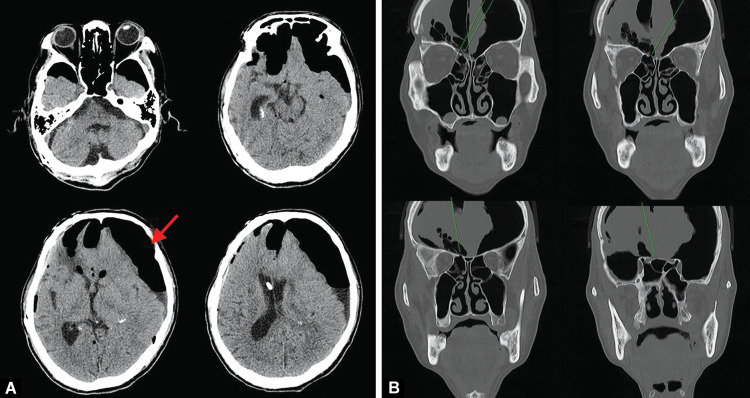
High-flow nasal cannula (HFNC) therapy has been established as a promising oxygen treatment with various advantages for respiratory mechanics. One of the main mechanisms is to provide positive airway pressure. This effect could reduce lung injury and improve oxygenation; conversely, it may cause a complication of positive pressure ventilation. However, data are scarce regarding the possible adverse effects, particularly in adults. We report a patient who developed HFNC-induced tension pneumocephalus from an unrecognized skull base fracture. Physicians should be cautious when applying HFNC to patients with suspected skull base or paranasal sinus fracture, especially when applying a higher flow rate.
Chang Y, Kim T-G, Chung S-Y. High-flow Nasal Cannula-induced Tension Pneumocephalus. Indian J Crit Care Med 2020;24(7):592-595.
高流量鼻导管(HFNC)治疗已被确立为一种有前景的氧疗方法,对呼吸力学具有多种优势。其主要机制之一是提供气道正压。这种作用可减轻肺损伤并改善氧合;相反,它可能导致正压通气的并发症。然而,关于可能的不良反应的数据很少,尤其是在成人中。我们报告了一名因未被识别的颅底骨折而发生HFNC诱导的张力性气颅的患者。当对疑似颅底或鼻窦骨折的患者应用HFNC时,尤其是应用较高流速时,医生应谨慎。
Chang Y, Kim T-G, Chung S-Y. 高流量鼻导管诱导的张力性气颅。《印度重症监护医学杂志》2020年;24(7):592 - 595。