Bodelon Clara, Oh Hannah, Derkach Andriy, Sampson Joshua N, Sprague Brian L, Vacek Pamela, Weaver Donald L, Fan Shaoqi, Palakal Maya, Papathomas Daphne, Xiang Jackie, Patel Deesha A, Linville Laura, Clare Susan E, Visscher Daniel W, Mies Carolyn, Hewitt Stephen M, Brinton Louise A, Storniolo Anna Maria V, He Chunyan, Chanock Stephen J, Garcia-Closas Montserrat, Gierach Gretchen L, Figueroa Jonine D
Division of Cancer Epidemiology and Genetics, National Cancer Institute, Bethesda, MD USA.
Division of Health Policy and Management, College of Health Sciences, Korea University, Seoul, Korea.
NPJ Breast Cancer. 2020 Sep 7;6:41. doi: 10.1038/s41523-020-00184-7. eCollection 2020.
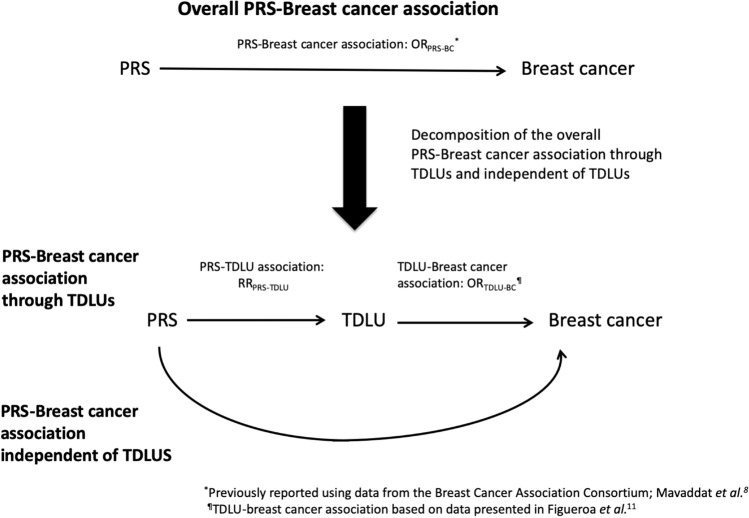
Terminal duct lobular units (TDLUs) are the predominant anatomical structures where breast cancers originate. Having lesser degrees of age-related TDLU involution, measured as higher TDLUs counts or more epithelial TDLU substructures (acini), is related to increased breast cancer risk among women with benign breast disease (BBD). We evaluated whether a recently developed polygenic risk score (PRS) based on 313-common variants for breast cancer prediction is related to TDLU involution in the background, normal breast tissue, as this could provide mechanistic clues on the genetic predisposition to breast cancer. Among 1398 women without breast cancer, higher values of the PRS were significantly associated with higher TDLU counts ( = 0.004), but not with acini counts ( = 0.808), in histologically normal tissue samples from donors and diagnostic BBD biopsies. Mediation analysis indicated that TDLU counts may explain a modest proportion (≤10%) of the association of the 313-variant PRS with breast cancer risk. These findings suggest that TDLU involution might be an intermediate step in the association between common genetic variation and breast cancer risk.
终末导管小叶单位(TDLUs)是乳腺癌起源的主要解剖结构。年龄相关的TDLU退化程度较低,以较高的TDLU计数或更多的上皮性TDLU亚结构(腺泡)来衡量,与患有良性乳腺疾病(BBD)的女性患乳腺癌风险增加有关。我们评估了一种最近开发的基于313个常见变异体用于乳腺癌预测的多基因风险评分(PRS)是否与背景正常乳腺组织中的TDLU退化有关,因为这可能为乳腺癌的遗传易感性提供机制线索。在1398名无乳腺癌的女性中,在来自捐赠者的组织学正常组织样本和诊断性BBD活检中,PRS值越高与TDLU计数越高显著相关(=0.004),但与腺泡计数无关(=0.808)。中介分析表明,TDLU计数可能解释313变异体PRS与乳腺癌风险关联的适度比例(≤10%)。这些发现表明,TDLU退化可能是常见基因变异与乳腺癌风险关联中的一个中间步骤。